North America retained its position as the most influential region for the global cryptocurrency markets during the 12-year reporting period ending July 1, 2026. Despite a minor regional contraction—driven primarily by a 2.2% drop in the United States’ $2.78 trillion crypto economy amid a protracted bear market—the continent’s total crypto valuation held steady at $3.02 trillion. While overall asset values softened slightly from the preceding cycle, the foundational architecture of North American crypto expanded aggressively. Industry experts point out that the primary narrative of 2026 is no longer speculative retail trading, but rather the maturation of infrastructure products built in the U.S. and Canada that are effectively exported to the rest of the world. Driven by deep institutional investor bases, evolving legislative frameworks, and surging demand for tokenized instruments, the region continues to dictate the global velocity of digital assets.

The institutionalization of North America’s crypto landscape rests heavily on three foundational pillars: autonomous AI-driven commerce, the proliferation of U.S. dollar-pegged stablecoins, and the rapid tokenization of real-world assets (RWAs). While local markets experienced minor cooling due to shifting macroeconomic conditions and capital rotation into artificial intelligence sectors during early 2026, the underlying utility of blockchain infrastructure reached unprecedented levels. Industry analysts note that the building blocks established during the 2025 market cycle have successfully transitioned into production-grade systems featuring deep liquidity and high daily active user counts.
The Rise of Autonomous AI Commerce and Machine-to-Machine Payments
One of the most consequential developments in the 2026 crypto economy is the explosive growth of agentic commerce—economic activity conducted autonomously by artificial intelligence agents on-chain. The United States has emerged as the unchallenged leader in this sector, supported by cornerstone web3 entities such as Circle, which issues the dominant agent currency USDC, and Coinbase, which incubated the x402 digital payment protocol designed specifically for machine-to-machine microtransactions.

Traditional credit card networks are fundamentally unsuited for processing transactions valued at fractions of a cent due to fixed processing overhead. However, on-chain stablecoin rails enable the friction-free settlement of transactions costing less than a hundredth of a cent. This capability has unlocked an entirely new economy centered on pay-as-you-go APIs, code reviews, financial intelligence data feeds, and model inference services. By the end of the 2026 reporting period, cumulative x402 transactions on the Base blockchain surpassed 138 million.
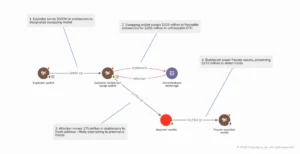
Data tracking the "stickiness" of these AI payments indicates that agentic commerce is rapidly moving past its experimental phase. The percentage of newly funded wallets receiving a second funding injection within 30 days climbed from 70.6% in the third quarter of 2025 to 89.3% in the second quarter of 2026. Furthermore, the temporal gap between a wallet’s initial funding and its first x402 spend collapsed dramatically from a median of 73 days in late 2025 down to just 18 minutes by the third quarter of 2026. This behavioral shift signals that modern wallets are being provisioned with pre-allocated budgets to perform immediate, automated tasks rather than sitting dormant as speculative vehicles.

Geographical analysis of x402 traffic reveals a distinct global division of labor in AI-to-AI transactions. U.S.-funded wallets command an 88.1% share of all geolocated AI model inference payments on the protocol, alongside significant dominance in agent frameworks and data search APIs. Conversely, Chinese-linked wallets heavily concentrate in security and code analysis, accounting for nine out of ten transactions routed into smart contract auditing tools like AgentLISA. Observers attribute this divergence to a mix of AI nationalism and economic efficiency, with Chinese operators favoring open-weight domestic models like DeepSeek and Qwen, while Western systems heavily utilize metered, commercial APIs.
Exporting Digital Dollars While Importing Digital Gold
The regulatory and economic relationship between the United States and global crypto markets took on a bifurcated character in 2025 and 2026. Following the congressional passage of the GENIUS Act in mid-2025, the U.S. solidified its role as the world’s premier exporter of digital dollars. Stablecoins transformed U.S. sovereign debt into the default currency of choice for cross-border trade and peer-to-peer economies in developing and developed nations alike.

Conversely, domestic American crypto market participants increasingly treated bitcoin as an institutional store of value. Spot bitcoin exchange-traded funds (ETFs), launched in January 2024, drove a continuous rise in the U.S. share of global bitcoin activity. While stablecoin utilization accounts for a comparatively smaller share of domestic U.S. crypto volume than international markets—where users lack convenient access to traditional American banking accounts—institutional bitcoin accumulation reached historic highs. For the first time since 2022, the United States became a net importer of cross-border bitcoin in 2026, driven primarily by large-denomination institutional inflows exceeding $10 million per transfer, even as retail investors continued to send smaller amounts abroad.
This dynamic creates a powerful economic feedback loop for the United States. Every dollar-pegged stablecoin circulating internationally represents indirect, continuous demand for short-dated U.S. Treasury securities held in reserve by issuers like Circle, whose USDC circulation expanded 19% year-over-year to $73.3 billion. Meanwhile, institutional bitcoin accumulation continues to absorb circulating supply, bolstered by private sector allocations and implicit sovereign reserve proposals.

Tokenization and the Real-World Asset Boom
Tokenized real-world assets experienced explosive expansion through the first half of 2026, with the total market capitalization climbing 135% period-over-period to reach $36.07 billion by the end of the second quarter. U.S. financial instruments spearheaded this growth, with tokenized U.S. Treasury bonds representing the single largest asset category at $15.42 billion—accounting for roughly 42.8% of the entire tokenized RWA market.
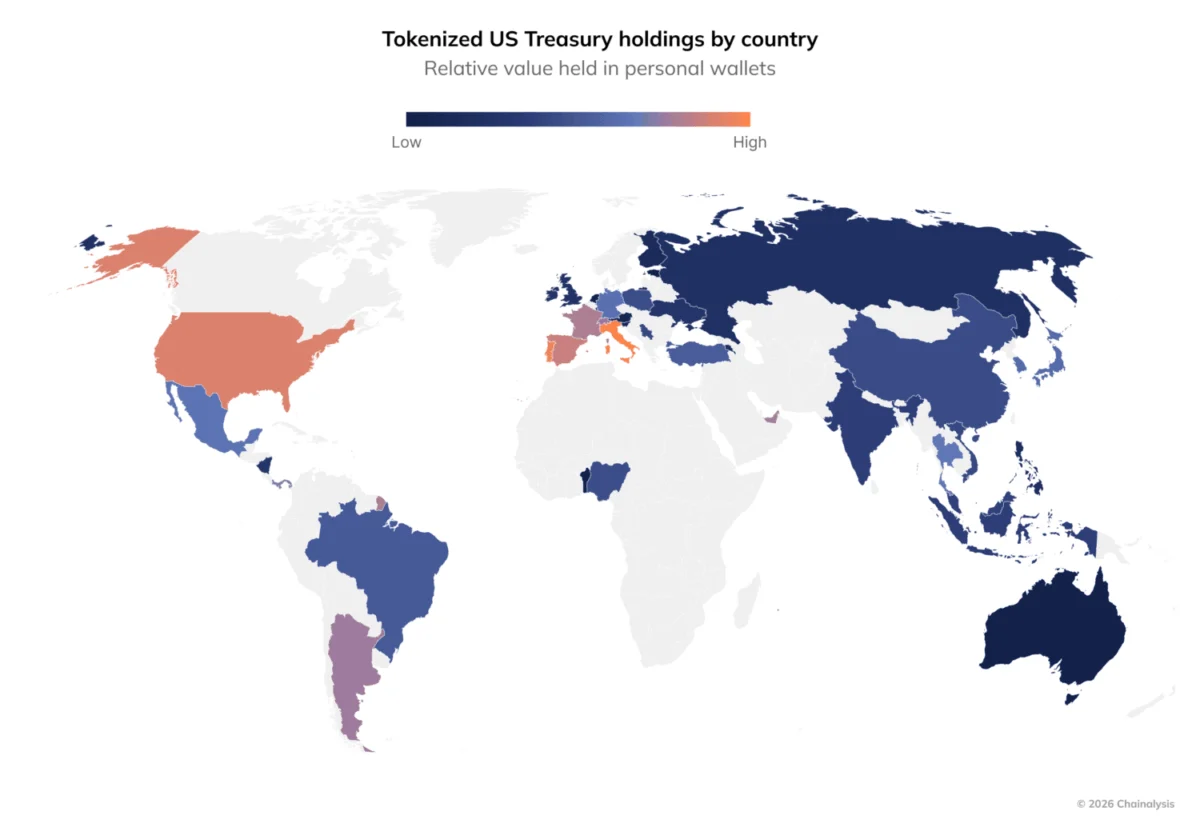
While American entities provided the primary issuance infrastructure, international investors drove a significant portion of the demand. Geolocated data indicates that European and Asian jurisdictions—led by Italy, Portugal, and Singapore—accounted for the vast majority of tokenized Treasury holding values. By lowering the minimum investment threshold and bypassing traditional brokerage barriers, tokenization effectively converted wholesale institutional instruments into retail products accessible to investors worldwide, thereby channeling foreign capital directly into U.S. sovereign debt obligations.

Lending markets adapted to these new asset classes accordingly. While tokenized Treasuries experienced a 27% contraction in lending protocols—largely because traditional financial markets already offer deeply liquid collateralized repo markets for government debt—tokenized private credit surged by over 1,600%, establishing itself as the primary asset posted as collateral within decentralized finance lending environments.
Canada Defies the Downtrend Through Robust Peer-to-Peer Networks
While the United States experienced a minor contraction in total crypto volume, Canada’s digital asset economy registered a 2.3% expansion, reaching $247.7 billion during the 2026 reporting period. Canada maintained its status as the most robust peer-to-peer crypto market among G7 nations, placing seventh globally in both domestic and cross-border payment flows.

A critical driver of Canada’s resilient crypto activity is its high foreign-born population, which stands at approximately 23%—the highest share within the G7. Remittance corridors connecting Canadian residents to family members and business obligations in India, China, and the Philippines expanded dramatically. Stablecoin and bitcoin transfers across these specific corridors totaled $2.36 billion during the reporting period, representing a 141% year-over-year increase spread across 3.56 million transactions. The primary motivation for this shift is economic efficiency: while traditional banking channels and legacy remittance providers charge average fees exceeding 6%, stablecoin settlements complete instantaneously for a fraction of a cent.
Domestically, Canada’s peer-to-peer transaction volumes demonstrated a direct correlation with temporary visa and study permit populations. As policy shifts altered temporary resident inflows, domestic crypto volumes fluctuated in parallel, highlighting how transient populations with complex cross-border financial needs naturally gravitate toward frictionless digital currencies. However, this trend has sparked policy debates in Ottawa. According to representatives from the Canadian Web3 Council, the heavy domestic reliance on U.S. dollar-pegged stablecoins risks bypassing Canadian sovereign debt instruments in favor of American alternatives, prompting Canadian lawmakers to advance a dedicated Stablecoin Act to encourage domestic, CAD-backed digital payment rails.

Chronology of Key Market Milestones (2024–2026)
- January 2024: The United States Securities and Exchange Commission approves the launch of spot bitcoin exchange-traded funds (ETFs), initiating a multi-year trend of rising institutional bitcoin accumulation and net inbound cross-border flows.
- Mid-2025: The U.S. Congress officially passes the GENIUS Act, formalizing regulatory clarity around digital dollar issuers and accelerating the global export of USD-pegged stablecoins.
- May 2025: Coinbase introduces the x402 payment protocol, laying the technical foundation for autonomous AI agents to execute microtransactions on-chain without human intervention.
- March 2026: Canada passes its landmark Stablecoin Act, setting the stage for the creation of regulatory-compliant Canadian dollar-denominated digital assets to counter foreign currency dominance.
- July 1, 2026: The conclusion of the Chainalysis annual reporting period reveals that North America remains the world’s leading crypto influence hub, totaling $3.02 trillion in on-chain economic activity despite a minor bear market contraction.
Broader Implications and Outlook
The 2026 data underscores a profound structural reality: North America’s primary contribution to the global cryptocurrency ecosystem is no longer merely retail speculation, but foundational financial and technological infrastructure. American corporations and developers have successfully engineered the core rails—comprising stablecoins, tokenized debt instruments, and machine-to-machine payment protocols—that power digital economies worldwide.
At the same time, foreign jurisdictions are actively working to challenge this dominance. Regulatory frameworks such as the European Union’s Markets in Crypto-Assets (MiCA) regulation, alongside stablecoin licensing frameworks in Singapore and Hong Kong and Brazil’s central bank digital currency (CBDC) pilot projects, represent deliberate efforts to foster domestic alternatives to dollar-denominated systems. However, despite these regulatory advancements, international market adoption overwhelmingly favors U.S.-backed liquidity layers.

As policymakers in Washington and Ottawa finalize upcoming guidance regarding artificial intelligence commerce and asset tokenization, the gap between infrastructural builders and global users will depend heavily on regulatory adaptability. Whether international alternatives can unseat the digital dollar, or whether the global economy will continue to consolidate around North American web3 rails, remains the defining question for the next era of digital finance.