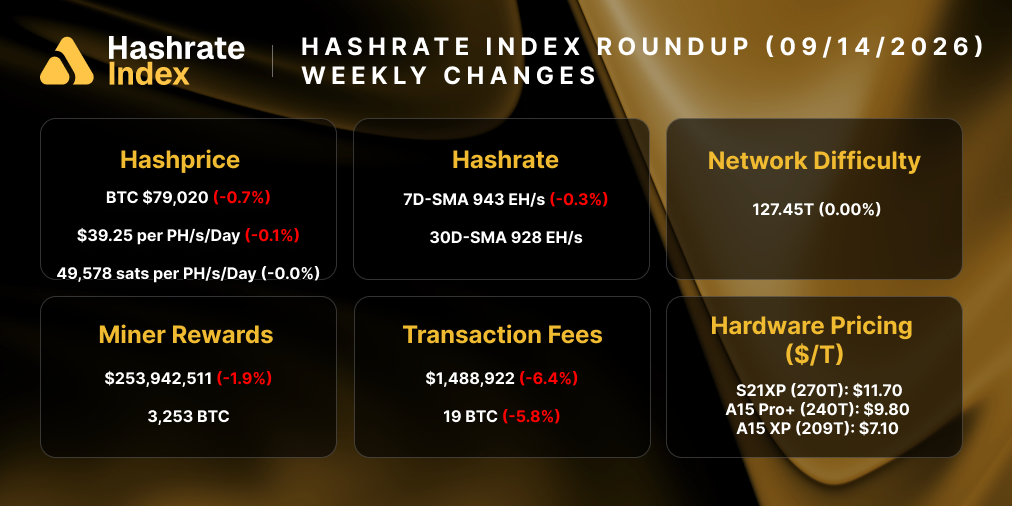
The Bitcoin mining sector experienced a period of relative stagnation during the week ending September 14, 2026, characterized by flat performance in key revenue metrics and a minor contraction in network hashrate. As the industry navigates a complex macroeconomic environment, miners continue to grapple with thin margins and the looming prospect of a significant network difficulty increase. Total miner revenue for the week reached approximately $253 million, derived from 3,253 BTC in block rewards. Transaction fees, which have faced downward pressure throughout the month, contributed only a marginal 0.59% to the total haul, amounting to 19 BTC or roughly $1.49 million.
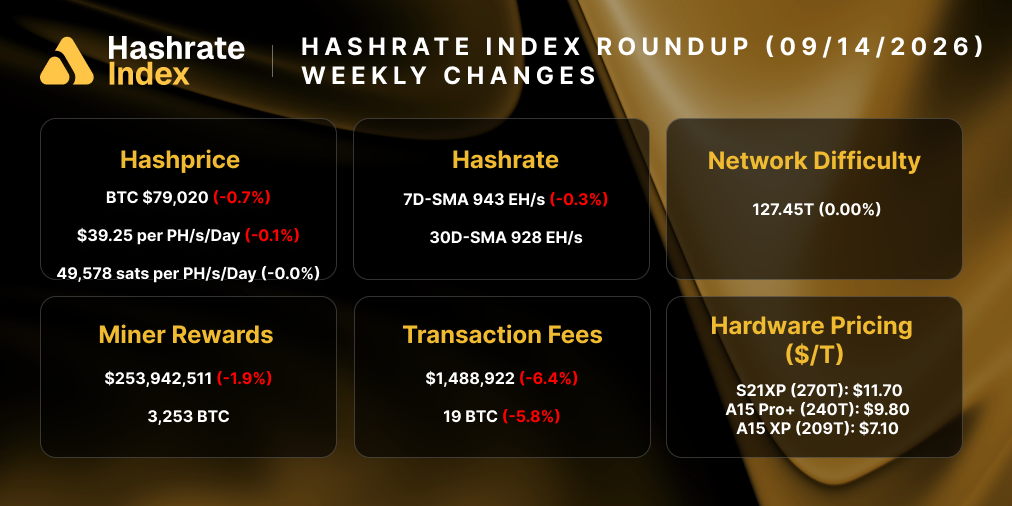
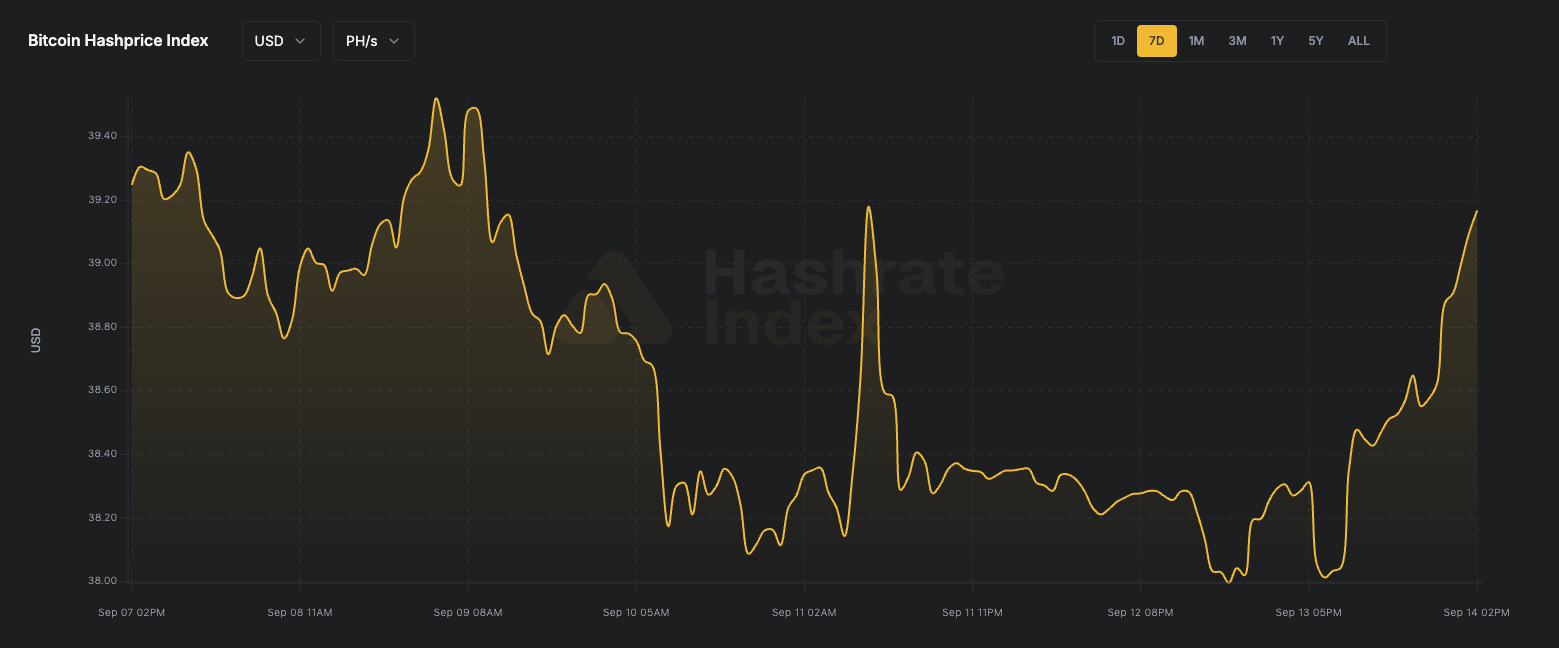
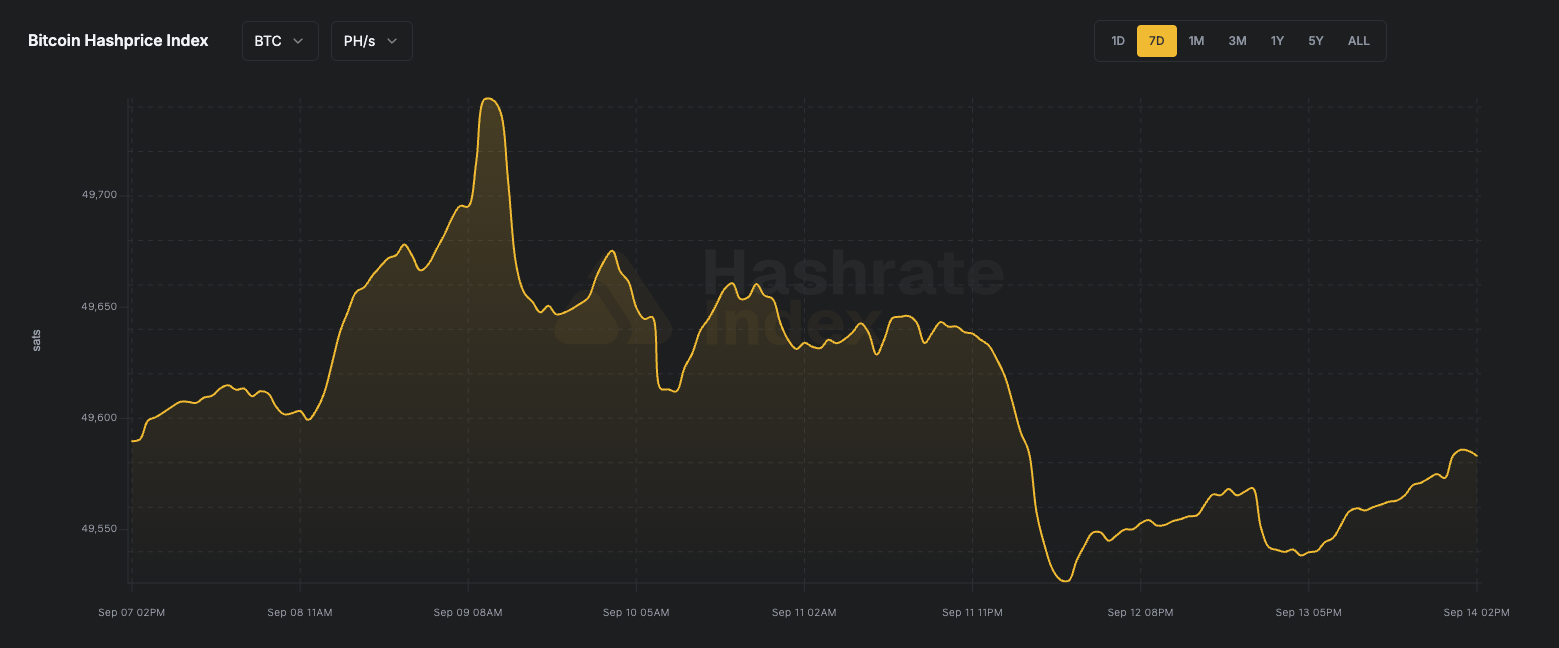
Market conditions remained subdued as the spot price of Bitcoin fluctuated within a narrow band. Opening the week at approximately $79,581, the asset concluded the period at $79,020, representing a modest 0.7% decline. This movement contributes to a challenging year-to-date performance, with Bitcoin currently trailing by 9.6%. The lackluster price action has translated directly into the mining economy, where USD-denominated hashprice—a critical metric representing the expected daily revenue for a unit of computing power—remained nearly static, dipping by only 0.1% to $39.25 per PH/s/day.
Chronology of Network Metrics and Difficulty Adjustments
The Bitcoin network continues to exhibit high levels of computational competition. As of September 14, 2026, the network hashrate, measured by a 7-day simple moving average (SMA), stands at 943 EH/s, a marginal decrease of 0.3% from the previous week’s 946 EH/s. The 30-day SMA, which smooths out short-term volatility, currently sits at 928 EH/s, suggesting that while the most recent week saw a minor dip, the underlying trend remains characterized by robust network participation.
The last major event in network governance occurred on September 5, 2026, when the network difficulty underwent a 1.31% adjustment, rising to 127.45T. This adjustment serves as a reminder of the automated self-regulation inherent in the Bitcoin protocol, which maintains a consistent block production cadence regardless of fluctuations in mining power. Current metrics indicate that the network is averaging a block time of 9 minutes and 30 seconds. Analysts are already looking toward the next epoch transition, expected around September 19, 2026. Projections currently favor a difficulty increase of approximately 5.26%, which would further compress profit margins for operators utilizing older, less energy-efficient hardware.
Economic Analysis of Transaction Fees and Revenue Streams
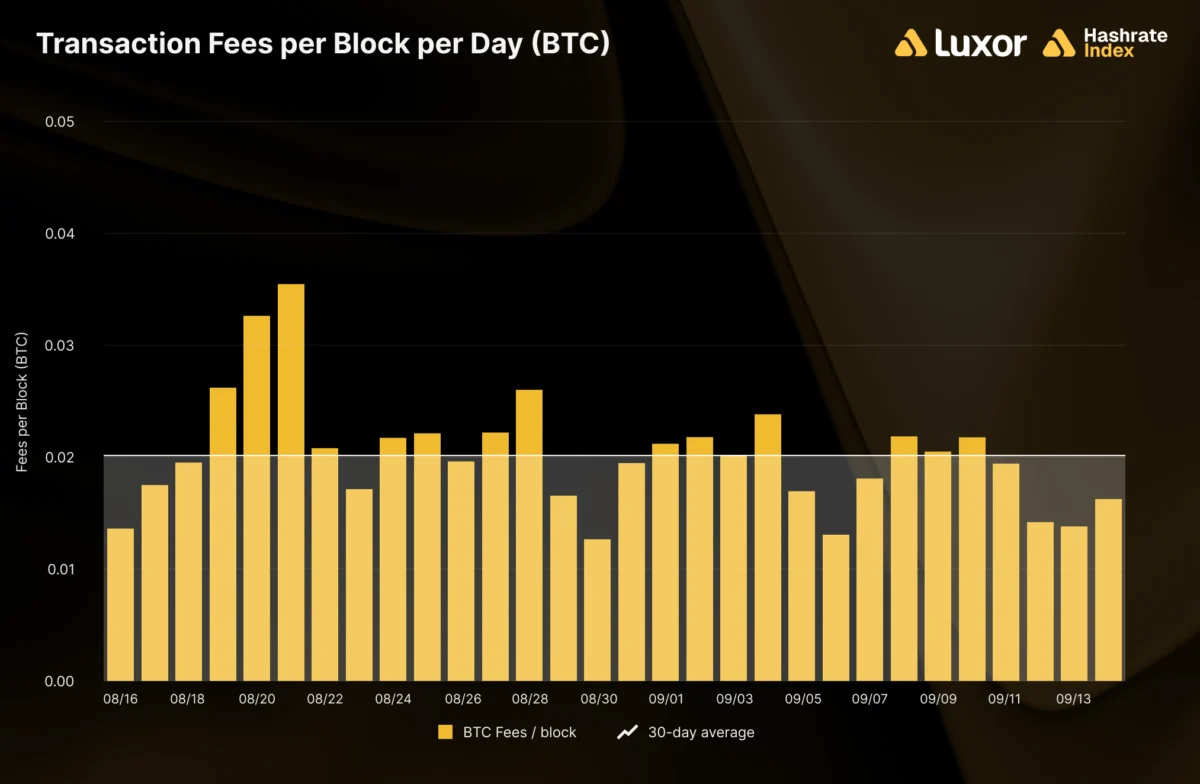
A notable trend over the past thirty days has been the persistent decline in transaction fee revenue. Miners collected an average of 0.0183 BTC per block in fees over the last seven days, marking a 5% decline from the previous week. When examined on a broader horizon, the 14-day and 30-day averages show a downward trajectory of 2.8% and 9.6%, respectively.
This contraction in fee-based revenue forces a heightened reliance on block subsidies, placing greater emphasis on the cost of electricity and the efficiency of mining fleets. As the market enters the latter half of September, the forward market—a key indicator of industry sentiment—is pricing in an average hashprice of $36.92 or 0.00047 BTC per PH/s/day over the next six months. This forward-looking data suggests that market participants are bracing for continued margin compression, likely driving further consolidation among smaller, high-cost operations.
Equity Market Performance: Mining Stocks Under Pressure
The publicly traded segment of the Bitcoin mining industry faced significant headwinds during the week, with the majority of tracked equities closing in the red. The sector, often used as a high-beta proxy for Bitcoin’s price, reacted poorly to the lack of upward momentum in the underlying asset.
Major players saw double-digit or near-double-digit pullbacks in market valuation. Cipher Mining (CIFR) experienced a 14.0% decline, while Stronghold Digital Mining (WULF) shed 12.4%. Terawulf (WULF) and Iris Energy (IREN) also saw notable volatility, reflecting investor anxiety over capital expenditure requirements and the impact of the anticipated difficulty spike on future earnings.
Conversely, some smaller-cap firms saw outlier performance. ANY recorded an 18.0% gain, while Canaan (CAN) rose by 6.3%. These discrepancies highlight the divergence in strategy within the mining sector, where firms with diversified energy portfolios or lower-cost power purchase agreements are better positioned to weather periods of sustained, low-margin hashprice than their more leveraged counterparts.
Broader Implications and Industry Outlook
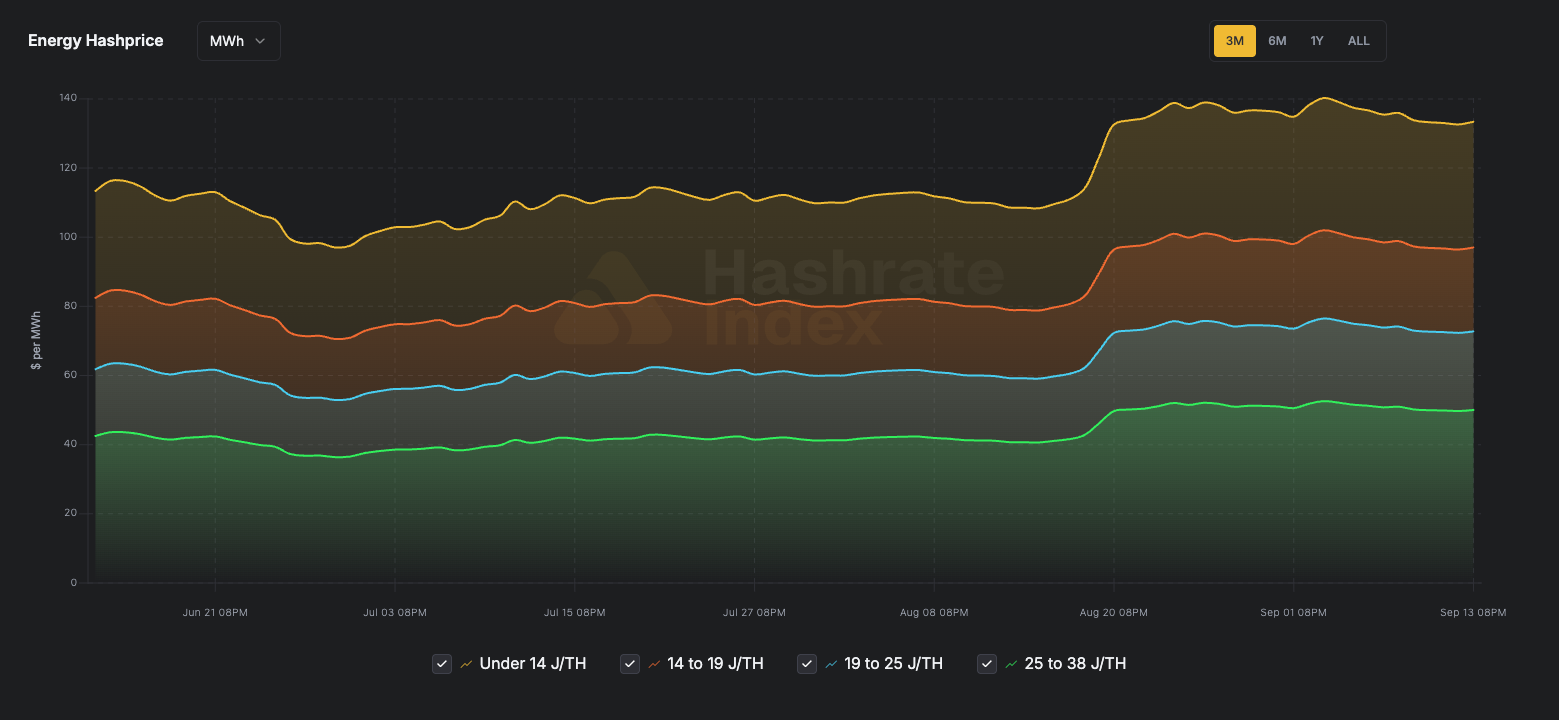
The current landscape for Bitcoin mining is defined by a "survival of the fittest" mentality. With the network difficulty trending upward and transaction fees failing to provide a significant buffer, the focus has shifted almost exclusively toward operational efficiency. The industry is witnessing a clear bifurcation between large-scale operations with proprietary liquid-cooling infrastructure and those relying on legacy air-cooled systems that are becoming increasingly obsolete in the face of rising difficulty.
The upcoming difficulty adjustment on September 19 serves as a critical inflection point. If the network hashrate continues to grow, the resulting difficulty increase will necessitate the decommissioning of older hardware for many mid-sized firms. This process is expected to accelerate the trend of corporate mergers and acquisitions, as well-capitalized firms look to acquire the infrastructure and power capacity of struggling competitors at distressed valuations.
Furthermore, the data from the Luxor Hashrate Forward Market underscores a cautious outlook for the coming winter. By pricing in a lower hashprice for the next two quarters, the market is signaling that it does not expect a rapid resurgence in miner profitability in the near term. For mining firms, this implies a period of fiscal discipline. Capital allocation is likely to shift away from aggressive expansion toward debt restructuring and optimization of existing site economics.
In conclusion, the week of September 14, 2026, serves as a snapshot of a maturing industry. The "flatline" in performance metrics, while appearing stagnant on the surface, hides a deeper, constant evolution in operational strategy. As the network difficulty climbs and revenue margins tighten, the Bitcoin mining ecosystem is effectively filtering out inefficiency, ensuring that the remaining hashrate is supported by the most resilient and energy-efficient infrastructure available. The coming weeks will likely determine which firms have the liquidity and operational agility to thrive in this high-difficulty environment, and which will be forced to yield to the relentless efficiency requirements of the Bitcoin protocol. Industry observers will be closely monitoring the September 19 difficulty adjustment to gauge the extent of the upcoming pressure on global mining fleets.