In a significant technological shift for the energy sector, a GPU cluster recently demonstrated the ability to respond to real-time grid curtailment signals, effectively transitioning AI infrastructure from a static, high-demand load into a dynamic, flexible grid asset. In early August 2026, a specialized GPU cluster received a Four Coincident Peak (4CP) curtailment signal generated by Luxor’s Qualified Scheduling Entity (QSE). The system responded by reducing its power consumption to approximately 25% of its baseline draw in less than 500 milliseconds. The operation was facilitated by Ziani, a software solution developed by Bentaus, which executed the entire curtailment loop—from the reception of the grid signal to the successful throttling of power—without requiring human intervention or causing the loss of active inference workloads.
This event marks a critical milestone in the integration of high-performance computing (HPC) into the Texas energy market. Traditionally, data centers have been categorized by grid operators as inflexible baseload consumers, forcing interconnection queues to treat them as permanent, non-negotiable drains on system capacity. The successful automation of GPU throttling suggests that the massive electricity requirements of the AI revolution need not be at odds with the stability of the regional power grid.
The Mechanics of 4CP and Grid Demand
To understand the significance of this development, one must examine the specific mechanics of the Electric Reliability Council of Texas (ERCOT) transmission cost structure. The Four Coincident Peak (4CP) program is a regulatory mechanism designed to incentivize large industrial consumers to reduce their load during the four highest system-wide peak demand intervals of the summer season (June through September).
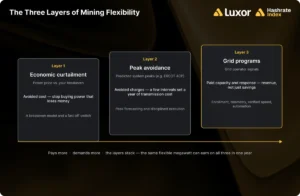
In the ERCOT market, a load’s contribution to these four specific 15-minute peaks dictates its transmission charges for the entire subsequent year. For years, Bitcoin mining operations have utilized sophisticated curtailment strategies to avoid these peaks, essentially turning off their hardware to avoid the high costs associated with being active during the grid’s most stressed moments. By applying this logic to AI data centers, Luxor and Bentaus have effectively unlocked a new economic model where compute facilities are compensated for their flexibility rather than penalized for their total energy consumption.
Overcoming the Technical Barrier: The Inference Challenge
The transition from Bitcoin mining to AI inference as a flexible load represents a substantial leap in technical complexity. Bitcoin mining hardware is inherently "interruptible"—if a miner is powered down, the primary consequence is a temporary loss of hashrate, which can be resumed almost immediately upon the restoration of power.
AI inference workloads, however, are far more delicate. A GPU performing complex machine learning inference or large language model (LLM) processing maintains a specific "state." If the power is cut or the hardware is interrupted mid-cycle, the work in progress is typically lost, leading to significant delays and potential data degradation. This sensitivity is the primary reason why AI data centers have historically been modeled as inflexible loads.
The technical breakthrough described by the operators involves "checkpointing." By integrating software capable of saving the computational state at a millisecond-level interval, the GPU cluster can effectively pause an inference job, throttle power in response to a grid signal, and resume precisely where it left off once the grid stability is restored. This "cheatcode" allows for the flexibility of a Bitcoin miner while maintaining the integrity of high-value AI workloads.
Chronology of the August 2026 Trial
The August 2026 demonstration followed a period of rigorous testing and infrastructure integration. The timeline for the implementation involved:
- Q2 2026: Integration of Luxor’s QSE capabilities with Bentaus’ Ziani software, focusing on low-latency communication between the grid operator’s signals and the hardware power management interfaces.
- Early August 2026: Deployment of the automated curtailment protocol on a live test node, calibrated specifically for the 4CP signal parameters.
- August 2026 (Execution): Receipt of the curtailment signal during a period of high grid demand. The Ziani software successfully throttled the GPU cluster’s power usage by 75% within the 500-millisecond window.
- Post-Event: Validation that no inference tasks were corrupted or lost during the power ramp-down, proving that the checkpointing mechanism functioned as intended under real-world conditions.
Strategic Perspectives on Energy and Compute
Ethan Vera, COO of Luxor, emphasized that the industry is at a crossroads where data center operators must choose between traditional, rigid operational models or more innovative, grid-integrated frameworks. "Two trends are converging in the market: AI data centers are consuming a rapidly growing share of total power, while the industry itself is maturing," Vera stated. "In that future, the winners will be the data centers that act as grid stabilizers, and get paid for it through energy programs."
This sentiment is shared by Robert Davidoff, CEO of Bentaus, who views the success of this trial as a blueprint for future infrastructure. "We are currently extending this work across additional liquid-cooled accelerator systems and next-generation GPU platforms, while developing toward rack-scale architectures," Davidoff noted. The goal is to move beyond individual nodes and apply this logic to entire data center facilities, potentially offering grid operators a massive, distributed pool of "virtual power plants" that can respond to fluctuations in supply and demand.
Implications for the Energy Market and AI Operators
The economic implications of this development are significant. If an AI data center can generate revenue not only from compute services but also from grid-balancing programs—such as the Emergency Response Service (ERS) or frequency regulation—it creates a competitive advantage that could fundamentally reshape the data center industry.
For grid operators, the ability to control large, flexible loads during emergency events provides a powerful tool for maintaining grid reliability without the need for expensive, carbon-intensive "peaker" plants that are only used occasionally. As AI energy demand continues to surge, the ability of these data centers to play a role in grid resilience may become a regulatory requirement rather than just an economic incentive.
Furthermore, this development addresses the growing scrutiny from policymakers regarding the impact of AI infrastructure on local power grids. By demonstrating that AI facilities can be "good citizens" on the grid—voluntarily reducing their load when the system is stressed—operators can mitigate concerns about local energy scarcity and potentially expedite the approval process for new data center projects.
Future Outlook and Research Targets
The collaboration between Luxor and Bentaus is now entering a new phase of development. The next steps involve expanding the test parameters to include larger-scale GPU clusters and evaluating participation in a broader range of ERCOT programs. The primary economic question currently under evaluation is whether the revenue generated from participating in energy-balancing programs exceeds the potential loss of income from occasional, albeit controlled, pauses in compute uptime.
As the industry moves toward rack-scale architectures, the complexity of managing these systems will increase. However, the successful demonstration in August 2026 provides a proof of concept that technical hurdles like workload state-management are surmountable. The industry is now watching closely to see if this model can be scaled to support the thousands of megawatts of new data center load currently in development across the United States.
In summary, the transition of GPU clusters into flexible loads represents a convergence of energy and technology that may define the next decade of infrastructure investment. By turning the "curse" of high power consumption into a tool for grid stabilization, data center operators are positioning themselves as essential partners in the global energy transition. Whether through 4CP participation or broader emergency response programs, the integration of compute and energy is likely to become a standard operating procedure for the next generation of AI-ready infrastructure.