
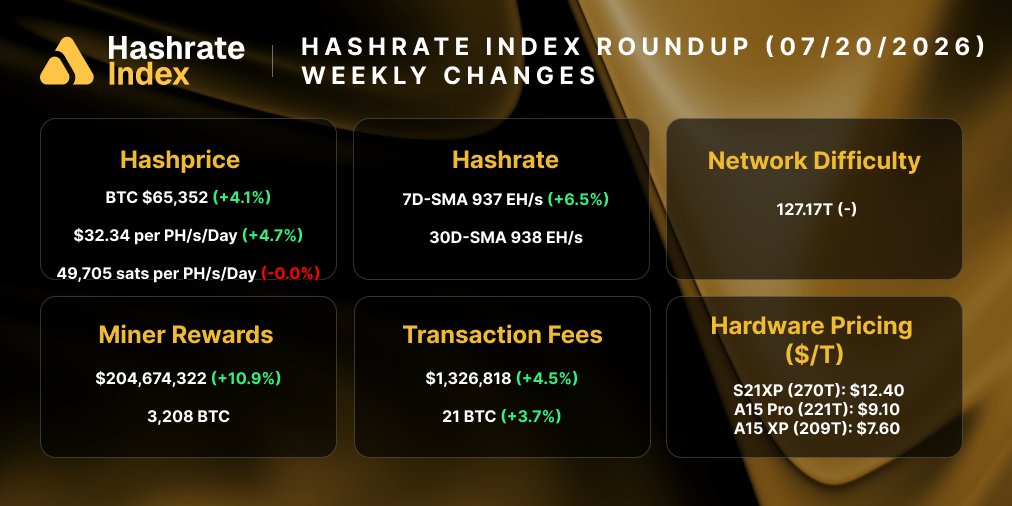
The global Bitcoin mining sector experienced a notable shift in momentum during the week ending July 20, 2026, characterized by a recovery in market prices and a substantial increase in network computational power. Bitcoin miners generated a total of approximately 3,208 BTC in block rewards over the seven-day period, a sum valued at roughly $204 million based on current market rates. While the industry continues to navigate a challenging post-halving environment, the latest data suggests a period of relative stabilization for operators who have managed to optimize their energy costs and hardware efficiency. Transaction fees, a critical secondary revenue stream for the network, accounted for 0.65% of total block rewards, contributing 21 BTC, or approximately $1.33 million, to the total revenue pool.
Bitcoin Market Dynamics and Price Recovery
Bitcoin’s price action during the third week of July provided a much-needed reprieve for the mining community. The digital asset climbed 4.1%, moving from a weekly low of approximately $62,759 to a spot price of $65,330 at the time of reporting. This upward movement reflects a broader resilience in the cryptocurrency markets, even as the year-to-date (YTD) performance remains down by 25.3%. The discrepancy between the weekly gain and the YTD decline highlights the volatility that has defined the 2026 fiscal year, largely driven by shifting macroeconomic policies and the ongoing absorption of the 2024 halving’s supply-side impact.
On the institutional front, CME Bitcoin futures indicated a steady outlook. The July CME Future stood at $65,310, while the August and September contracts showed slight premiums at $65,460 and $66,135, respectively. This contango structure suggests that professional traders maintain a cautiously optimistic view of Bitcoin’s price trajectory heading into the late third quarter. For miners, the price appreciation directly bolsters the USD-denominated value of their daily production, providing a buffer against the rising difficulty of the network.
Hashrate Expansion and Network Difficulty
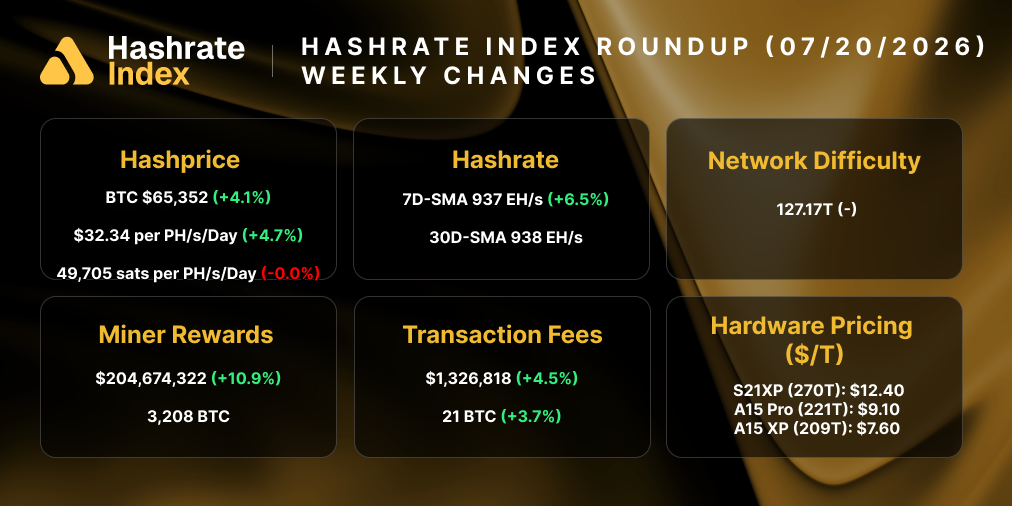
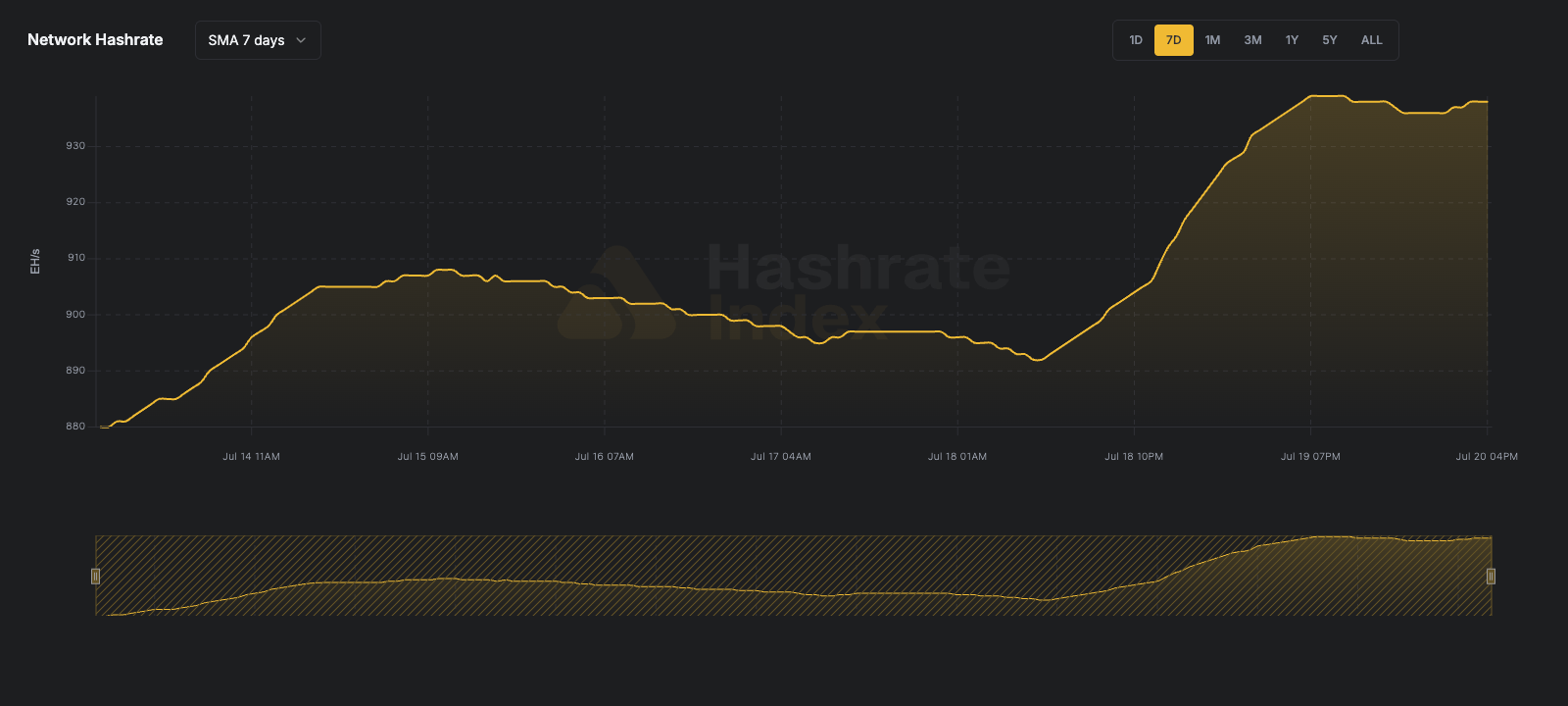
The Bitcoin network’s hashrate—a measure of the total computational power dedicated to securing the blockchain—saw a significant surge of 6.5% over the past week. The 7-day simple moving average (SMA) rose from 880 EH/s (exahashes per second) to 937 EH/s. This spike suggests that several large-scale mining facilities may have brought new hardware online or re-activated older fleets following a period of maintenance or curtailment. The 30-day SMA currently tracks closely at 938 EH/s, indicating that the network is operating near its all-time highs for computational density.
This increase in hashrate occurs despite the network recently undergoing a downward difficulty adjustment. On July 11, 2026, the Bitcoin protocol reduced its mining difficulty by 5.00%, bringing the metric to 127.17T. This adjustment was intended to make it easier for miners to find blocks following a period of slower block production. However, the subsequent influx of hashrate has already begun to compress block times, which averaged approximately 9 minutes and 45 seconds over the last 24 hours—faster than the targeted 10-minute interval. Consequently, the network is currently projected to see a +2.56% difficulty increase during the next adjustment cycle, estimated for July 25, 2026.
The Economics of Mining: Hashprice and Efficiency
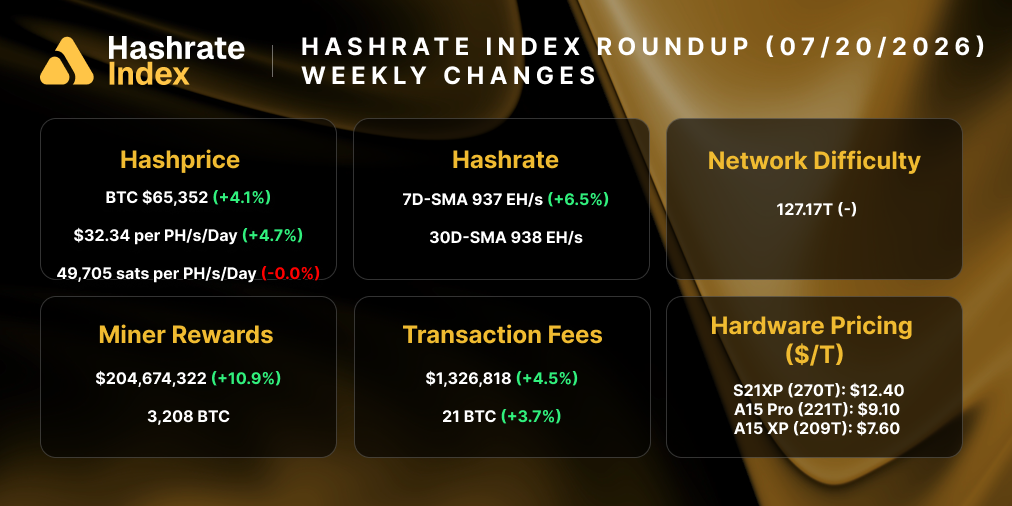
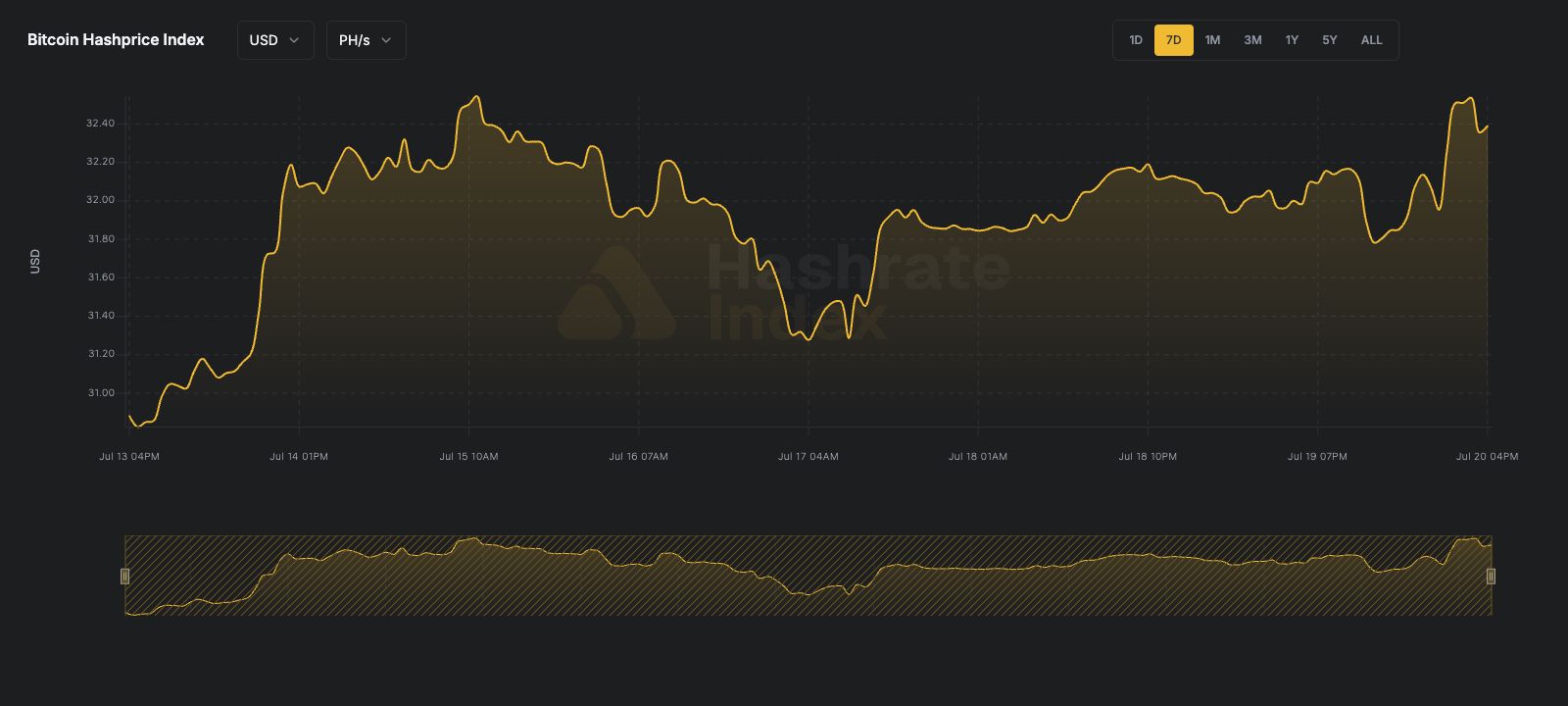
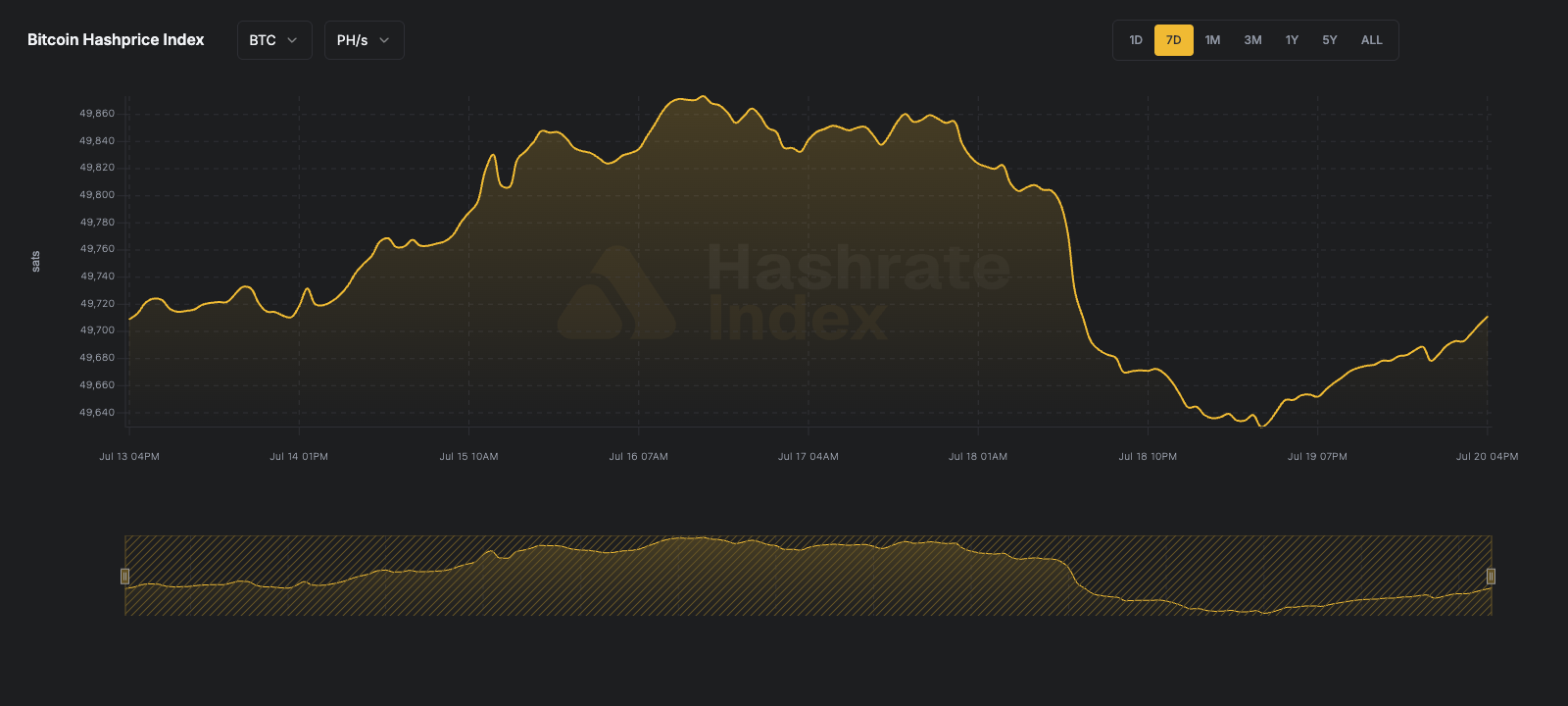
The Luxor Hashprice Index, a standardized measure of mining profitability expressed as USD per petahash per day (PH/s/Day), rose by 4.7% to $32.34. This increase is primarily a function of the rising Bitcoin price, as the BTC-denominated hashprice remained virtually flat at 0.00049705 BTC per PH/s/Day. For many operators, the $32 threshold represents a critical "breakeven" zone. Miners utilizing older generation hardware, such as the Antminer S19 series, are finding margins increasingly thin, particularly those with electricity costs exceeding $0.06 per kilowatt-hour (kWh).
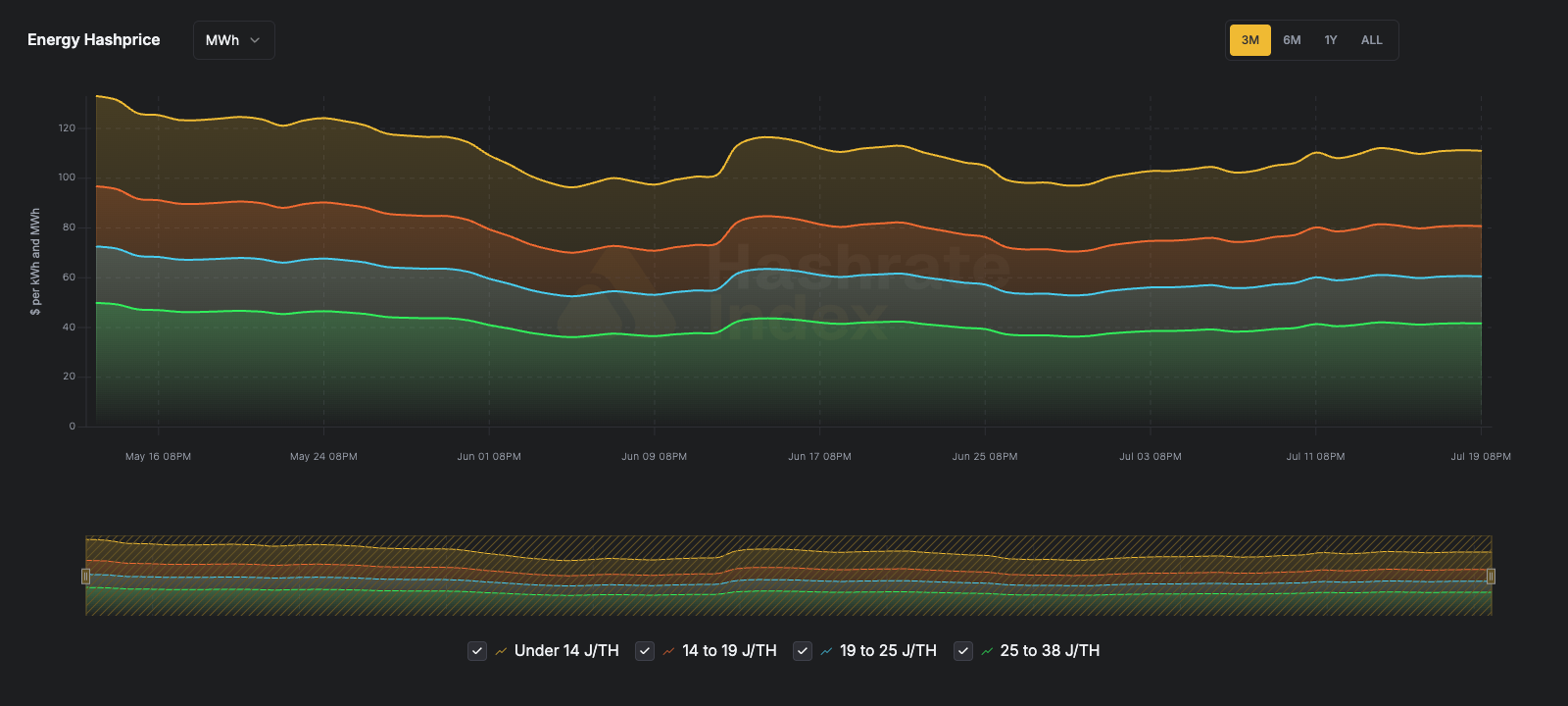
Conversely, operators who have transitioned to the latest generation of hardware, including the Bitmain S21 and MicroBT Whatsminer M60 series, continue to find the current environment profitable. The focus within the industry has shifted aggressively toward "joules per terahash" (J/TH) efficiency. As the USD hashprice hovers at these levels, firmware optimizations and underclocking strategies have become essential tools for survival. Many miners are now utilizing advanced firmware to lower power consumption during peak energy pricing hours while maximizing output when hashprice spikes or energy costs dip.
Transaction Fee Trends
Transaction fees remain a modest portion of the total miner revenue, though they showed slight growth over the past week. Miners collected an average of 0.0208 BTC per block in fees, representing a 4% increase from the previous week’s average of 0.0200 BTC. While this is a far cry from the fee-heavy periods seen during the height of the Ordinals and Runes craze in previous years, the steady baseline of fee activity provides a necessary supplement to the 3.125 BTC block subsidy.
The 30-day average for transaction fees stands at 0.0213 BTC, suggesting that while the network is not currently experiencing significant congestion, there is a consistent level of high-priority transactional demand. Industry analysts suggest that until a new wave of on-chain activity—such as a resurgence in layer-2 utilization or digital collectibles—takes hold, fees are likely to remain below 1% of total rewards for the foreseeable future.
Performance of Publicly Traded Mining Companies
The equity markets for Bitcoin miners presented a fragmented picture last week, as investors weighed company-specific developments against the backdrop of a rising Bitcoin price. Some of the most significant gains were seen in CleanSpark (CLSK), which surged 16.7% to reach a market capitalization of $3.70 billion, and Soluna Holdings (SLNH), which spiked 21.4%. These gains are often attributed to successful infrastructure expansions or the securing of favorable power contracts.
However, the sector also faced headwinds. Applied Digital (AIBZ) saw a sharp decline of 18.7%, and Terawulf (WULF) dropped 9.7% despite its substantial $9.35 billion market cap. The divergence in stock performance highlights a growing trend in the industry: the pivot toward High-Performance Computing (HPC) and Artificial Intelligence (AI) data centers. Investors are increasingly favoring "diversified" miners who can pivot their power capacity between Bitcoin mining and AI workloads, depending on which offers the higher return on energy. IREN (formerly Iris Energy) remains a heavyweight in this category, maintaining a massive $14.37 billion market cap with a 3.1% weekly gain.
Forward Outlook and Industry Implications
Looking ahead, the hashrate forward market is pricing in a degree of caution. Current contracts on the Luxor Hashrate Forward Market suggest an average hashprice of $30.77 (or 0.00048 BTC) over the next six months. This suggests that market participants expect either a further increase in network difficulty or a potential stagnation in Bitcoin’s price growth, both of which would exert downward pressure on daily earnings per petahash.
The broader implications for the industry are twofold. First, the "industrialization" of Bitcoin mining is nearly complete. The days of small-scale, hobbyist mining at scale are over, replaced by multi-billion-dollar corporations that manage gigawatts of power and navigate complex global supply chains. Second, the integration of mining with the energy grid is becoming more sophisticated. By acting as a flexible load, miners are increasingly seen as partners by utility providers, helping to stabilize grids that are increasingly reliant on intermittent renewable energy sources like wind and solar.
As the industry moves toward the final week of July, all eyes will be on the July 25 difficulty adjustment. If the hashrate continues to climb at its current pace, the subsequent increase in difficulty could once again squeeze the margins of less efficient players, potentially leading to another round of consolidation in the mining landscape. For now, the "green bag" of rising prices and stable fees provides a moment of optimism in an otherwise rigorous and competitive market.