On July 13, 2026, a coordinated and unprecedented wave of sanctions was unleashed by the United States, the European Union, and the United Kingdom, targeting a vast and interconnected network of nation-state hackers, cybercriminals, and their crucial enablers. This comprehensive enforcement action, hailed as one of the most significant cyber enforcement efforts to date, underscores the critical imperative of robust international collaboration in the relentless fight against ransomware and the pervasive threat of cybercrime. The infrastructure and individuals ensnared by these sanctions are collectively believed to be responsible for billions of dollars in damages, impacting businesses, critical infrastructure, and governmental bodies across the globe.
At the heart of this multilateral offensive lies the European Union’s designation of Vitaly Nikolayevich Kovalev, widely known by his moniker "Stern." Kovalev is identified as the administrator of the notorious Trickbot criminal syndicate, a sprawling organization implicated in the development and deployment of some of the most destructive ransomware strains in recent history, including Conti. While Kovalev had previously been designated by the U.S. Office of the Treasury’s Office of Foreign Assets Control (OFAC) and the U.K. Office of Financial Sanctions Implementation (OFSI) on February 9, 2023, the EU’s action marks the first time the alias "Stern" has been officially recognized as a key identifier by a major sanctioning body. Financial intelligence indicates that cryptocurrency wallets associated with "Stern" have processed over $300 million in ransom payments, positioning him as potentially the single most prolific ransomware operator ever formally identified.
Stern: The Architect of Billions in Ransomware Extortion
The European Union’s detailed designation provides a stark profile of Vitaly Nikolayevich Kovalev, a Russian national operating under a multitude of aliases, with "Stern" being the most prominent. According to EU intelligence, Kovalev has served as a senior figure within the Trickbot Group, a nexus responsible for disseminating devastating malware programs such as Ryuk and Conti ransomware, along with their numerous offshoots. These malicious tools have been employed in extensive ransomware campaigns that have crippled essential services, including healthcare systems and financial institutions, inflicting widespread disruption and financial loss.
While the $300 million figure associated with wallets linked to "Stern" represents his personal financial gains, it offers a chilling glimpse into the scale of his illicit operations. This amount is understood to be his individual cut of the proceeds, with the Trickbot group’s total earnings over its operational lifespan being substantially greater. This disparity highlights the immense financial scale and sophisticated operational structure of the syndicate under Kovalev’s alleged leadership.
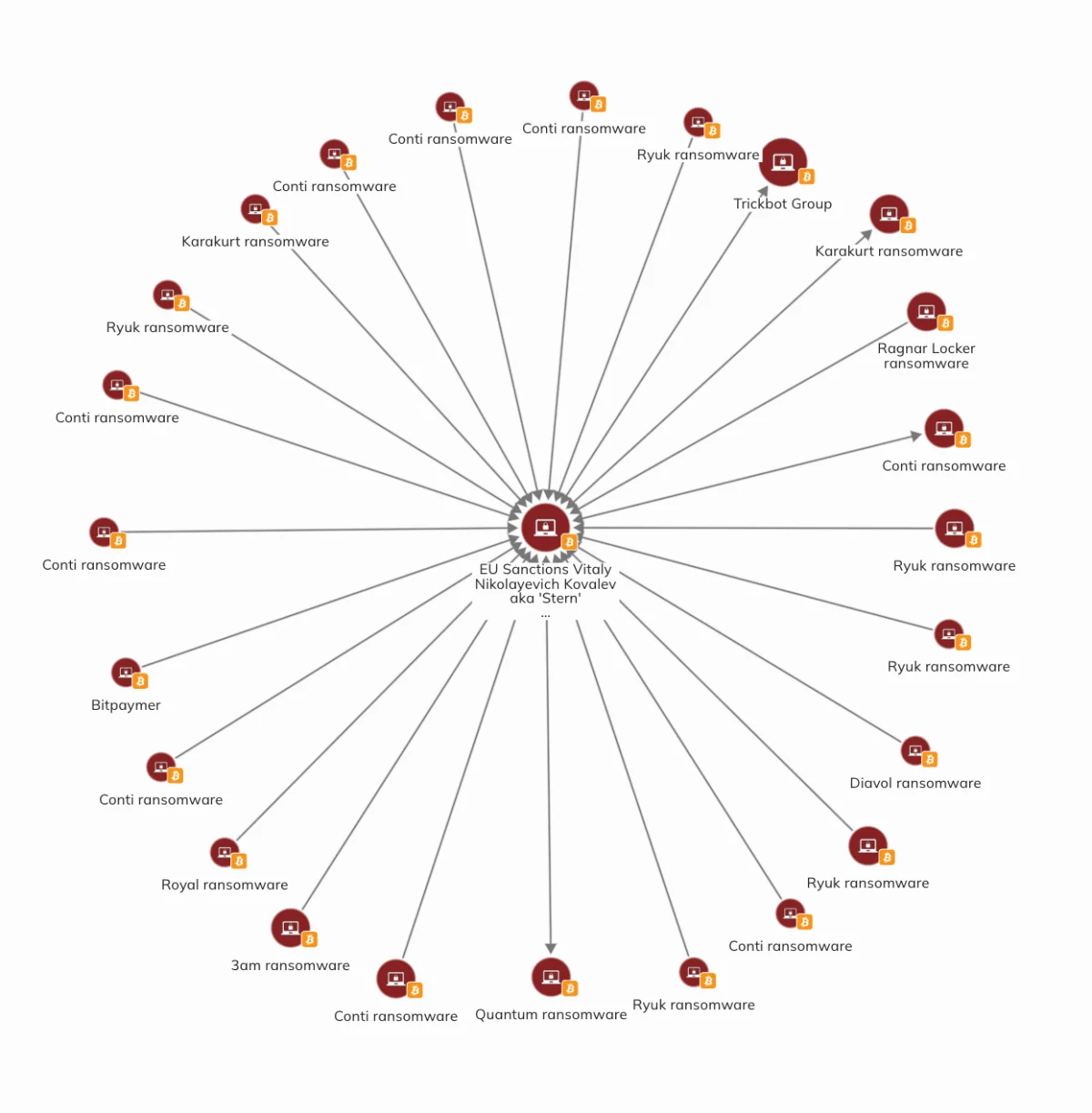
Analysis of cryptocurrency transactions, visualized through tools like the Chainalysis Reactor graph, reveals "Stern’s" deep integration with a wide array of ransomware strains. His financial activities have intersected with Ryuk, Conti, Diavol, Karakurt, Royal, 3am, Quantum, and Bitpaymer, among others. This intricate web of transactions demonstrates his pivotal role in facilitating and profiting from the operations of multiple ransomware families, underscoring his central position within the broader cybercriminal ecosystem.

The designation of "Stern" follows a series of targeted actions by the UK and US governments. In 2023 alone, both nations sanctioned seven, and later an additional eleven, members of the Trickbot syndicate. This latest action brings the total number of sanctioned Trickbot members to nineteen, reflecting a sustained and escalating effort to dismantle the group’s leadership and operational capabilities. The flow of cryptocurrency payments within the Trickbot Group mirrors its hierarchical structure, clearly indicating "Stern’s" centrality not only in terms of personal earnings but also in his capacity to disburse funds for infrastructure, services, and operational upkeep. The leaked "Conti Leaks" provided further damning evidence, painting "Stern" as a quasi-"CEO" figure within the syndicate, wielding significant authority over budget allocation, procurement, recruitment, and even the strategic planning of cyberattacks.
OFAC Targets Key Infrastructure Providers Enabling Ransomware
In parallel to the focus on high-level operators, the U.S. Department of the Treasury’s OFAC has also taken decisive action against critical infrastructure providers that serve as the backbone for ransomware operations. OFAC has designated First VPN Service (1VPNS), a Virtual Private Network (VPN) provider whose principal clients are identified as ransomware actors. The sanctions extend to its administrator, Dmytro Rashevskyi, and cryptor provider Yevgeniy Vladimirovich Silayev, both of whom are accused of facilitating ransomware attacks by providing essential anonymizing and obfuscation services.
OFAC has successfully identified and linked cryptocurrency wallet addresses associated with both 1VPNS and Rashevskyi across multiple major blockchains, including Bitcoin, Ethereum, Litecoin, Zcash, Dash, TRON, Dogecoin, and Solana. This extensive tracing capability is crucial for disrupting the financial flows of these illicit actors. This latest action by OFAC builds upon previous enforcement efforts. In May 2026, European law enforcement authorities, with vital support from the FBI’s Boston Field Office, successfully took down the website and infrastructure of 1VPNS, disrupting its operations and exposing its user base.
EU Broadens Scope to Encompass the Wider Cybercriminal Ecosystem
The European Union’s designation efforts have extended to encompass a more diverse range of nation-state cybercriminal actors and their essential enablers. Beyond "Stern" and the Trickbot syndicate, the EU has also sanctioned entities and individuals involved in providing crucial services that facilitate cybercriminality. These include LummaC2, identified as a Malware-as-a-Service (MaaS) platform specializing in the theft of sensitive data, browser credentials, cryptocurrency wallets, and system information. The EU’s action against LummaC2 targets the proliferation of sophisticated tools that empower less technically adept cybercriminals.
Furthermore, the EU has designated Media Land LLC, a Russian-based "bullet-proof" hosting provider. This entity has been instrumental in supporting major ransomware operations, including LockBit, EvilCorp, and BlackBasta, since 2016. By offering services designed to resist law enforcement takedowns and maintain operational continuity for malicious actors, Media Land LLC plays a critical role in the sustained success of these ransomware gangs. The EU’s targeting of such infrastructure providers signifies a strategic shift towards disrupting the entire support network that underpins cybercrime.
The Strategic Impact on Cryptocurrency Compliance and Global Security
Today’s coordinated sanctions represent a significant strategic evolution in the global effort to combat malicious cyber activity. The approach has demonstrably shifted from solely targeting the operators of ransomware attacks to comprehensively addressing the broader ecosystem of enablers that make these operations feasible. VPN providers, malware-as-a-service platforms, bullet-proof hosting services, cryptor developers, and other infrastructure providers are no longer operating in the shadows unchallenged. They are increasingly becoming the focal points of law enforcement and sanctions authorities worldwide, recognizing their indispensable role in facilitating extortion, defacement, Distributed Denial of Service (DDoS) attacks, and sabotage.

The implications of this coordinated action for cryptocurrency compliance are profound. By identifying and labeling cryptocurrency addresses associated with sanctioned entities, organizations that utilize blockchain analysis tools, such as Chainalysis Reactor, can proactively identify exposure to these illicit networks. This capability is essential for maintaining global compliance standards and mitigating the risk of inadvertently transacting with sanctioned individuals or entities. The ability to monitor and detect exposure to these cybercriminal networks allows businesses and financial institutions to strengthen their defenses, enhance due diligence, and avoid becoming unwitting facilitators of criminal enterprises.
The effectiveness of such broad-based sanctions hinges on seamless international cooperation. Cybercriminals, by their very nature, exploit jurisdictional boundaries to evade detection and prosecution. Coordinated sanctions regimes, like the one announced on July 13, 2026, are instrumental in closing these legal and operational gaps. By simultaneously freezing assets across multiple financial systems and imposing travel bans, these multilateral actions significantly hinder the ability of cybercriminals to profit from their illicit activities and operate with impunity. The continued strengthening of these international alliances is paramount in creating a less hospitable environment for cybercriminals and protecting global digital infrastructure.
Chronology of Key Events
- Prior to February 2023: Vitaly Nikolayevich Kovalev, operating under various aliases including "Stern," allegedly assumes a senior leadership role within the Trickbot Group, overseeing and facilitating the operations of ransomware strains like Conti and Ryuk.
- February 9, 2023: The U.S. Office of Foreign Assets Control (OFAC) and the U.K. Office of Financial Sanctions Implementation (OFSI) jointly designate Vitaly Nikolayevich Kovalev, identifying him as a key figure within the Trickbot syndicate.
- Throughout 2023: The UK and US governments continue their targeted sanctions campaign against Trickbot members, designating seven individuals and subsequently eleven more, bringing the total to nineteen.
- May 2026: European law enforcement authorities, with assistance from the FBI’s Boston Field Office, execute a takedown of the website and infrastructure of First VPN Service (1VPNS), a provider identified as serving ransomware actors.
- July 13, 2026: The United States, the European Union, and the United Kingdom announce a sweeping coordinated sanctions action targeting a broad network of nation-state hackers, cybercriminals, and their enablers, including the EU’s designation of Vitaly Nikolayevich Kovalev ("Stern") and OFAC’s designation of 1VPNS, its administrator, and a cryptor provider.
Broader Implications and Future Outlook
The multifaceted nature of this coordinated sanctioning effort signals a significant maturation in the global response to cybercrime. By targeting not only the direct perpetrators of ransomware attacks but also the essential infrastructure and services that enable their operations, allied nations are aiming to dismantle the entire criminal enterprise. This approach recognizes that disrupting the flow of funds, the availability of tools, and the anonymity offered by certain services can be as effective, if not more so, than simply targeting individual actors.
The inclusion of entities like bullet-proof hosting providers and VPN services in these sanctions indicates a strategic understanding of the cybercriminal supply chain. These providers, often operating with a degree of plausible deniability, are now facing direct repercussions for their role in facilitating illicit activities. This increased scrutiny is likely to force such providers to either cease their support for criminal enterprises or risk significant legal and financial penalties.
For the cryptocurrency industry, this heightened regulatory focus underscores the ongoing need for robust compliance measures. The ability to trace and label illicit cryptocurrency addresses, as demonstrated by Chainalysis, is becoming an indispensable tool for financial institutions and compliance officers seeking to navigate the complex regulatory landscape and avoid association with sanctioned entities. The trend towards greater transparency and accountability in the use of digital assets for illicit purposes is undeniable.
The success of these sanctions will ultimately be measured by their ability to disrupt the financial incentives driving ransomware operations and to degrade the operational capabilities of cybercriminal syndicates. Continued international cooperation, intelligence sharing, and the adaptive application of financial and legal tools will be critical in staying ahead of evolving threats and ensuring a more secure digital future for businesses and citizens worldwide. The message is clear: the era of operating with impunity in the cyber domain is drawing to a close, as a united front of international powers moves to dismantle the infrastructure of global cybercrime.