
Foundry, the digital asset infrastructure provider that operates the world’s largest Bitcoin mining pool, has officially announced its strategic expansion into the Zcash ecosystem with the planned launch of an institutional-grade mining pool in April 2026. This initiative is designed to bridge a significant gap in the current Zcash (ZEC) infrastructure, providing public companies and large-scale institutional entities with a professionalized, North American-based platform for mining one of the industry’s most prominent privacy-preserving digital assets. By leveraging the expertise gained from operating Foundry USA—the dominant force in Bitcoin computing power—the company aims to bring a new level of transparency, compliance, and reliability to the Zcash network.
The decision to enter the Zcash market comes at a pivotal moment for the privacy coin, which has seen a substantial surge in network hashrate and renewed interest from developers focused on the intersection of financial privacy and regulatory compliance. As the digital asset landscape matures, the demand for sophisticated mining operations that can meet the rigorous auditing and operational standards of institutional investors has never been higher. Foundry’s move signifies a vote of confidence in the long-term viability of Zcash’s Proof-of-Work (PoW) model and its underlying zero-knowledge technology.
The Strategic Vision Behind Foundry’s Zcash Expansion
Foundry Digital LLC, a subsidiary of Digital Currency Group (DCG), has established itself as a cornerstone of the North American mining industry. Its Bitcoin pool, Foundry USA, frequently accounts for 25% to 30% of the total global Bitcoin hashrate, providing a stable and lucrative environment for miners. In transitioning this expertise to Zcash, Foundry is addressing what its leadership describes as a disconnect between the asset’s maturity and its supporting infrastructure.
Mike Colyer, CEO of Foundry, emphasized that while Zcash has evolved into an institutional-grade asset, the mining ecosystem has largely remained fragmented or geared toward retail participants. The new pool is intended to provide the same level of white-glove service and technical excellence that helped Foundry USA ascend to the top of the Bitcoin mining rankings. By offering a US-based, enterprise-grade solution, Foundry aims to attract public mining firms and private funds that require a higher degree of operational oversight than what is currently available in the Zcash mining sector.

The launch, scheduled for April 2026, allows for a comprehensive development cycle to ensure the pool can handle the specific technical requirements of the Equihash algorithm used by Zcash. Unlike Bitcoin’s SHA-256 algorithm, Equihash is memory-oriented, requiring specialized hardware (ASICs) that differ from those used for Bitcoin. Foundry’s entry into this space suggests a long-term commitment to supporting diverse PoW ecosystems beyond the market leader.
Understanding Zcash: Privacy, Compliance, and Technology
Launched in 2016, Zcash was born out of a desire to improve upon the privacy limitations of Bitcoin. While Bitcoin is often perceived as anonymous, it is more accurately described as pseudonymous; every transaction and wallet balance is recorded on a public ledger, accessible to anyone with an internet connection. This lack of inherent privacy can be a deterrent for institutional players who require commercial confidentiality for their financial operations.
Zcash solves this through the use of Zero-Knowledge Succinct Non-Interactive Arguments of Knowledge, or ZK-SNARKs. This cryptographic breakthrough allows users to prove that a transaction is valid without revealing the sender, receiver, or the amount involved. Zcash offers two types of addresses: transparent addresses (t-addresses), which function similarly to Bitcoin, and shielded addresses (z-addresses), which utilize ZK-SNARKs to protect user data.
The Foundry press release highlighted that Zcash demonstrates how financial privacy and compliant digital infrastructure can coexist. For institutions, this is a critical distinction. In a world of increasing regulatory scrutiny, the ability to maintain privacy while providing "view keys" to auditors or regulators is a unique value proposition of the Zcash protocol. This "selective disclosure" feature allows Zcash to meet Anti-Money Laundering (AML) and Know Your Customer (KYC) requirements while still protecting sensitive business information from the general public.
The Economic Model and Recent Network Growth
Zcash’s tokenomics are intentionally modeled after Bitcoin. It has a hard supply cap of 21 million tokens and utilizes a halving mechanism where the block reward is reduced by 50% approximately every four years. This disinflationary model is designed to preserve the asset’s value over time, a trait that appeals to "store-of-value" investors.

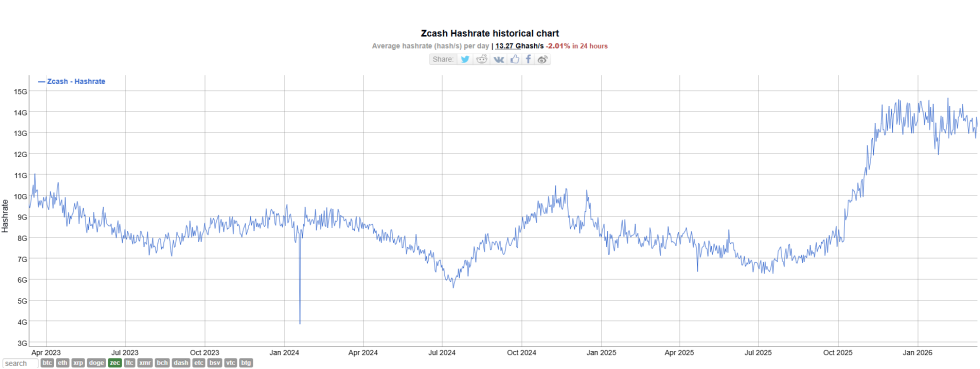
The timing of Foundry’s announcement coincides with a remarkable period of growth for the Zcash network. Data from BitInfoCharts reveals a significant upward trend in the network’s hashrate—a measure of the total computational power dedicated to securing the blockchain. In October of the previous year, the Zcash hashrate was hovering below 8 Ghash/s. By March 2026, that figure had climbed to over 13 Ghash/s, representing a nearly 63% increase in network security and miner participation in just a few months.
This surge in hashrate suggests that miners are either deploying more efficient hardware, such as the latest generation of Bitmain Antminer Z-series machines, or that the profitability of ZEC mining has attracted new participants. A higher hashrate makes the network more resistant to 51% attacks, further bolstering its appeal to institutional stakeholders who prioritize security above all else.
Collaboration with Shielded Labs and the North American Context
Foundry’s expansion is being met with enthusiasm from the core organizations supporting Zcash development. Zooko Wilcox, the founder of Zcash and Chief Product Officer of Shielded Labs, expressed strong support for the initiative. Shielded Labs, an independent support organization based in Switzerland, has been instrumental in fostering the Zcash ecosystem.
Wilcox noted that having a North American-based, enterprise-grade pool is a major milestone for the network. Historically, much of the mining power for various PoW coins has been concentrated in regions with lower regulatory clarity. By establishing a major pool in the United States, Foundry provides a "home base" for miners who operate in strictly regulated jurisdictions and require a partner that understands the legal and tax implications of large-scale mining.
The collaboration between Foundry and Shielded Labs highlights a concerted effort to decentralize the mining landscape while simultaneously professionalizing it. This dual approach is essential for the longevity of privacy-centric protocols, which often face more skepticism from traditional financial institutions than their non-privacy counterparts.
Market Implications and the Future of Privacy Coins
The announcement has had a notable impact on the market’s perception of Zcash. While the price of ZEC has experienced recent volatility—trading around $209 with an 11% weekly retracement—the long-term outlook is buoyed by the entry of a player as significant as Foundry. When the largest Bitcoin mining pool operator enters a new market, it typically signals that the asset has reached a level of liquidity and stability that justifies the investment.
There are several broader implications for the cryptocurrency industry following this move:
- Validation of PoW for Privacy: As many blockchains move toward Proof-of-Stake (PoS), Foundry’s commitment to a new PoW pool reinforces the belief that PoW remains the gold standard for security and fair distribution in the eyes of many institutional miners.
- Regulatory Maturity: Foundry’s involvement may act as a catalyst for clearer regulatory frameworks regarding privacy coins in the U.S. By operating a compliant pool, Foundry is essentially creating a blueprint for how privacy-preserving assets can be integrated into the regulated financial system.
- Increased Competition: The presence of an institutional giant like Foundry may force existing Zcash pools to upgrade their services, lower their fees, or improve their transparency to remain competitive. This "race to the top" benefits the entire mining community.
- Hardware Demand: A surge in institutional interest usually leads to a surge in demand for specialized mining hardware. This could lead to further innovations in Equihash ASIC technology, improving the efficiency and carbon footprint of the Zcash network.
Conclusion and Chronology of Events
The roadmap for Foundry’s Zcash pool is set against a backdrop of steady development. Following the initial announcement in March 2026, the company will enter a phase of rigorous testing and onboarding. The planned launch in April 2026 marks a new chapter for Zcash, transitioning it from a developer-favored privacy tool to a mainstream institutional asset.
- 2016: Zcash is launched, introducing ZK-SNARKs to the blockchain world.
- 2020-2024: Zcash undergoes multiple network upgrades (such as Canopy and NU5) to improve scalability and privacy features.
- Late 2025: Zcash hashrate begins a sharp ascent, growing from 8 Ghash/s to over 13 Ghash/s.
- March 2026: Foundry officially announces the development of its institutional Zcash pool.
- April 2026: The scheduled launch of the Foundry Zcash pool.
As the digital asset industry continues to grapple with the balance between transparency and privacy, Foundry’s new venture stands as a testament to the idea that both can exist simultaneously. By providing the "pipes and plumbing" for the Zcash network, Foundry is not just launching a mining pool; it is reinforcing the infrastructure of financial freedom in the digital age. For public companies looking to diversify their treasuries or participate in the security of decentralized networks, the arrival of an institutional-grade Zcash pool provides a long-awaited and necessary gateway.