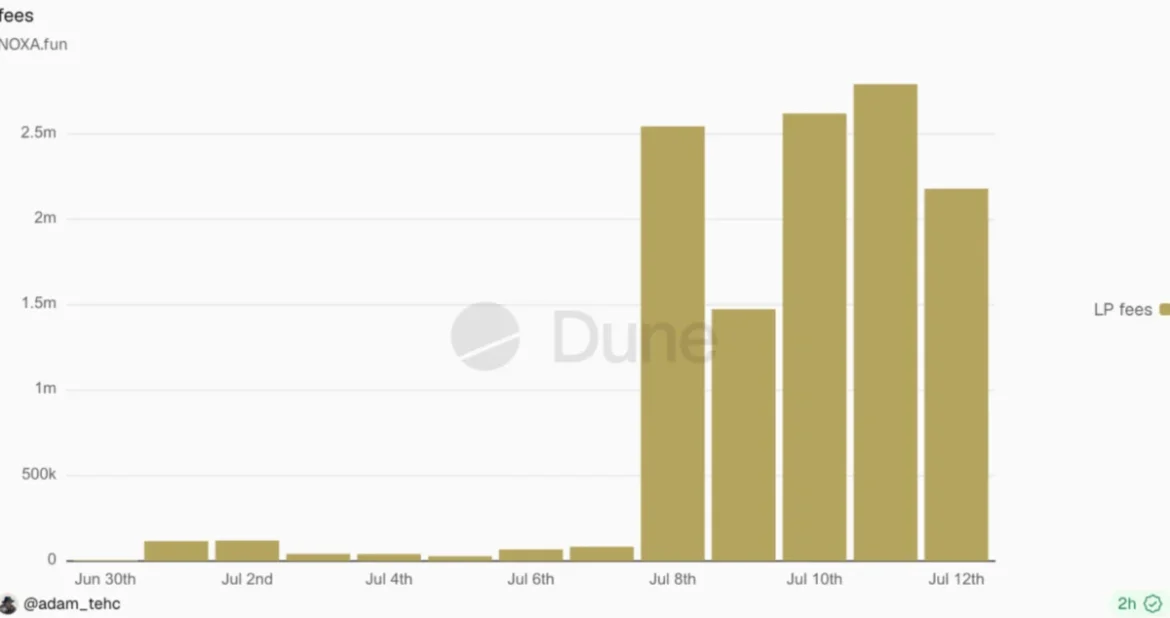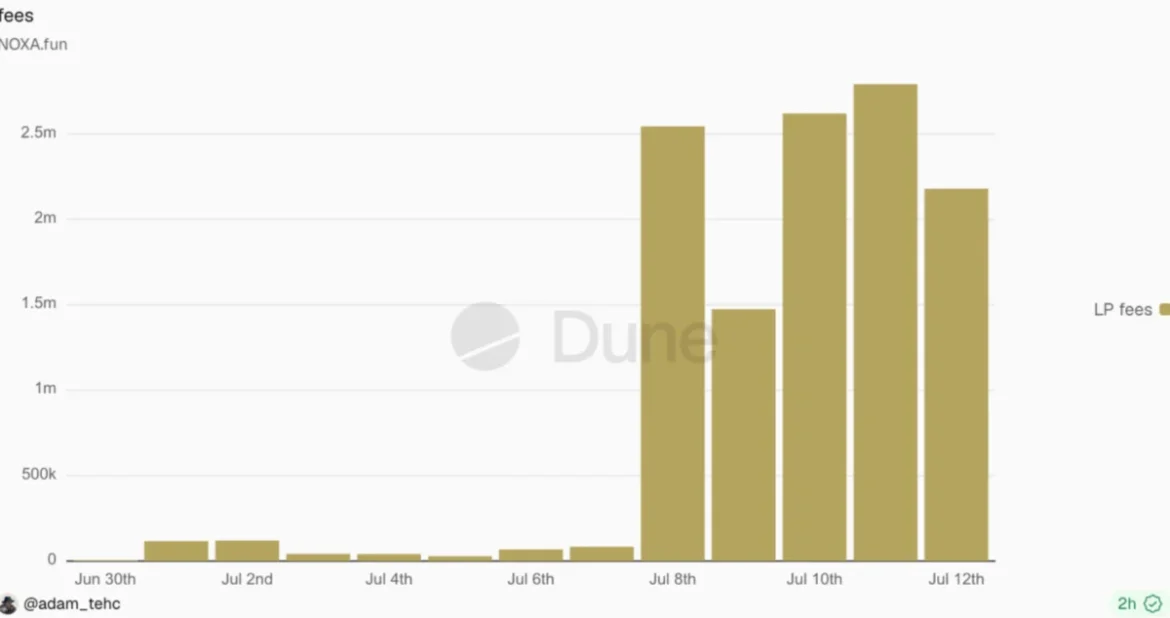
The burgeoning decentralized finance ecosystem on the Robinhood Chain faced its most significant architectural crisis this week following the abrupt dissolution of Noxa, the dominant launchpad responsible for the vast majority of the network’s recent memecoin activity. On July 11, 2026, Noxa management announced a cessation of operations, a move that sent shockwaves through a market that had, until days prior, been hailed as the newest frontier for retail-driven crypto speculation. The shutdown occurred after Noxa successfully extracted an estimated $12 million to $14.5 million in protocol fees within a narrow two-week window, leaving investors and developers questioning the long-term viability of the nascent blockchain.
Noxa was far more than a mere peripheral service; it functioned as the primary liquidity engine for the Robinhood Chain. Since the chain’s official launch on July 1, 2026, Noxa had facilitated the deployment of over 60,000 unique tokens, accounting for approximately 75% of all smart contract deployments on the network. This unprecedented level of dominance allowed the platform to briefly eclipse industry giants like Solana’s Pump.fun in daily fee generation—a feat maintained for five consecutive days during the height of the "Robinhood Summer" frenzy. However, the sudden disappearance of this infrastructure has precipitated a liquidity vacuum, leading to a sharp correction in the valuation of top-tier ecosystem assets.
The Rise and Sudden Fall of Noxa: A Chronological Breakdown
To understand the magnitude of Noxa’s exit, one must examine the rapid timeline of the Robinhood Chain’s ascent. The network was positioned by Robinhood leadership, including CEO Vlad Tenev, as a high-performance environment designed to bridge traditional finance with decentralized applications. While the stated goal was the proliferation of tokenized real-world assets (RWAs), the reality of the first two weeks of July was a localized "memecoin season" that rivaled the early days of Base and Solana.
The chronology of the collapse began on July 8, 2026, when Tenev declared on social media that "Robinhood Summer is here," signaling institutional confidence in the network’s growth. By July 10, the Robinhood Chain had flipped Base to become the second-most active network for Uniswap deployments by volume, trailing only Ethereum Mainnet. At this peak, cumulative decentralized exchange (DEX) volume surpassed $4 billion.
The turning point arrived on July 11. Noxa leadership issued a statement citing an overwhelming influx of "bot spam" and "low-quality token floods" as the primary reasons for halting new token launches. While presented as a measure to protect the integrity of the ecosystem, the market reacted with immediate skepticism. Two days later, on July 13, the Noxa website went dark entirely. The team initially attributed the outage to technical difficulties with Cloudflare, but the platform did not return to full functionality.
In a final, highly scrutinized move, Noxa announced it would redirect 100% of its ongoing trading fees to token creators. While framed as a benevolent gesture toward the community, critics argued it was a calculated exit strategy, allowing the developers to step away from operational responsibilities while the infrastructure they built began to crumble.
Market Impact: The Devaluation of Flagship Assets
The immediate fallout of the Noxa shutdown was felt most acutely by CASHCAT, the flagship memecoin of the Robinhood Chain. At its zenith, CASHCAT boasted a market capitalization of $226 million and had attracted 267,642 unique wallet holders—a staggering level of adoption for a token less than ten days old. Following the news of Noxa’s departure, CASHCAT’s valuation plummeted by more than 33% in a 24-hour period.
Other ecosystem tokens that had previously posted triple-digit gains, including FOX and HOODIE, followed a similar downward trajectory. These assets were deeply integrated into Noxa’s bonding curve mechanics and liquidity pools. Without the launchpad’s continuous flow of new users and the "front-page" visibility it provided, these tokens lost the momentum required to sustain their speculative premiums.
The impact was not limited to individual tokens. The total DEX volume on the Robinhood Chain, which had peaked at $878 million on July 12, began a steady decline as traders migrated their capital back to more established networks like Solana or Base. Although the chain’s Total Value Locked (TVL) has remained relatively resilient near the $200 million mark, the velocity of capital has slowed significantly, suggesting a shift from active speculation to passive holding or staged exits.
The "Soft Rug" Controversy and Community Reaction
The crypto community remains deeply divided over the nature of Noxa’s exit. On social media platforms, the discourse has split into two distinct camps. One segment of the market views Noxa’s decision to halt operations as a principled stand against the "extractive" nature of bot-driven memecoin launches. Supporters of this view argue that the platform’s decision to return fees to creators is evidence of a "clean exit" rather than a malicious act.
Conversely, a large contingent of investors and analysts have labeled the event a "soft rug." This term describes a scenario where a project team does not explicitly steal funds (a "hard rug") but instead abandons the project after extracting maximum value through fees or token sales, effectively leaving the community with a dying ecosystem. Prominent traders have pointed to the $12 million in fees as a motive for a "hit-and-run" operational model.
"Noxa the scam and other similar platforms slowly killed the momentum," noted a popular analyst under the pseudonym Shuarix. "The volume is already rotating to other chains. People got caught in the hype of a new chain without realizing the infrastructure was built on sand."
However, not all high-stakes players share this pessimism. The trader known as 0xAvast, who reportedly turned a modest investment into a multi-million dollar position during the CASHCAT rally, dismissed the current downturn as "irrelevant FUD" (Fear, Uncertainty, and Doubt). These conflicting perspectives highlight the high-risk, high-reward nature of early-stage blockchain ecosystems where sentiment can shift as rapidly as the underlying code.
Institutional Divergence: Memecoins vs. Real-World Assets
A critical aspect of the Noxa crisis is the stark disparity between the Robinhood Chain’s intended purpose and its actual usage. When Robinhood launched the chain, the primary marketing focus was on the tokenization of Real-World Assets (RWAs). However, as of mid-July 2026, the total market cap of RWA projects on the network stands at a mere $12.66 million.
To put this in perspective, at its peak, the CASHCAT memecoin alone was worth more than twelve times the entire RWA sector on the chain. This imbalance suggests that while Robinhood provided the "rails" for institutional-grade finance, the initial "passengers" were almost exclusively retail speculators. The collapse of Noxa exposes the fragility of a network whose growth is top-heavy with speculative assets. If the Robinhood Chain is to survive this volatility, it must find a way to pivot back to its original value proposition or foster a new generation of launchpads that prioritize long-term stability over short-term fee extraction.
The Search for a New Engine: Rival Platforms Step In
The void left by Noxa has created a competitive scramble among secondary launchpads. Platforms such as flap.sh, trensh.today, and bankr have all seen a marginal uptick in activity as they attempt to capture the displaced volume. A new entrant, Pons, has also positioned itself as a direct successor to Noxa, offering similar bonding curve mechanics but promising enhanced bot protection and more transparent governance.
Despite these efforts, none of the existing rivals have yet demonstrated the "brand pull" or the sheer scale that Noxa commanded. The technical barrier to entry for a launchpad is relatively low, but the social capital required to drive hundreds of millions of dollars in volume is difficult to replicate. Furthermore, the exit of Vlad.fun, another rival platform that went dark citing "internal integrity issues" just days after Noxa, has created a broader crisis of confidence in Robinhood Chain-native tooling.
Analytical Implications and Future Outlook
The Noxa episode serves as a cautionary tale for the broader cryptocurrency industry regarding "platform-dependent" ecosystems. In many modern Layer 2 and specialized Layer 1 networks, the health of the chain is inextricably linked to the health of its dominant dApps. When a single entity controls 75% of a chain’s deployments and then abruptly exits, the resulting damage to the network’s reputation can be permanent.
For Robinhood, the challenge now lies in damage control. The company’s foray into a proprietary blockchain was intended to showcase its technological prowess and its ability to capture the DeFi market. However, the association with "soft rugs" and volatile memecoin crashes may deter the very institutional partners needed for the RWA sector to flourish.
Investors moving forward must weigh the potential for "next-CASHCAT" style returns against the systemic risk of infrastructure failure. As the Robinhood Chain enters a period of consolidation, the focus will likely shift from how many tokens are being launched to how many of them possess actual utility beyond the bonding curve. The Noxa collapse has proven that in the world of decentralized finance, the platform is often more powerful than the asset—and when the platform disappears, it takes the market’s momentum with it.