
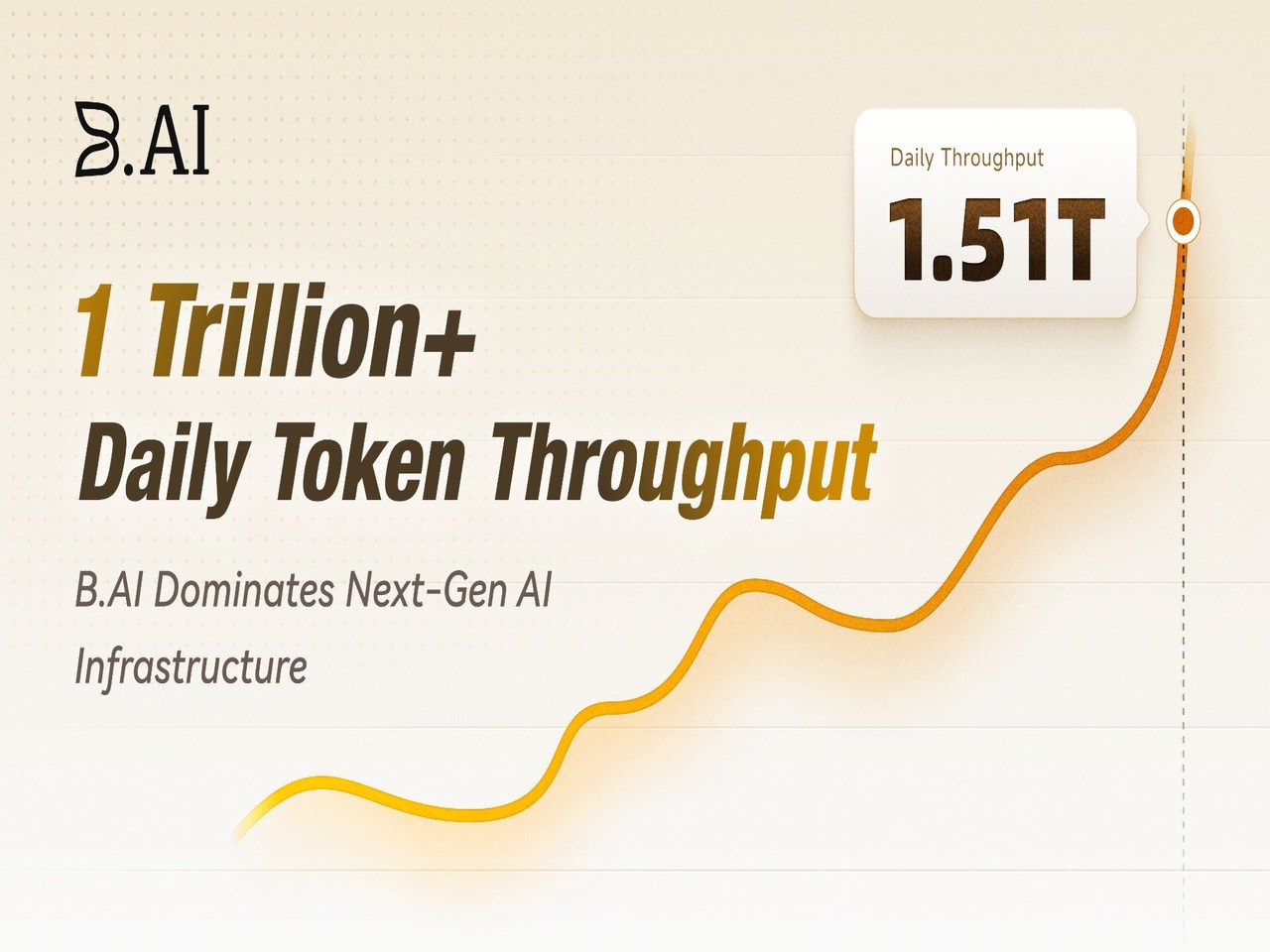
Positioned firmly at the critical intersection of foundational artificial intelligence models and autonomous software agents, B.AI has rapidly ascended to the forefront of the next-generation AI infrastructure stack. Barely five months after its initial market introduction, the platform has shattered preceding industry benchmarks, achieving a phenomenal daily throughput exceeding 1.51 trillion tokens. This astonishing milestone represents a more than 71,500-fold expansion from the platform’s initial launch metrics, illustrating a profound structural shift in how computational workloads, model aggregation, and decentralized economic settlements are managed on a global scale.
To contextualize the velocity of this expansion, B.AI accomplished in slightly more than 100 days what took early API aggregation pioneers, such as OpenRouter, approximately two years to build out. This exponential growth curve validates the platform’s comprehensive full-stack commercial strategy, proving that integrating high-performance compute routing directly with decentralized settlement networks can unlock unprecedented liquidity and operational efficiency. As the global artificial intelligence landscape transitions rapidly from human-prompted interactions to autonomous agent-to-agent economies, B.AI has cemented its role as an indispensable master ledger and distribution hub for machine intelligence.
The Genesis and Strategic Catalysts of B.AI’s Meteoric Rise
Co-incubated by prominent industry builders TRON and YZi Labs, B.AI was conceived to alleviate acute bottlenecks in global compute distribution and fragmented model accessibility. The platform’s early success stems primarily from its strategic alignment with two major macro trends reshaping the technology sector: the meteoric rise of highly cost-effective, high-performance Chinese large language models (LLMs), and the surging global demand for low-latency, high-throughput inference tailored for the emerging agentic era.
Over the past year, Chinese LLM developers—including DeepSeek, Alibaba’s Qwen, Zhipu AI’s GLM, Moonshot AI’s Kimi, and MiniMax—have achieved performance benchmarks that rival top-tier global proprietary models, yet at a fraction of the API invocation cost. This unprecedented cost-efficiency has made international adoption an economic imperative for global developers seeking to scale applications without incurring prohibitive operational expenditures. Capitalizing on this dynamic, B.AI positioned itself as an all-encompassing global gateway. By aggregating western foundation models like OpenAI’s GPT and Anthropic’s Claude alongside these rising eastern LLMs, the platform established a comprehensive model portfolio that serves as an immediate launchpad for international expansion.
Strategic partnerships with domestic giants such as Tencent, Alibaba, and ByteDance further solidified B.AI’s positioning. Specific models like DeepSeek-V4-Flash, Qwen3.8-Flash, and GLM-5.3 Flash emerged as dominant drivers of platform traffic, propelled by aggressive developer incentives including tiered pricing structures, temporary free access tiers, and volume-based discounts of up to 90 percent. Simultaneously, ecosystem partner YZi Labs acted as an intensive distribution engine, systematically onboarding early-stage web3 and AI projects to create a steady, compounding influx of commercial demand and real-world utilization.
Chronology of Growth and Milestone Metrics
The timeline of B.AI’s expansion highlights a hyper-accelerated trajectory rarely observed in enterprise software infrastructure:
- Launch Phase: B.AI debuts with a localized developer community and modest baseline routing capabilities, focusing on basic multi-model API aggregation.
- Days 1 through 50: Integration of initial Chinese LLM partners, accompanied by the rollout of aggressive tiered pricing and introductory zero-cost inference tiers, sparking exponential developer migration from legacy routers.
- Days 51 through 100: Strategic integration of foundational Web2 payment gateways alongside decentralized Web3 rails, bridging compute distribution with automated transaction settlement.
- Day 100 and Beyond: Daily token throughput breaches the 1.51 trillion mark, accompanied by the deployment of native runtime environments, toolchains, and transaction protocols designed explicitly for autonomous agent economies.
This calculated progression transformed B.AI from a standard multi-model traffic conduit into a primary commercial facilitator, effectively scaling the global reach of leading LLM providers while redefining international compute distribution standards.
Constructing a Closed-Loop Infrastructure for the Agent Economy
While front-end compute routing and API aggregation serve as vital growth catalysts, B.AI’s leadership recognized early that sustaining a multi-trillion-dollar agent economy requires addressing a more fundamental infrastructural deficiency: the absence of a closed financial and operational loop at the foundational layer.
In traditional paradigms, software systems route data and instructions while financial settlements occur asynchronously through legacy banking channels characterized by high friction, geographic restrictions, and settlement delays. In contrast, B.AI bridges models and autonomous agents by engineering a global settlement layer for intelligence. This architecture transforms the platform from a simple routing utility into the central master ledger for the entire agent ecosystem, ensuring that every cross-region API call, computational task allocation, and automated service exchange is precisely metered, securely verified, and instantly settled.
To execute this vision without alienating either traditional enterprise users or decentralized developers, B.AI deployed an innovative dual-track payment network. On the Web3 front, the platform leverages advanced on-chain settlement rails to provide global developers with decentralized, verifiable, and low-friction mechanisms capable of executing automated micropayments between autonomous agents. Simultaneously, the architecture maintains full backward compatibility with legacy Web2 enterprise gateways, including WeChat Pay, Alipay, UnionPay, and Visa. This dual-track approach ensures a frictionless capital flow, accommodating diverse regulatory jurisdictions and enterprise accounting requirements without sacrificing the speed necessary for high-frequency machine transactions.

The Strategic Integration of TRON’s Liquidity Rail
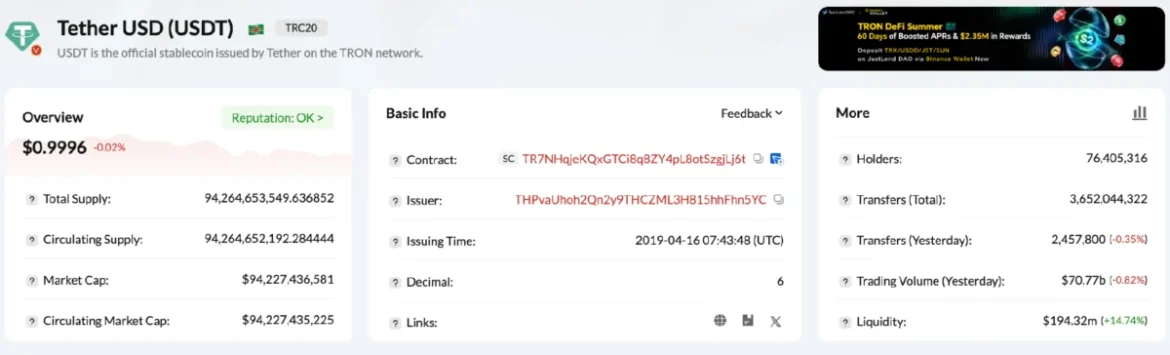
A cornerstone of B.AI’s decentralized settlement architecture is its deep integration with the TRON network. As the world’s largest stablecoin transfer network, TRON provides B.AI with a battle-tested, high-liquidity native payment rail centered around the massive Tether (USDT) ecosystem. With total TRC-20 USDT supply surpassing 94.2 billion, TRON offers the throughput, minimal latency, and negligible transaction fees required to sustain high-frequency automated agent micro-transactions and cross-border compute scheduling.
By embedding this financial rail directly into the computational infrastructure, B.AI eliminates the settlement friction that has historically hindered machine-to-machine commerce. Autonomous agents can now negotiate, contract, execute tasks, and settle financial obligations in fractions of a second, opening up entirely new commercial models in decentralized finance, automated research, and real-time enterprise logistics.
Full-Stack Runtime Environment for Autonomous Agents
Anticipating the inevitable maturation of agent-to-agent (A2A) collaboration, B.AI expanded its technical scope far beyond basic payment rails by deploying a dedicated, full-stack runtime environment for artificial intelligence agents. This holistic architecture is structured across three distinct operational layers:
-
The Scheduling Layer: B.AI enforces fine-grained compute allocation through a sophisticated tiered API system. This structure reshapes compute procurement logic, allowing developers to dynamically match specific business demands with optimal computational resources, thereby maximizing cost efficiency across heterogeneous hardware arrays.
-
The Execution Layer: The platform equips agents with direct operational capabilities to interact with the digital world. Through embedded toolchains such as Skills and Agent Wallet, alongside natively integrated AI assistants including BAIclaw and BAIcode, agents transition from passive conversational models into fully fledged digital workers capable of autonomous data acquisition, task execution, and multi-agent coordination.

-
The Protocol Layer: Perhaps its most strategically profound innovation, B.AI establishes foundational transaction standards for A2A commerce by natively integrating the x402 payment protocol and the 8004 identity authentication protocol. This standardization paves a clear, secure path for mutual trust, cryptographic identity verification, and automated settlement between disparate agent networks operated by independent entities.
Industry Implications and Future Outlook
The rapid ascent of B.AI and its crossing of the multi-trillion-token threshold signal a fundamental maturation point for the global artificial intelligence sector. Industry analysts observe that as foundation model commoditization accelerates, the true competitive advantage shifts away from raw model training toward the efficiency of distribution, orchestration, and economic settlement.
By seamlessly fusing perception, reasoning, action, and settlement into a unified, interoperable stack, B.AI is actively reshaping the global flow of compute value. The platform’s capacity to handle hyper-concurrency and micro-transactions at scale establishes a new baseline for what developers and enterprises should expect from foundational AI infrastructure. As autonomous agents transition from experimental novelties to core drivers of digital productivity, B.AI’s comprehensive architecture positions it as the foundational backbone for the machine-driven economy of the future.
