
In the rapidly evolving landscape of high-performance computing, the competition for power has become the primary metric by which infrastructure viability is measured. As of mid-October 2026, the industrial landscape is defined by a three-way tug-of-war between specialized ASIC miners for Zcash, high-end Bitcoin mining equipment, and the increasingly dominant NVIDIA H100 GPU clusters used for artificial intelligence workloads. At a standardized power cost of $0.08 per kilowatt-hour (kWh), the economic output of these machines varies drastically. While the NVIDIA H100 offers superior revenue per megawatt-hour, the capital expenditure requirements and the volatility of rental demand create a complex investment environment where specialized hardware like the Antminer Z15 Pro continues to hold a distinct edge in capital efficiency and payback timelines.
The Economics of Energy Allocation
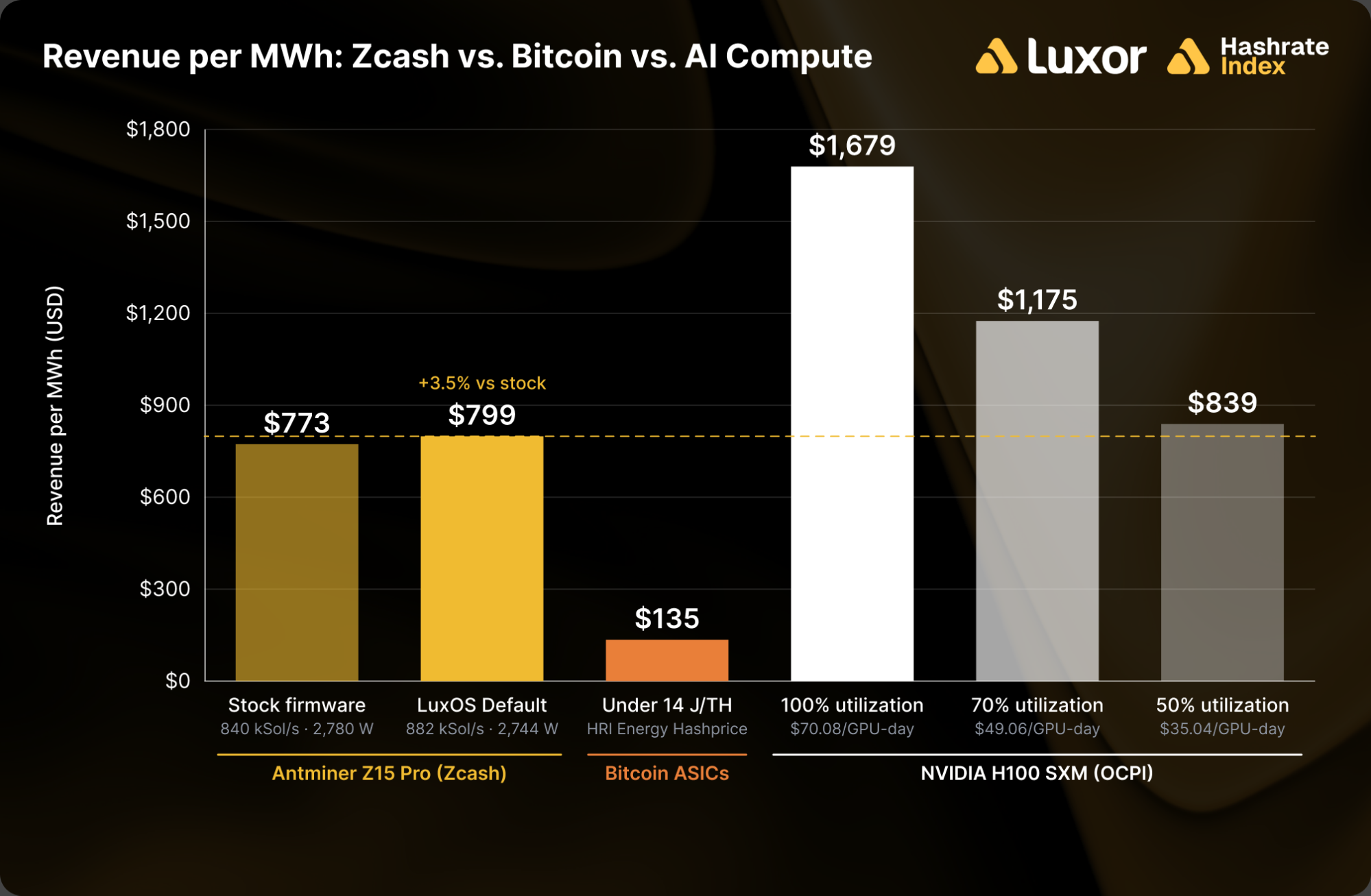
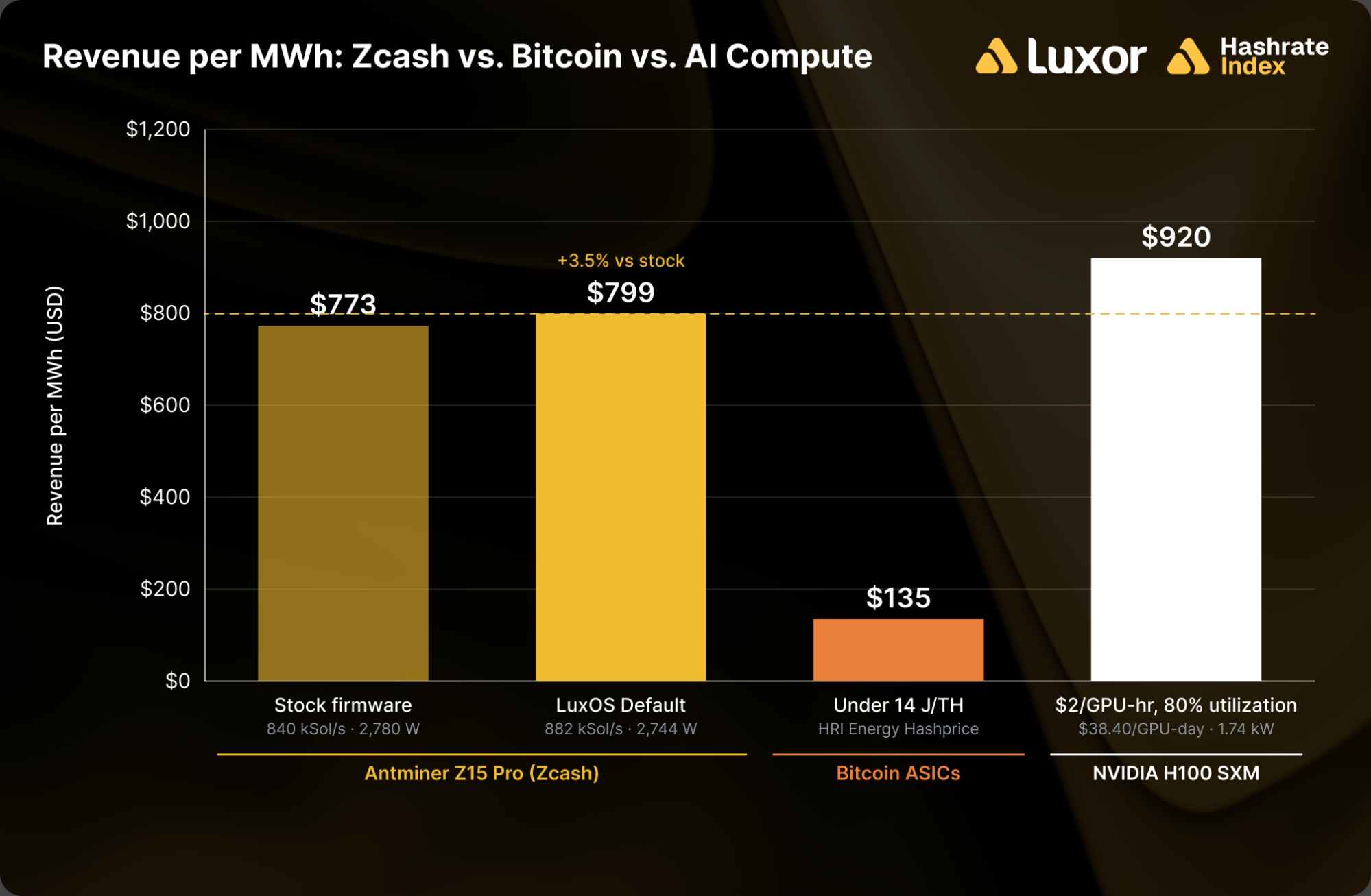
The fundamental denominator in the modern data center is the megawatt-hour (MWh). When analyzing hardware performance on October 13, 2026, the discrepancy in earning potential per unit of electricity became stark. An Antminer Z15 Pro, optimized for the Zcash (ZEC) network, generates approximately $770 in revenue per MWh at current market conditions—with ZEC priced at $1,185 and the network hashrate hovering near 27.8 GSol/s. By comparison, the most efficient Bitcoin ASICs currently on the market generate roughly $135 per MWh, highlighting the significant premium currently commanded by the Zcash mining ecosystem.
The outlier in this equation remains the NVIDIA H100 GPU. When fully utilized, a rented H100 produces roughly $1,680 per MWh—more than double the revenue of the Z15 Pro. However, this figure is highly sensitive to utilization rates. The profitability of the H100 is tethered to its rental occupancy; should utilization drop to 50%, the revenue per MWh falls to approximately $839, bringing it into direct competition with the Zcash mining hardware. This cross-over point, occurring at roughly 46% to 48% utilization, serves as a critical threshold for data center operators deciding whether to pivot infrastructure toward AI inference and training or maintain traditional cryptocurrency mining operations.
Chronology of the Zcash Mining Surge
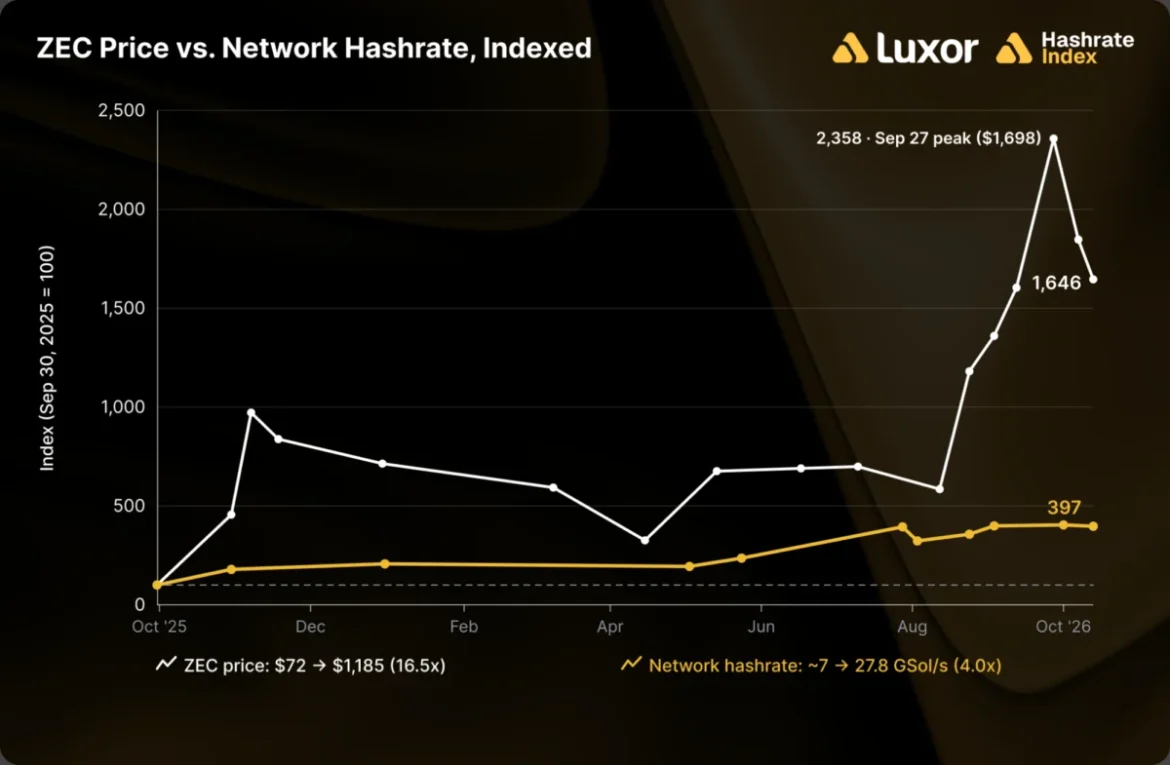
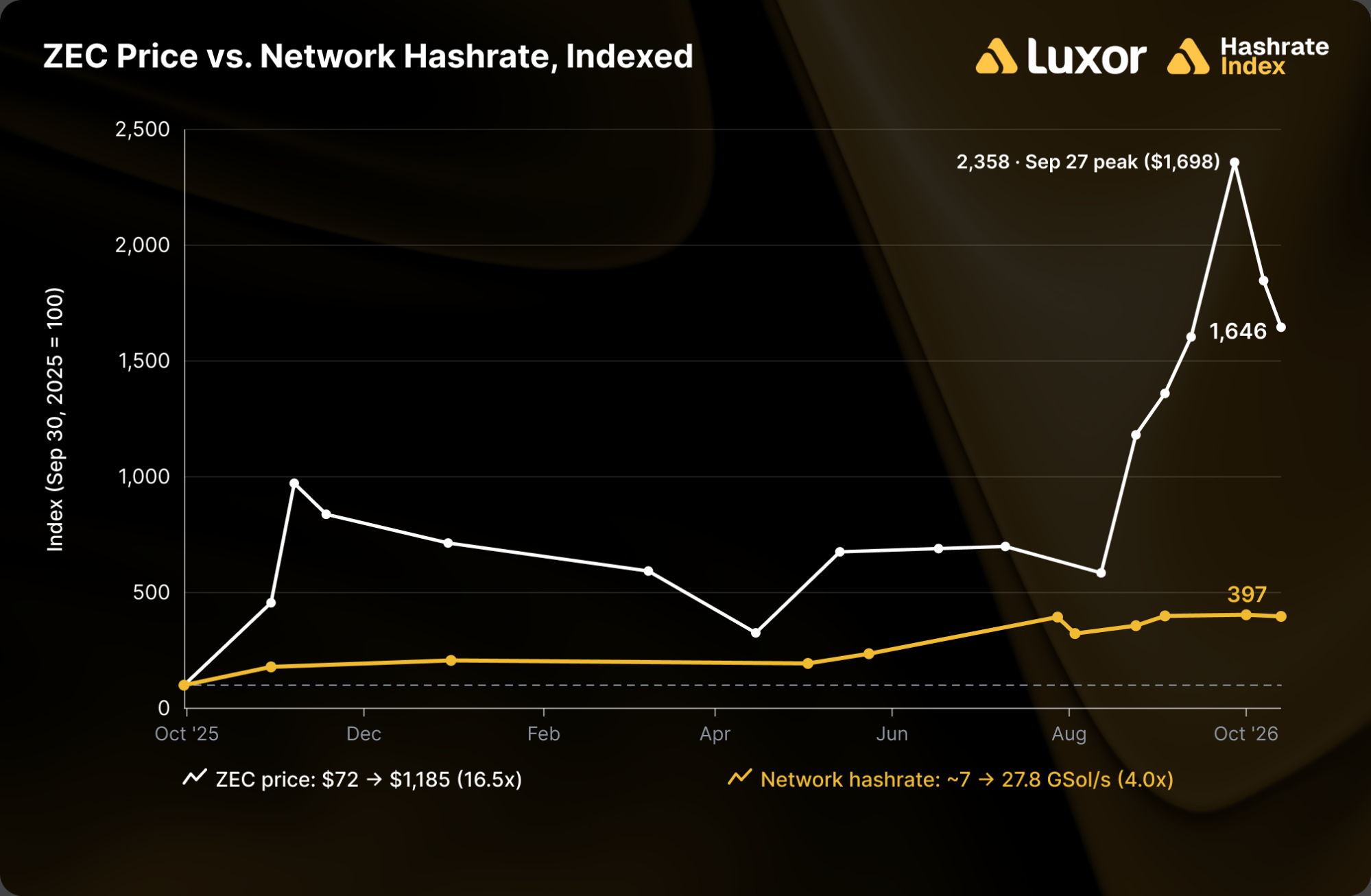
The rise of Zcash mining as a lucrative alternative to Bitcoin mining has been a gradual process punctuated by intense volatility over the last twelve months. Since September 2025, the Zcash network has experienced a nearly 4x increase in hashrate, rising from approximately 7 GSol/s to current levels of 27.8 GSol/s. This surge was catalyzed by a massive appreciation in the underlying asset price, which climbed from $72 in late 2025 to a peak of approximately $1,698 in late September 2026.
Despite the recent 30% pullback from those highs, the ecosystem remains robust. Hashrate growth has consistently lagged behind price appreciation, allowing early adopters and those with established fleets to maintain high margins. The network currently consumes approximately 90 MW of power, equivalent to the draw of 33,000 Antminer Z15 Pro units. As of October 2026, the supply of specialized hardware remains the primary bottleneck; Bitmain’s next generation of Equihash-compatible ASICs is not slated for release until the second quarter of 2027, leaving the market in a state of hardware scarcity that preserves the profitability of current-generation machines.
Capital Intensity: The Hidden Variable
While the H100 wins the battle of revenue per unit of energy, the capital expenditure (CAPEX) requirements tell a different story. A megawatt of Zcash mining capacity, consisting of roughly 360 Antminer Z15 Pro units, requires an investment ranging from $3.2 million to $5.8 million, depending on the secondary market cost of the units. Conversely, a megawatt of H100 capacity requires approximately 575 GPUs, with the total hardware and Tier-3 facility infrastructure costs reaching between $18 million and $23 million for new units.
This disparity in capital intensity means that the Z15 Pro achieves a full return on investment in as little as 6 to 11 months under current conditions. The H100, while generating higher gross daily profit per unit, requires a significantly longer duration to amortize the initial multi-million-dollar facility and hardware investment. This makes Zcash mining an attractive proposition for operators who prioritize shorter cash-recovery windows over the potentially higher, yet more volatile, upside of AI-focused cloud compute services.
Firmware and Optimization Strategies
In the absence of new silicon, the mining industry has turned to firmware optimization to squeeze additional performance from existing hardware. On October 1, 2026, Luxor introduced Z15 Pro support for its LuxOS firmware, providing operators with tuning profiles similar to those used in the Bitcoin mining sector.
Performance testing indicates that the "Default" tuning profile offers the most efficient balance, providing a 5% increase in hashrate while reducing power consumption by 1%. This configuration improves revenue per MWh from $773 to $799. While more aggressive overclocking profiles exist—capable of pushing hashrate up by 18%—they come at the cost of significantly higher power draw. For operators in regions with electricity costs exceeding $0.15/kWh, these aggressive profiles may prove counterproductive, as the marginal revenue gained is offset by the exponential increase in energy expenditure.
The Competitive Landscape and Market Implications
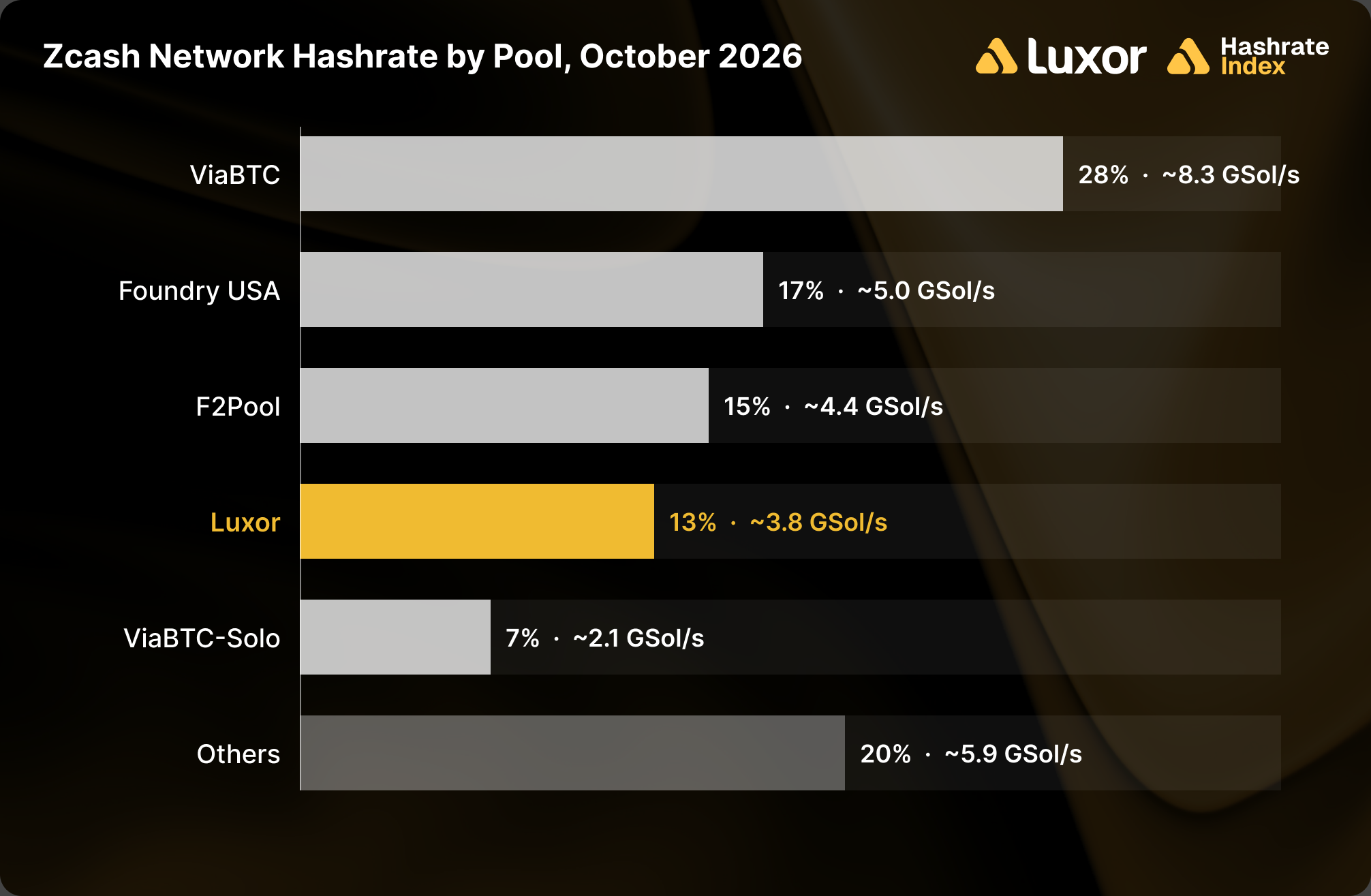
The current Zcash mining market is characterized by a high degree of centralization, with six major pools controlling roughly 80% of the network hashrate. ViaBTC leads the sector with a 28% share, while operators like Cypherpunk Technologies maintain a significant footprint at approximately 15% of the network. The constant dilution of hashrate share serves as a testament to the aggressive expansion of the network; even as operators keep their machines online, the influx of new hardware continuously pushes the network difficulty upward.
For institutional investors and facility operators, the choice between Bitcoin, Zcash, and AI compute is no longer a simple matter of choosing the most profitable asset. It is an exercise in risk management. The "mullet mining" strategy—the practice of running different types of compute on the same site—is becoming increasingly prevalent as a hedge against the volatility of AI rental demand and the cyclical nature of cryptocurrency markets.
Future Outlook and Sector Consolidation
Looking ahead to 2027, the market is expected to remain supply-constrained. With the next generation of Equihash ASICs not arriving until the second quarter, the current fleet of Z15 Pro units will remain the backbone of the Zcash network. The primary risk to this model is a further reduction in the block reward or a sustained decline in the price of ZEC. However, even if the ZEC price were to drop significantly, the current power break-even point for the Z15 Pro—approximately $0.77/kWh—provides a massive cushion compared to Bitcoin miners, which are far more sensitive to fluctuations in energy costs and network difficulty.
In conclusion, the competition for compute is multifaceted. The NVIDIA H100 dominates in high-revenue AI environments where energy efficiency and top-line performance are paramount. However, for the industrial miner, the Zcash ASIC remains a superior tool for capital preservation and rapid payback. As the industry matures, the ability to pivot between these hardware profiles—or to run them in tandem—will likely become the defining factor for the long-term survival and profitability of data center operators globally. The era of "monoculture" mining is ending, replaced by a sophisticated, multi-asset strategy designed to extract the maximum value from every available megawatt of power.
