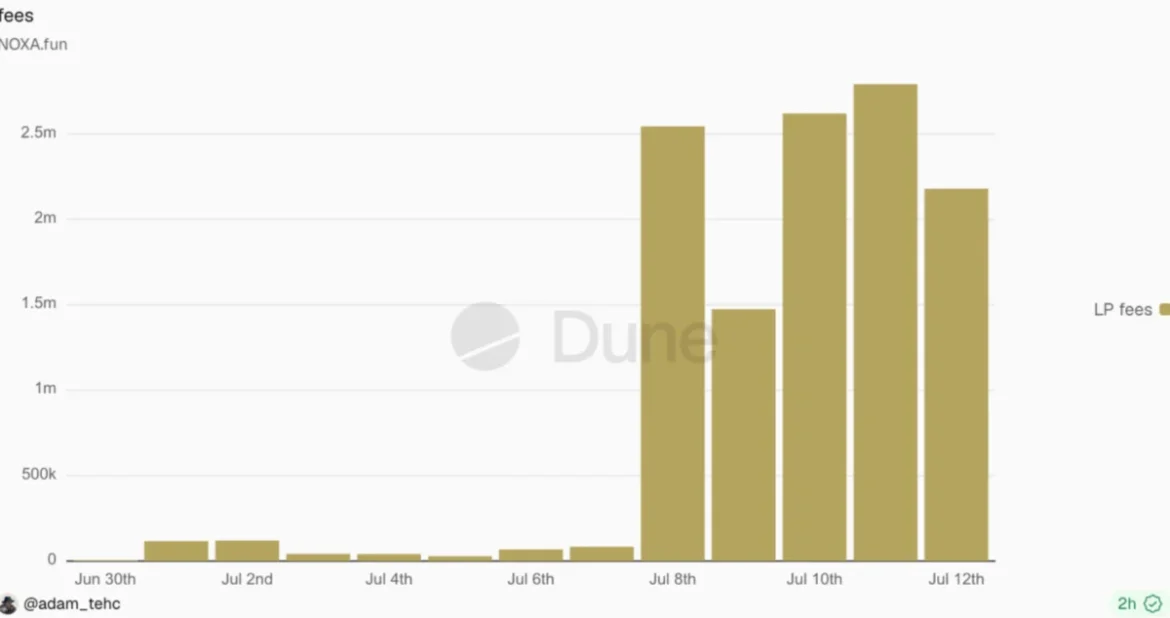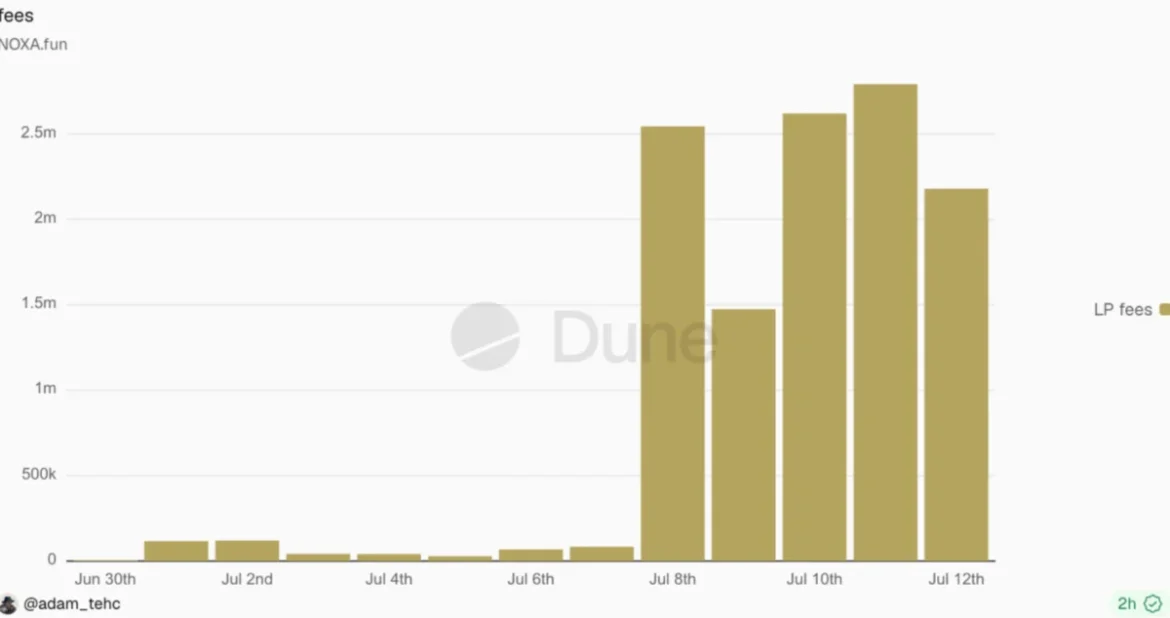
The nascent Robinhood Chain ecosystem, which recently emerged as a formidable contender in the decentralized finance (DeFi) landscape, is currently grappling with its first major systemic crisis. Noxa, the dominant launchpad responsible for the vast majority of the network’s speculative activity, abruptly ceased its operations on July 11, 2026. The platform’s departure comes after an unprecedented two-week period during which it generated more than $12 million in protocol fees, a figure that briefly positioned it as the most profitable launchpad in the entire cryptocurrency industry. This sudden exit has sent shockwaves through the market, resulting in a sharp contraction in trading volume and a significant devaluation of the chain’s flagship assets.
The Rise and Dominance of the Noxa Engine
When Robinhood Chain officially went live on July 1, 2026, it was positioned by its parent company as a high-performance, low-cost environment primarily intended for the tokenization of real-world assets (RWAs). However, as is common with high-throughput blockchains, the initial liquidity was driven almost exclusively by the memecoin sector. Noxa emerged as the central infrastructure for this boom.
Functioning as a fair-launch platform similar to Solana’s Pump.fun, Noxa allowed users to deploy tokens with minimal technical expertise and zero upfront liquidity. Its user-friendly interface resonated with the retail-heavy demographic of the Robinhood ecosystem. Within its short operational lifespan, Noxa facilitated the launch of over 60,000 unique tokens, accounting for approximately 75% of all token deployments on the Robinhood Chain.
The platform’s growth was so explosive that it achieved a cumulative decentralized exchange (DEX) volume of $4 billion in less than fourteen days. For five consecutive days leading up to its shutdown, Noxa’s daily protocol fees surpassed those of Pump.fun, a record-breaking feat that underscored the massive migration of speculative capital to the Robinhood-backed network. At its peak, Noxa was not merely a service provider; it was the primary economic engine of the chain.
Chronology of a Sudden Collapse
The timeline of Noxa’s ascent and subsequent disappearance highlights the volatility inherent in launchpad-driven ecosystems. The chain’s momentum was bolstered on July 8, when Robinhood CEO Vlad Tenev declared on social media that "Robinhood Summer is here," signaling official confidence in the network’s trajectory.
However, the euphoria was short-lived. On July 11, Noxa’s management team issued a statement halting all new token launches. The initial reason provided was the need to combat "bot spam" and an "overwhelming flood of low-quality tokens" that they claimed were degrading the user experience. While some viewed this as a responsible move to curate the ecosystem, others grew suspicious of the timing, given the platform’s massive fee accumulation.
By July 13, the situation escalated when the Noxa website went dark. The team initially blamed the outage on a technical issue with Cloudflare. Shortly thereafter, the platform made an unusual announcement: they would redirect 100% of ongoing trading fees from existing tokens to the original token creators. This move was interpreted by market analysts as a definitive exit strategy, with the platform effectively walking away from its primary revenue stream while leaving the infrastructure in a state of abandonment.
The contagion spread quickly. Rival platform Vlad.fun, which had attempted to capture the overflow of users from Noxa, also ceased operations just days later. The Vlad.fun team cited "internal integrity issues," a vague explanation that further eroded investor confidence and sparked fears of a coordinated "soft rug" across the chain’s primary gateways.
Market Impact: The Fall of CASHCAT and Ecosystem Tokens
The most immediate casualty of the Noxa shutdown was CASHCAT, the flagship memecoin of the Robinhood Chain. CASHCAT had served as a bellwether for the network’s health, reaching a peak market capitalization of $226 million. The token had attracted 267,642 unique wallets, representing the largest retail participation for a single asset on the chain.
Following the news of Noxa’s closure, CASHCAT’s value plummeted, shedding more than 33% within a 24-hour window. The selloff was not isolated to CASHCAT; other prominent ecosystem tokens such as FOX and HOODIE, which had posted triple-digit gains in the preceding week, saw their liquidity dry up as traders rushed to exit positions.
Data indicates that DEX volume on the Robinhood Chain peaked at $878 million on July 12, just as the Noxa crisis began to unfold. Since then, volumes have steadily declined. While the network’s Total Value Locked (TVL) has remained relatively stable near the $200 million mark, the composition of that liquidity is now under scrutiny. The departure of the primary launchpad has left a vacuum that secondary platforms like flap.sh, trensh.today, and bankr are struggling to fill. While a new platform named Pons has attempted to step in, it currently lacks the brand recognition and historical track record required to restore the momentum seen during the "Noxa era."
Analyzing the "Soft Rug" Accusations and Platform Integrity
The crypto-community remains divided over the motivations behind Noxa’s exit. On social media platforms like X (formerly Twitter), a significant contingent of investors has labeled the move a "soft rug." This term refers to a situation where developers do not necessarily steal user funds directly but abandon a project after extracting maximum value—in this case, the $12 million in fees—thereby leaving the community with depreciating assets and no support infrastructure.
Conversely, some market participants, including prominent trader 0xAvast, have dismissed the panic as "irrelevant FUD" (Fear, Uncertainty, and Doubt). These proponents argue that the shutdown was a necessary step to prevent the chain from being completely overrun by automated bots and fraudulent "rug-pull" tokens that were being launched at a rate of thousands per hour.
The decision to redirect fees to creators is particularly polarizing. Proponents see it as a gesture of goodwill toward the builders who contributed to the chain’s early success. Skeptics, however, view it as a legal maneuver designed to distance the Noxa team from the ongoing trading of tokens that could potentially be classified as securities or fall under regulatory scrutiny.
The Divergence Between Speculation and Utility
The Noxa episode has brought a glaring disparity in the Robinhood Chain’s development to the forefront. When the chain was conceived, the primary value proposition was the integration of tokenized real-world assets. However, current data reveals that RWA market capitalization on the network stands at a mere $12.66 million.
At its height, the market cap of the CASHCAT memecoin alone was more than twelve times the size of the entire RWA sector on the chain. This imbalance highlights a recurring theme in the blockchain industry: while institutional-grade utility is the long-term goal, short-term network activity is often driven by high-risk speculation. The collapse of Noxa demonstrates the danger of an ecosystem becoming overly reliant on a single, speculative vertical.
Robinhood’s strategic position is now at a crossroads. The chain had successfully flipped Coinbase’s "Base" network to become the number two chain on Uniswap by deployment volume, a milestone achieved largely through Noxa’s integration. With that engine now gone, the network must prove it can attract sustainable liquidity that is not dependent on the "hyper-growth" tactics of a single launchpad.
Broader Implications for Exchange-Backed Blockchains
The events surrounding Noxa serve as a cautionary tale for the burgeoning sector of exchange-backed blockchains. As more traditional finance (TradFi) and fintech companies launch their own proprietary networks, they face the challenge of balancing decentralized permissionless innovation with the need for platform integrity.
For investors, the Noxa shutdown is a reminder of "infrastructure risk." In many modern DeFi ecosystems, the value of a token is inextricably linked to the platform that launched it. When a dominant launchpad ceases to function, it does not just stop new tokens from being created; it destroys the social and technical coordination that provides liquidity and visibility to existing assets.
As of mid-July 2026, the Robinhood Chain remains operational, and its underlying technology continues to process transactions. However, the "Robinhood Summer" has been cooled by a harsh reality check. The focus now shifts to whether the network can pivot toward its original goal of RWA tokenization or if it will remain a ghost town of abandoned memecoins.
The exit of Noxa, while financially lucrative for its founders, has left a stain on the early reputation of the Robinhood Chain. For the ecosystem to recover, it will likely require a move away from launchpad-dependent growth and toward a more diversified array of decentralized applications. Until then, the $12 million fee haul remains a stark symbol of the rewards—and the risks—of the modern memecoin gold rush. Investors are advised to exercise extreme caution and perform rigorous due diligence on the underlying infrastructure of any chain before committing significant capital to high-volatility assets.