
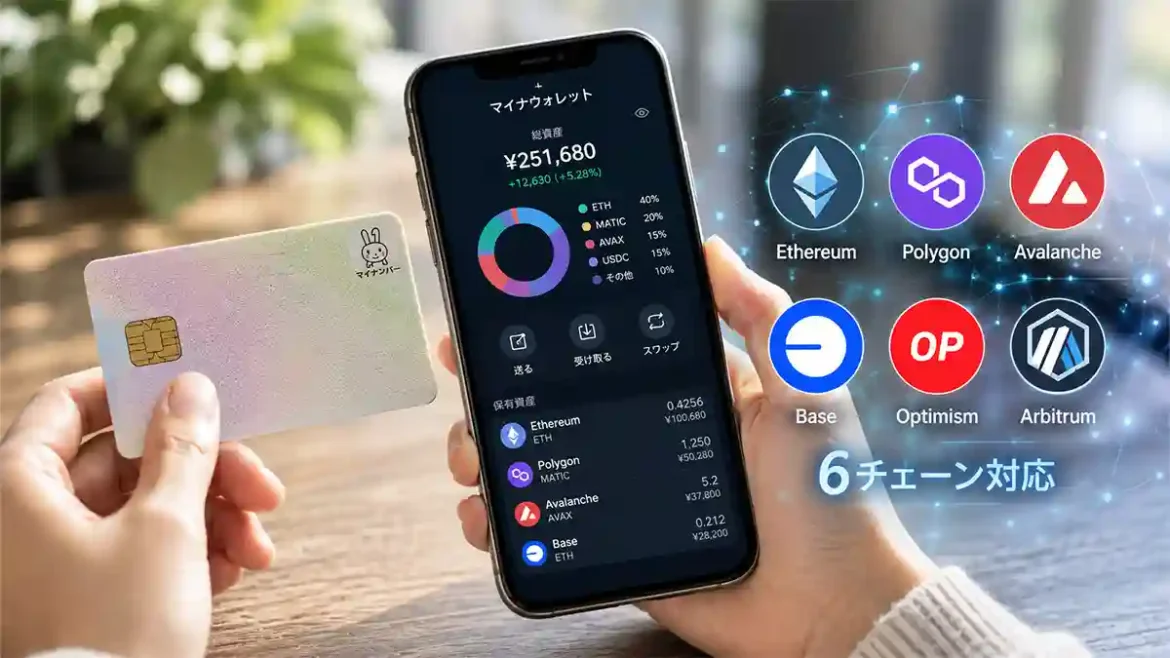
MynaWallet Inc. officially announced the general release of its innovative digital asset wallet application, MynaWallet, on July 21, 2026, marking a significant milestone in the integration of national identification infrastructure with decentralized finance. Available for download on both the Apple App Store and Google Play, the application leverages Japan’s "My Number Card" system to provide a streamlined, secure gateway for users to manage stablecoins, cryptocurrencies, and non-fungible tokens (NFTs). By utilizing the Near Field Communication (NFC) capabilities of modern smartphones, the app allows users to perform identity verification and execute transactions through a simple physical tap of their government-issued ID card, effectively lowering the barrier to entry for blockchain technology across all age demographics in Japan.
The launch comes at a pivotal moment for the Japanese digital economy, as the government continues to push for "on-chain finance" as a core pillar of its national growth strategy. MynaWallet distinguishes itself by being a non-custodial wallet—meaning users retain full control over their private keys—while simultaneously offering a user experience that mimics the simplicity of traditional fintech apps. The integration of the Public Key Infrastructure (JPKI) stored on the My Number Card’s IC chip ensures that the wallet meets rigorous security and "Know Your Customer" (KYC) standards without the cumbersome manual processes typically associated with opening digital asset accounts.
Technical Innovation: JPKI and Account Abstraction
At the core of MynaWallet’s functionality is the sophisticated use of the Japanese Public Key Infrastructure (JPKI). When a user taps their My Number Card against their smartphone, the app accesses the electronic certificate stored on the card’s IC chip to verify the user’s identity. This method provides a higher level of security than traditional photo-based ID verification, as it relies on encrypted government hardware rather than visual inspection.
Furthermore, MynaWallet incorporates "Account Abstraction," a technical standard based on the Ethereum Improvement Proposal (EIP-4337). This technology allows the wallet to function as a smart contract rather than a simple pair of cryptographic keys. For the end-user, this translates to several high-utility features that have historically been missing from the Web3 ecosystem:
- Rapid Onboarding: Users can set up a fully functional, secure wallet in as little as 60 seconds by combining the JPKI verification with "Passkeys"—a biometric authentication method (such as FaceID or fingerprint scanning) that eliminates the need for users to memorize or store complex 12-word seed phrases.
- Social and ID-Based Recovery: One of the greatest risks in the crypto space is the loss of access to one’s wallet. MynaWallet addresses this by allowing users to recover their accounts using their My Number Card. If a device is lost or a passkey is compromised, the user can re-verify their identity using their physical ID card to regain control of their digital assets.
- Sponsored Transactions: Traditionally, every blockchain transaction requires "gas" (a fee paid in the network’s native token). MynaWallet utilizes a "Paymaster" system allowed by EIP-4337, where the company or a third-party sponsor can cover these fees. MynaWallet Inc. has stated that for basic usage within certain limits, they will subsidize gas fees, allowing users to send and receive assets without needing to hold a balance of native tokens like Ethereum (ETH) or Polygon (POL).
A Chronology of Development and Strategic Partnerships
The general release of MynaWallet is the culmination of years of research and pilot programs aimed at bridging the gap between public infrastructure and private blockchain innovation. In September 2023, the project gained international recognition when it was selected for the "ERC-4337 Account Abstraction Grant Round" by the Ethereum Foundation. This grant provided the necessary resources to develop the recovery and gas-less transaction mechanisms that are now central to the app.
Following the research phase, MynaWallet Inc. entered into a strategic partnership with Mitsui Sumitomo Card in January 2026. This collaboration focused on a "Tap-to-Pay" verification trial using the JPYC stablecoin—a digital currency pegged to the Japanese Yen. The trial successfully demonstrated that the My Number Card could be used not just for identity, but as a trigger for instant, compliant blockchain payments in a retail environment.
The current 2026 launch supports six major Ethereum-compatible (EVM) chains. While the company has not listed all six in the initial announcement, the architecture is designed for multi-chain interoperability, allowing users to track their asset history and balances across different ecosystems within a single interface. The company has confirmed plans to progressively add more supported chains and assets based on user demand and regulatory approvals.
Government Alignment: The "Honebuto" Policy and Beyond
The timing of MynaWallet’s release is closely aligned with the Japanese government’s "Basic Policy on Economic and Fiscal Management and Reform 2026," often referred to as the "Honebuto" (Big-Bones) policy. Approved by the Cabinet on the same day as MynaWallet’s launch, the 2026 policy explicitly includes the "promotion of on-chain finance" as a national growth strategy.
The government’s vision involves the widespread adoption of tokenized deposits and stablecoins to modernize the payment landscape and improve the efficiency of financial transfers. By utilizing the My Number Card—which has now been issued to over 100 million citizens—MynaWallet provides the necessary hardware-software link to make this policy a reality for the average person.
In the public sector, MynaWallet is being positioned as a tool for local governments. Potential use cases include the distribution of digital regional currencies and the direct payout of government subsidies via stablecoins. Because the wallet is tied to a verified national ID, it ensures that government funds are delivered accurately to the intended recipients, reducing administrative overhead and preventing fraud.
Real-World Applications: The Lawson Pilot and MynaPay
The utility of MynaWallet is already being tested in the retail sector. Starting in early August 2026, the major convenience store chain Lawson will begin a pilot program at its "Takanawa Gateway City" location in Minato-ku, Tokyo. This trial will allow customers to use JPYC stablecoins for over-the-counter purchases.
MynaWallet Inc. is also developing a dedicated payment service called "MynaPay." This service will support both QR code payments and NFC "Tap" payments. The goal of MynaPay is to create a seamless bridge between a user’s digital asset holdings and their daily spending habits. For merchants, this system offers the potential for lower transaction fees compared to traditional credit card networks and instant settlement via stablecoins.
Broader Impact and Market Implications
The launch of MynaWallet represents a paradigm shift in how digital assets are perceived in Japan. For years, the sector was hampered by complex user interfaces and security concerns that alienated non-technical users. By integrating the national ID card, MynaWallet effectively "normalizes" crypto assets, treating them as another component of a citizen’s digital life, alongside their health insurance and tax information.
Industry analysts suggest that this integration could lead to a surge in Web3 participation among the elderly and younger populations. The elderly, who may struggle with the complexities of private key management, can now rely on a familiar physical card for security. Conversely, younger users benefit from a mobile-first, "gas-less" experience that feels as intuitive as popular social media or payment apps.
However, the success of MynaWallet will depend on continued trust in the My Number system and the robustness of the underlying blockchain networks. While the non-custodial nature of the wallet protects users from exchange-level collapses (like the FTX incident of 2022), it still requires users to maintain the physical security of their ID card and their smartphone.
As MynaWallet Inc. moves forward, the company plans to expand its ecosystem by inviting third-party developers to build decentralized applications (dApps) that can interact with the MynaWallet identity layer. This could lead to a new generation of "verified" dApps for voting, healthcare, and secure communications, all anchored by the security of Japan’s national identity infrastructure.
The release of MynaWallet is not merely the launch of a new app; it is the implementation of a sophisticated financial infrastructure that could serve as a global blueprint for how sovereign nations can integrate decentralized technologies into the daily lives of their citizens. With the support of both the central government and major financial institutions, MynaWallet is poised to become the definitive "super-app" for the Japanese Web3 era.
