
The global cryptocurrency landscape continues to be heavily shaped by North American developments, retaining its status as the world’s most influential regional market through the 12-year reporting period ending July 1, 2026. Backed by the deep capital reserves of U.S. investors, evolving legislative frameworks, the widespread integration of stablecoins as a preferred digital currency, and traditional financial institutions bridging the gap into on-chain assets, the region dictates global digital asset trends. According to recent data tracking global economic power, the United States and Canada jointly topped the unweighted crypto-economic index. Their combined digital asset economies totaled $3.02 trillion during the 2026 reporting period, marking a modest 1.9% contraction compared to the previous year.
This slight regional downturn was primarily driven by a domestic slowdown within the United States. The U.S. crypto economy, valued at $2.78 trillion, experienced a 2.2% period-over-period decline—an outcome industry experts viewed as unsurprising given the prevailing market conditions. Despite a challenging bear market environment, the world’s largest single crypto economy successfully retained nearly all of the explosive, near-doubling growth it achieved during the 2025 reporting cycle. Institutional catalysts, notably the maturation and proliferation of spot crypto exchange-traded funds (ETFs), accelerating real-world asset tokenization, and the massive scaling of stablecoins, provided a solid financial floor that protected these previous gains.
Industry leaders attribute this shift to structural maturation rather than stagnation. Hoolie Tejwani, Head of Coinbase Ventures, emphasized that the underlying infrastructure laid during 2025 successfully transitioned into practical applications featuring active users, deep liquidity, and thriving markets by mid-2026. This chapter of digital asset evolution highlights a trio of U.S.-developed financial products driving heavy domestic and international engagement: artificial intelligence-driven commerce, stablecoins, and tokenized assets, all of which underscore America’s outsized footprint on the global economy. Concurrently, the Canadian market demonstrated remarkable resilience, resisting the broader regional downtrend with a 2.3% expansion, bringing its total crypto economy to approximately $250 billion, heavily influenced by its unique demographic and remittance trends.

The United States Leads the Emerging AI On-Chain Economy
The global race for artificial intelligence development has begun to permeate every major economic sector, with cryptocurrency proving to be no exception. To understand how automated software is reshaping financial rails, researchers closely monitored x402, one of the most prominent digital payment protocols designed specifically to allow autonomous AI agents to execute financial transactions independently.
Autonomous software has officially entered the era of on-chain spending, with the United States acting as the primary epicenter for development. Cornerstone American crypto enterprises—such as Circle, the issuer of the dominant USD Coin (USDC) utilized by digital agents, and Coinbase, the creator of the x402 architecture—have aggressively supported this nascent ecosystem. Institutional giants are also taking notice; Will Su, Head of Digital Assets Research at BlackRock, noted that the firm is closely observing agentic commerce due to its potential to generate meaningful, round-the-clock demand for frequent, low-value micro-transactions.
By the close of the 2026 reporting period, cumulative activity on Base—the leading blockchain for agentic commerce—surpassed 138 million transactions executed via the x402 protocol. On-chain infrastructure enables economic activity that is structurally impossible on legacy financial rails. Traditional credit card networks cannot profitably process sub-dollar transactions, let alone payments worth a fraction of a cent, due to high flat-rate processing fees and interchange minimums. Conversely, stablecoin settlements that cost less than a single cent to execute make it economically viable for machines to spend tiny amounts of capital instantaneously. This technological leap unlocks an entirely new market for pay-as-you-go digital services, such as purchasing targeted data retrievals through automated API calls.

Circle characterizes this structural shift as a clean division of labor: traditional card rails remain optimized for consumer-prompted, human-initiated payments, while stablecoin rails dominate machine-to-machine settlements that fall well below the economic viability threshold of credit card networks. Data from the 16-month observation window ending September 2026 reveals that the overwhelming majority of x402 activity consists of micropayments. Over 87% of all recorded payments ranged between one-hundredth of a cent and ten cents, with the highest concentration occurring in the one-to-ten-cent bracket.
AI Payments Demonstrate Growing Stickiness and Purposeful Adoption
While agentic commerce remains largely in its experimental phase, clear indicators point toward rapid maturation. Early deployments of the x402 protocol were characterized by speculative, one-off users who engaged briefly with digital asset trading before abandoning their wallets once initial funds were depleted. However, behavioral analytics show this dynamic is rapidly changing as automated systems and developers embed recurring utility into the ecosystem.
Wallet retention metrics illustrate a deepening commitment from users. When grouping wallets by the quarter in which they were initially funded, the proportion that received a secondary funding injection within 30 days climbed dramatically. For wallets funded in the third quarter of 2025, the 30-day top-up rate stood at 70.6%; by the second quarter of 2026, that figure rose to 89.3%. In the blockchain ecosystem, topping up a depleted wallet functions identically to a software subscription renewal. By filtering out single-use experimenters and counting only wallets that broadcast transactions across two or more separate days, researchers confirmed that users consistently find sufficient utility in x402 to maintain active balances.

Furthermore, x402 users have grown increasingly purposeful in their deployment of capital. The temporal gap between a wallet’s seed funding and its initial protocol expenditure has compressed significantly. In late 2025, newly funded wallets maintained a median age of 73 days before executing their first x402 transaction. By the third quarter of 2026, that duration plummeted to a mere 18 minutes. Concurrently, the share of wallets executing a payment within their first hour of funding surged from 4% in Q3 2025 to 67% in Q3 2026. This temporal compression confirms that modern wallets are intentionally provisioned for immediate, task-specific agentic commerce rather than speculative value-parking.
What AI Agents Are Buying On-Chain
As agentic commerce shifts from ephemeral memecoin experimentation to robust utility, AI models are increasingly acquiring machine-readable knowledge and computational resources on-chain. Millions of transactions now flow autonomously from AI wallets into specialized information services, including automated code review, advanced financial intelligence, and enterprise-grade data and search APIs.
Beyond raw data, autonomous software regularly allocates funds toward gaming infrastructure, automated token issuance, gambling services, developer frameworks, and specialized agentic tooling. Significantly, one of the largest expenditure categories on the x402 protocol is model inference, meaning AI agents are effectively purchasing computational intelligence from other AI systems.

The United States Dominates AI-to-AI Commerce Globally
Geolocated data confirms that American-funded AI agents far outpace their international counterparts in interacting with x402 services. The United States captures approximately 30% of all geolocated agent-to-service transactions globally. A closer examination of input-heavy sectors reveals even starker American dominance: U.S.-linked wallets account for 88.1% of all geolocated AI model inference transactions, 41.8% of payments directed toward agent frameworks and tool catalogs, and 23.2% of payments fueling data and search APIs.
In contrast, Chinese-attributed wallets display a distinct specialization pattern, heavily concentrating in the security and code analysis sector. Approximately 90% of transactions directed toward security and smart-contract auditing services—such as AgentLISA, an automated model designed to audit Solidity code—originated from Chinese-linked infrastructure. Chinese operators also command substantial market shares in financial intelligence (46.7%) and settlement rails (35%). However, Chinese-funded AI agents accounted for a negligible 0.1% of global model inference payments.
This stark disparity highlights the intersection of economic reality and AI nationalism. The Chinese domestic market readily embraces locally developed open-weight models, led by DeepSeek and Qwen, which are largely free to deploy. Conversely, American markets rely heavily on metered, proprietary models such as OpenAI’s ChatGPT and Anthropic’s Claude. Consequently, the commercial market for machine-bought intelligence naturally thrives where proprietary utility requires metered, per-transaction settlement rails.

From a regulatory and compliance perspective, machine-speed transactions present unique surveillance challenges that legacy banking frameworks cannot accommodate. Individual micropayments occur too rapidly and frequently to serve as traditional compliance checkpoints. Instead, effective oversight must shift from screening individual transactions to evaluating the initial funding event, reviewing human-authorized budget allocations, and monitoring the behavioral patterns of known receiving counterparties. Regulatory models failing to adapt to machine-speed parameters risk either stifling innovation or remaining entirely blind to on-chain commerce.
The United States Imports Digital Gold While Exporting Digital Dollars
The mid-2025 legislative passage of the GENIUS Act formally codified what global digital asset markets already understood: the United States stands as the world’s preeminent exporter of digital dollars. Driven by stablecoins, U.S. sovereign debt has effectively become the base currency of choice for cross-border businesses and peer-to-peer economies alike. Throughout the 2026 reporting period, stablecoin utility expanded rapidly abroad, generating billions of dollars in economic activity that directly benefits U.S. financial institutions and bolsters macroeconomic demand for government debt.
While the U.S. successfully exports digital dollars, it simultaneously acts as a primary net importer of Bitcoin. Following the landmark introduction of spot Bitcoin exchange-traded funds in January 2024, the U.S. share of global Bitcoin activity has climbed steadily across successive reporting periods. Meanwhile, stablecoins occupy a proportionately smaller share of domestic American crypto activity compared to offshore jurisdictions, with the disparity widening over time.

Institutional capital allocation heavily favors Bitcoin as an alternative monetary asset amid historic global sovereign debt accumulation and inflationary pressures. Will Su of BlackRock noted that institutional interest in Bitcoin remains robust, driven by global macroeconomic conditions. Cross-border transaction metrics confirm a structural pivot: the United States became a net importer of Bitcoin in 2026 for the first time since 2022. While retail transfers valued under $10,000 remained net outbound, institutional-grade transfers over $10 million experienced massive net inflows, with the highest bracket alone accounting for over 53,200 accumulated coins.
Simultaneously, stablecoin issuance continues to expand at a rapid pace, with approximately 99.1% of all order book trading volume pegged directly to the U.S. dollar. Circle reported $73.3 billion of USDC in circulation at the close of the quarter—a 19% year-over-year increase—backed by $14.8 trillion in quarterly on-chain volume. These tokens function as an indispensable routing layer between fiat currencies, local stablecoins, and global dollar liquidity.
Despite international regulatory interventions designed to encourage local currency adoption—such as the European Union’s Markets in Crypto-Assets (MiCA) regulation establishing frameworks for euro-backed stablecoins—alternative fiat stablecoins account for a mere 0.45% of total order book volume. Emerging licensing frameworks in Asian financial hubs like Singapore and Hong Kong face a persistent structural gap: regulatory readiness currently outpaces organic market adoption, as global user demand remains firmly anchored to the dollar.
The U.S. Impact and Evolution of Real-World Asset Tokenization

The tokenization of real-world assets (RWAs) experienced explosive momentum during the 2026 reporting cycle, with the global market finishing the second quarter at $36.07 billion—representing a remarkable 135% period-over-period growth rate. American financial infrastructure continues to dominate this sector, led primarily by tokenized U.S. Treasury bonds, which emerged as the single largest real-world asset class on-chain, commanding $15.42 billion or 42.8% of total RWA value.
Industry participants observe a profound institutional shift. Tom Murphy, Head of Communications for Securitize, noted that asset managers are increasingly launching tokenized funds, public corporations are exploring on-chain equity structures, and financial institutions are deploying stablecoin rails to integrate tokenized assets into active lending, collateral, and trading markets. While niche sectors such as corporate credit (up 3,156%) and private equity (up 1,340%) posted triple-digit percentage gains from small baselines, Treasury debt’s 125% growth represented a massive nominal expansion exceeding the next three asset categories combined.
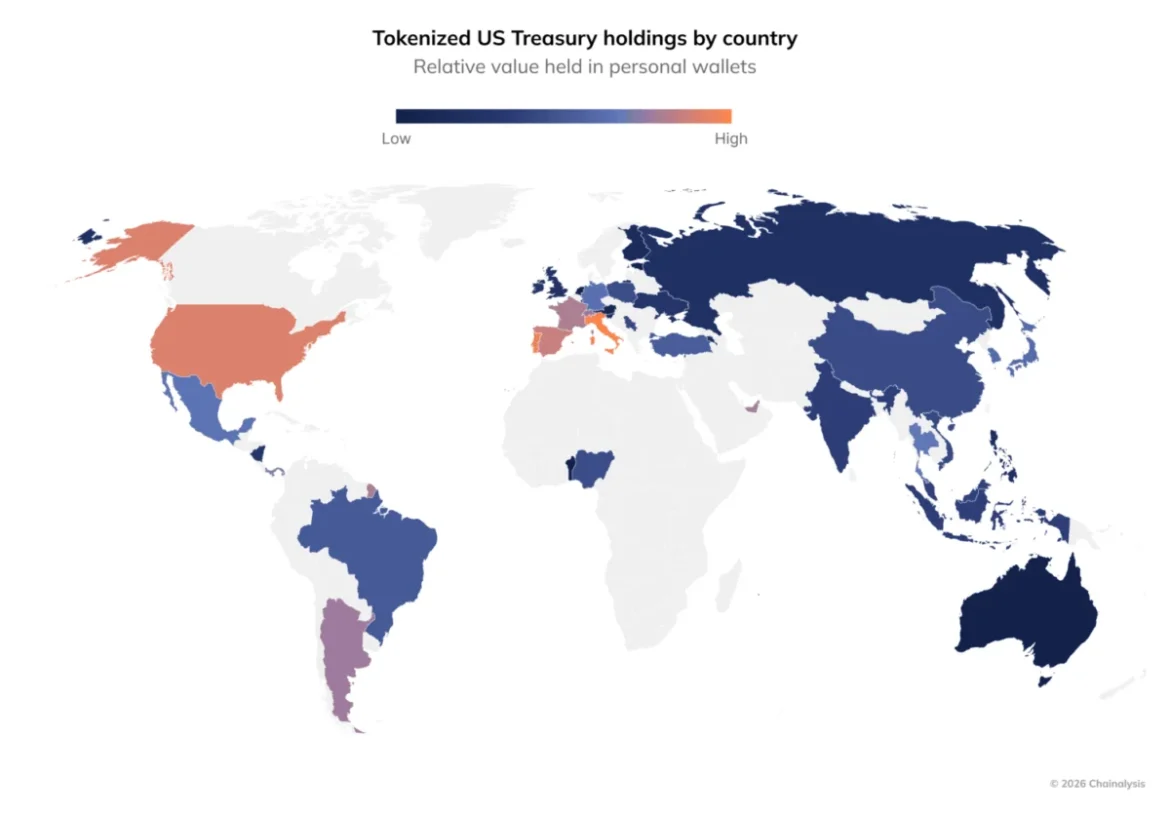
Geographic distribution metrics reveal a fascinating dichotomy in tokenized U.S. Treasuries. While American investors represent 11.7% of the global RWA holder base and 11.4% of overall value, geolocated holdings of tokenized Treasuries show foreign dominance by value: Italy leads with 29.9%, followed by Portugal at 18.8%, and Singapore at 18.2%, with the United States ranking fourth at 10.5%. Conversely, retail participation metrics invert these findings; Japan accounts for 16.4% of total tokenized Treasury holders while holding just 0.4% of the total nominal value. This divergence demonstrates that a concentrated base of large foreign institutional holders drives aggregate Treasury value, while a broader international retail base accumulates smaller fractional positions.
Lending dynamics further highlight evolving asset utility. Wallets utilizing private credit as collateral surged 1618%, making private credit account for 77% of all value lent against tokenized RWAs. Conversely, tokenized Treasuries experienced a 23% contraction in lending utilization. Because traditional Treasuries already function as the most liquid collateral in conventional finance, tokenization primarily serves foreign retail and institutional investors as a direct access mechanism to hold U.S. sovereign yield without establishing complex domestic brokerage accounts.

Canada Emerges as a Global Peer-to-Peer and Remittance Leader
Canada solidified its position as the second-largest crypto economy in North America and tenth globally in grassroots adoption. Between July 2025 and June 2026, the Canadian digital asset economy expanded by 2.3% to reach $247.7 billion. Within this mature market, everyday citizens utilize cryptocurrencies at rates far exceeding typical developed economies, making Canada the most robust peer-to-peer crypto economy among all G7 nations and placing it seventh globally in domestic and cross-border flows.
Stablecoins represent the primary driver of Canadian retail crypto adoption. By June 2026, stablecoins captured 44% of total Canadian-dollar-based order book trading volume, up significantly from 30% the previous year, with USDC commanding the vast majority of activity while Canadian-dollar-backed stablecoins remained virtually negligible. This reliance on foreign-denominated digital currency mirrors policy concerns raised by industry advocates. Morva Rohani, Executive Director of the Canadian Web3 Council, pointed out that heavy reliance on U.S. dollar-backed stablecoins inadvertently generates foreign sovereign debt demand at the expense of potential domestic Canadian debt issuance—a trend Canadian policymakers are monitoring closely.
Despite passing a domestic Stablecoin Act to facilitate future Canadian-dollar-denominated token issuance, local offerings have yet to challenge USD dominance. Nevertheless, Canada’s uniquely diverse demographic profile fuels a massive cross-border remittance economy. With approximately 23% of its population born abroad—the highest proportion within the G7—Canada relies heavily on crypto rails to service remittance corridors to India, China, the Philippines, Nigeria, and Pakistan.

During the reporting period, stablecoin and Bitcoin remittances from Canada to India, China, and the Philippines surged 141% year-over-year to reach $2.36 billion. This economic activity spanned 3.56 million distinct transactions, servicing an average of 75,100 unique monthly senders with an average transfer size of $663. Traditional banking channels impose average remittance fees exceeding 6.7% from Canada, whereas blockchain-based stablecoin transfers settle for fractions of a cent, driving continuous migration toward digital asset rails.
Furthermore, domestic peer-to-peer transaction volumes in Canada display a striking statistical correlation with the fluctuating population of temporary visa holders and international students from key immigration corridors. As temporary resident permit counts rose and fell between 2021 and 2026, domestic P2P crypto volumes mirrored those exact trajectories. Individuals maintaining active cross-border financial commitments naturally gravitate toward cost-effective settlement alternatives for daily expenses, including housing rent and utility payments.
The Infrastructure Layer Remains American While the User Base Scales Globally
The overarching narrative defining North America’s digital asset economy is the stark division between infrastructure creation and global user consumption. American institutions, regulatory frameworks, and developers firmly control the underlying technological stack powering tokenized Treasuries, algorithmic dollar-pegged stablecoins, and autonomous AI commerce. Meanwhile, international end-users and foreign markets drive the vast majority of actual transaction demand.

This geographic concentration faces increasing international pushback. The European Union’s MiCA framework, Singapore’s institutional stablecoin licensing regimes, and Brazil’s Central Bank digital currency (Drex) pilot represent coordinated attempts to establish sovereign alternatives to dollar-centric infrastructure. Whether these regional alternatives successfully capture market share or merely reinforce the global dominance of the digital dollar will depend entirely on organic user adoption rather than legislative decree alone.
As upcoming regulatory guidelines—ranging from Canada’s implementing regulations under its Stablecoin Act to anticipated U.S. frameworks governing tokenization and agentic AI payments—take effect, they will establish the permanent parameters governing the relationship between domestic builders and global digital asset consumers.
