
Cyber attackers are perpetually searching for technical advantages that can tip the balance of power in their favor against enterprise digital defenders and national cybersecurity task forces. In recent years, a rapidly growing segment of the threat landscape—ranging from financially motivated cybercriminal syndicates to advanced state-sponsored agents linked to countries like Iran and North Korea—has found a powerful new vector on the blockchain. Instead of relying on traditional centralized servers that are chronically vulnerable to domain seizures, hosting takedowns, and distributed denial-of-service disruptions, malicious actors are increasingly turning to public blockchains to store their operational code and infrastructure coordination pointers. These decentralized, censorship-resistant networks provide a permanent repository that cannot be switched off by law enforcement or hosting providers.
This sophisticated tradecraft, which blockchain analytics firm Chainalysis designates as "blockchain dead drops" (BDDs), involves embedding malicious payloads directly into on-chain transactions or smart contracts. Infected machines can then query these public ledgers on demand to retrieve updated instructions. Because public blockchains are immutable and distributed across thousands of independent nodes globally, this method grants cyber campaigns extraordinary longevity. Threat actors can communicate with compromised endpoints continuously without the constant fear of losing their command-and-control (C2) relayer or having their infrastructure pulled offline by vigilant web hosting providers.
The primary danger associated with blockchain dead drops is not an escalation in destructive payload capabilities, but rather a dramatic leap in campaign durability and resilience. When malicious actors use blockchains as persistent coordination layers, their operations effortlessly survive domain seizures, web hosting crackdowns, repository removals, and other traditional web2 disruptions. This structural advantage adds a formidable layer of complexity to corporate cybersecurity defenses, particularly because traditional threat-intelligence platforms often fail to monitor or index the on-chain activity associated with these sophisticated cyber operations, creating a significant visibility gap.

The Evolution and History of Blockchain Dead Drops
While the weaponization of blockchains has accelerated dramatically in recent years, the foundational concepts behind blockchain dead drops have a surprisingly long history, tracing back more than a decade to early experimentation on the Bitcoin network and its variants. The earliest recorded instance of this methodology dates back to September 2013, when operators utilizing a variant of the notorious Necurs botnet began storing command-and-control domains on Namecoin, an early fork of Bitcoin.
The technique evolved significantly over the subsequent years. In 2019, cybercriminal groups encoding banking malware utilized the specific amounts of Satoshis being transferred in Bitcoin transactions to hide C2 IP addresses. During the same year, the operators behind the Glupteba crypto-mining botnet began writing malicious configuration data directly into Bitcoin’s OP_RETURN data field, allowing infected network routers to update their C2 servers automatically.
However, the modern era of BDDs truly materialized on Ethereum Virtual Machine (EVM) compatible chains in mid-2023 with the advent of a technique widely dubbed "EtherHiding." Operators of the ClearFake infostealer campaign found themselves in a difficult operational position after Cloudflare cracked down on the traditional web servers they were using to deliver malware. To circumvent these defenses, the threat actors embedded their malicious payloads inside smart contracts deployed on the Binance Smart Chain (BSC). Because the Binance Smart Chain is structurally immutable and impossible to take offline, the cybercriminals successfully sustained their campaign despite aggressive takedown efforts.

Within days of this deployment, seemingly unrelated threat actor groups began experimenting with hosting their own malware variants on various public blockchains. This wave of adoption culminated in late December 2023 with the emergence of the Smargaft DDoS attack botnet, which relied entirely on smart contract-based C2 infrastructure hosted on BSC.
The Convergence of State Actors and Open-Source AI Tools
The inherent resilience, anonymity, and relative obscurity of blockchain-based command-and-control mechanisms soon attracted the attention of sophisticated nation-state actors. By late 2024, Iranian threat actors—assessed by intelligence analysts to be linked to the regime’s Ministry of Intelligence—began embedding C2 routing data directly into Bitcoin transactions. Shortly thereafter, in early 2025, North Korean state-sponsored operatives began integrating EtherHiding methodologies into their elaborate fake job interview ruses, which are designed to dupe cryptocurrency developers into downloading malicious code.
According to comprehensive research data compiled by blockchain intelligence firms, the daily volume of malicious writes to public blockchains surged dramatically following the proliferation of open-source artificial intelligence coding tools. Prior to the widespread availability of high-capacity open-source Chinese language models—which launched without the safety guardrails typically restricting the generation of malicious code—malicious blockchain writes averaged roughly 2.06 per day. Within months, that figure climbed to 11.1 writes per day, representing an astronomical 440% increase in less than a year.

Historically, executing successful blockchain dead drop operations required a high degree of specialized expertise in both advanced cybersecurity tradecraft and blockchain development. However, the emergence of unrestricted open-weight large language models in mid-2025 effectively eliminated this technical barrier to entry. Suddenly, less-experienced cybercriminals and low-tier threat groups could effortlessly generate the smart contracts and transaction scripts needed to deploy BDDs. Consequently, security analysts are currently tracking active BDD operations across five major blockchains and more than a dozen distinct malware strains.
Categorizing the Threat Landscape: Who is Driving BDD Activity?
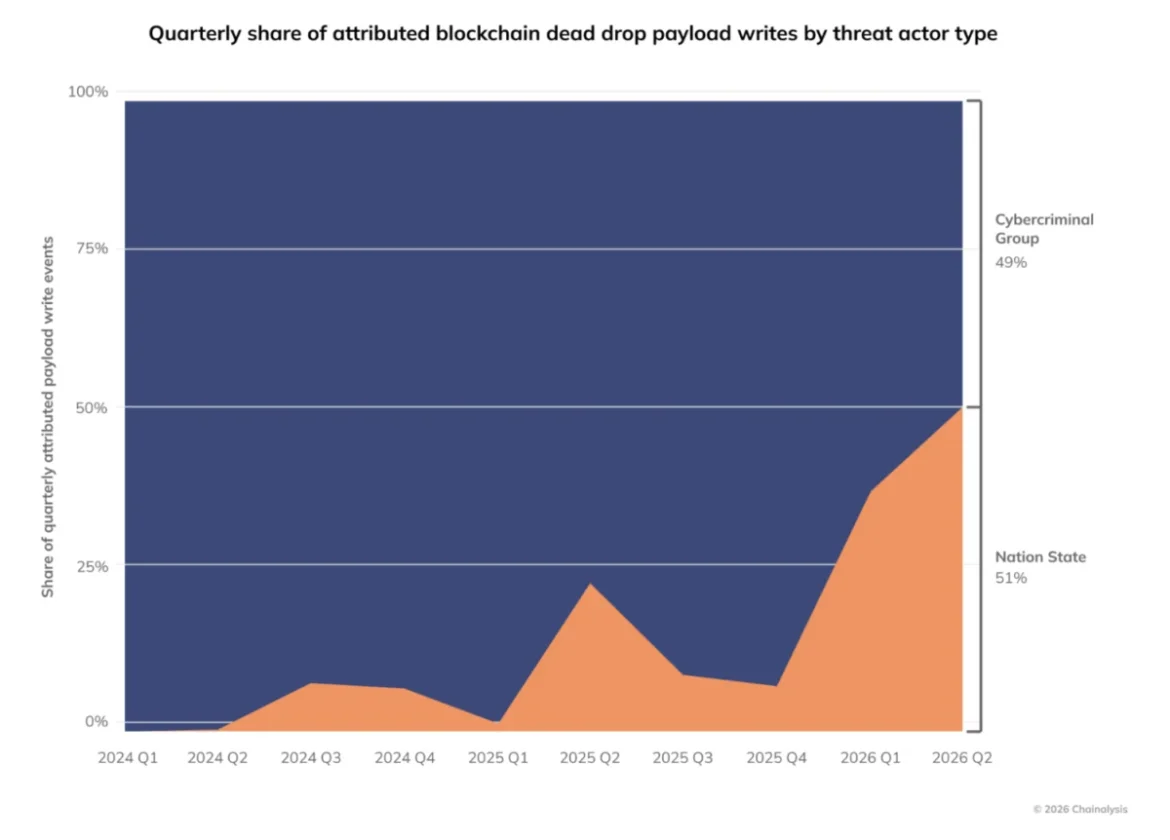
An examination of historical telemetry reveals a distinct shift in the perpetrators driving on-chain malicious activity. Through early 2024, traditional cybercriminals accounted for virtually all malware instructions posted to public blockchains. However, state-linked cyber espionage groups began appearing in mid-2024, and their footprint has expanded exponentially ever since. By the second quarter of 2026, groups associated with nation-state actors were responsible for approximately two-thirds of all newly initiated BDD activity each quarter, accounting for roughly half of the cumulative total BDD volume observed globally.
Nation-state operators have systematically refined, automated, and expanded upon the rudimentary techniques originally pioneered by cybercriminal syndicates. These state-backed campaigns generally fall into three distinct operational methodologies: North Korean groups deploying redundant multi-chain strategies, Iranian intelligence elements utilizing Bitcoin’s OP_RETURN fields, and Russian-language cybercriminal groups commercializing BDD frameworks through Malware-as-a-Service models.

Case Study: North Korean Multi-Chain Redundancy and Job-Seeker Exploitation
In February 2025, Google’s Threat Intelligence Group (GTIG)—incorporating Mandiant telemetry—identified a North Korean-linked threat cluster tracked as UNC5342. This group utilized smart contracts on public blockchains to deliver malware to job-seeking cryptocurrency developers. Bogus recruiters successfully tricked victims into executing malicious payloads retrieved via contract-based storage mechanisms characteristic of classic EtherHiding campaigns.
Subsequent on-chain investigations linked UNC5342 to a secondary, highly sophisticated transaction-based BDD technique designed to maximize operational redundancy. This newly discovered methodology relies on a multi-chain architecture spanning the TRON, Aptos, and Binance Smart Chain networks. The attackers embed encoded pointers within transactions on the TRON and Aptos blockchains that ultimately resolve to a single centralized target transaction hosted on BSC.
When an infected device initializes, its malware first executes a query on the TRON blockchain; if that query fails or encounters interference, it automatically rolls over to query the Aptos network. Regardless of the initial route, both paths successfully fetch precise directional pointers leading directly to the Binance Smart Chain, where the primary payload resides.

The BSC transaction contains heavily encrypted instruction sets detailing current C2 server addresses, configuration parameters, and secondary staging references. Once decrypted locally by the victim’s machine, the malware establishes outbound connections to off-chain infrastructure, seamlessly transitioning the operation into remote access and credential exfiltration. Because the attacker can rotate infrastructure simply by broadcasting a new transaction—which is instantly processed by every infected endpoint globally—disrupting the campaign requires coordinated, simultaneous enforcement actions across three distinct blockchain ecosystems.
Case Study: Iranian State Operators and Bitcoin OP_RETURN Exploitation
Parallel to North Korean operations, threat actors assessed to be operating under the direction of Iran’s Ministry of Intelligence have increasingly utilized the Bitcoin blockchain for infrastructure coordination. Rather than deploying complex smart contracts, these operators leverage the Bitcoin protocol’s OP_RETURN data field and standard transaction structures to store encoded C2 routing information.
In these campaigns, attacker-controlled wallet addresses initiate micro-transactions directed toward high-profile, static Bitcoin addresses—such as legacy addresses tied historically to pseudonymous creator Satoshi Nakamoto. The financial value of these cryptocurrency transfers is entirely negligible; the true operational value lies within the embedded metadata of each transaction. Malware implanted on compromised enterprise networks is specifically programmed to monitor and decode these designated Bitcoin transactions to extract up-to-date server routing indicators.

This architecture offers dual strategic advantages for Iranian operators. First, the reference addresses utilized as lookup points have zero direct association with the attackers, drastically minimizing their forensic footprint on the ledger. Second, infrastructure rotation remains frictionless: the operator simply broadcasts a fresh Bitcoin transaction containing updated routing bytes, and all infected machines automatically synchronize with the new parameters. Once the configuration is retrieved, the attack lifecycle transitions off-chain for traditional command retrieval, remote access deployment, and data exfiltration.
Case Study: Russian-Language Cybercriminals and Malware-as-a-Service Frameworks
In the European and Eurasian cybercrime ecosystems, Russian-language criminal syndicates have embedded blockchain dead drops directly into smart contracts deployed across the Polygon blockchain. Public threat intelligence reporting from cybersecurity firms such as Securonix, Trinity Cyber, and LevelBlue has documented the commercialization of a sophisticated BDD Malware-as-a-Service (MaaS) toolkit. Marketed extensively on underground cybercrime forums, this framework operates on a subscription model complete with localized operator control panels.
Technical analyses indicate a classic MaaS operation wherein a central operator maintains core infrastructural smart contracts that are leased or rented to downstream criminal affiliates running separate malware campaigns. On the Polygon network, this infrastructure typically manifests as a primary operator wallet controlling a fleet of distinct storage contracts, each dedicated to a unique customer or campaign variant.

Security researchers have identified two primary structural variants of this MaaS model. In the simpler variant, a single operator wallet maintains one master resolver contract that serves all downstream affiliate traffic. In the more complex variant, a primary operator wallet orchestrates a massive fleet of individual resolver contracts, allowing distinct criminal affiliates to independently update their respective C2 pointers without disrupting fellow subscribers.
Advanced on-chain attribution analysis has tied the primary deployer wallets associated with these Russian-language campaigns to a much broader spectrum of illicit activity. This includes the deployment of fraudulent stablecoin smart tokens, widespread clipboard-hijacking campaigns targeting retail cryptocurrency users, and over 50 near-identical Binance Smart Chain resolver contracts. Furthermore, investigators have observed central deployer wallets actively funding secondary deployer addresses, vastly expanding the operational reach of these criminal networks across multiple blockchains.
Implications and Strategic Defensive Recommendations
The widespread adoption of blockchain dead drops represents a profound challenge for modern enterprise cybersecurity architecture. Because public blockchains are designed to be globally accessible, economically efficient, and structurally immutable, traditional perimeter defenses are fundamentally unequipped to neutralize BDD threats.

Corporate security teams cannot effectively mitigate these risks by blocking general blockchain traffic within enterprise networks. Attempting to block standard Ethereum or EVM-related traffic, for instance, would require organizations to blacklist every public RPC endpoint operated by infrastructure providers such as Infura, Alchemy, and Cloudflare. Such a drastic measure would inadvertently break legitimate decentralized finance (DeFi) applications, corporate crypto-treasury tools, and authorized web3 integrations, while failing to stop a determined attacker capable of operating their own custom blockchain node.
Instead, cybersecurity professionals are increasingly turning to advanced blockchain intelligence and infrastructure identification tools to neutralize the threat. The very characteristic that makes BDDs attractive to malicious actors—their permanent, timestamped, and immutable nature—also makes them uniquely visible to advanced analytics platforms. By systematically tracking on-chain transaction histories, mapping operator wallets, analyzing smart contract bytecode, and cataloging update histories, defenders can successfully profile threat actor infrastructure and anticipate retaliatory network maneuvers.
Organizations seeking to fortify their defenses against emerging blockchain-based threats are advised to integrate specialized on-chain monitoring alongside traditional endpoint detection and response (EDR) solutions. By actively monitoring outbound JSON-RPC calls originating from enterprise endpoints toward public blockchain infrastructure, security teams can establish an effective early-warning system capable of detecting covert malware initialization routines before critical data exfiltration occurs. As threat actors continue to innovate within decentralized digital spaces, the convergence of traditional cybersecurity intelligence and blockchain analytics remains the most viable path toward neutralizing the evolving menace of blockchain dead drops.
