
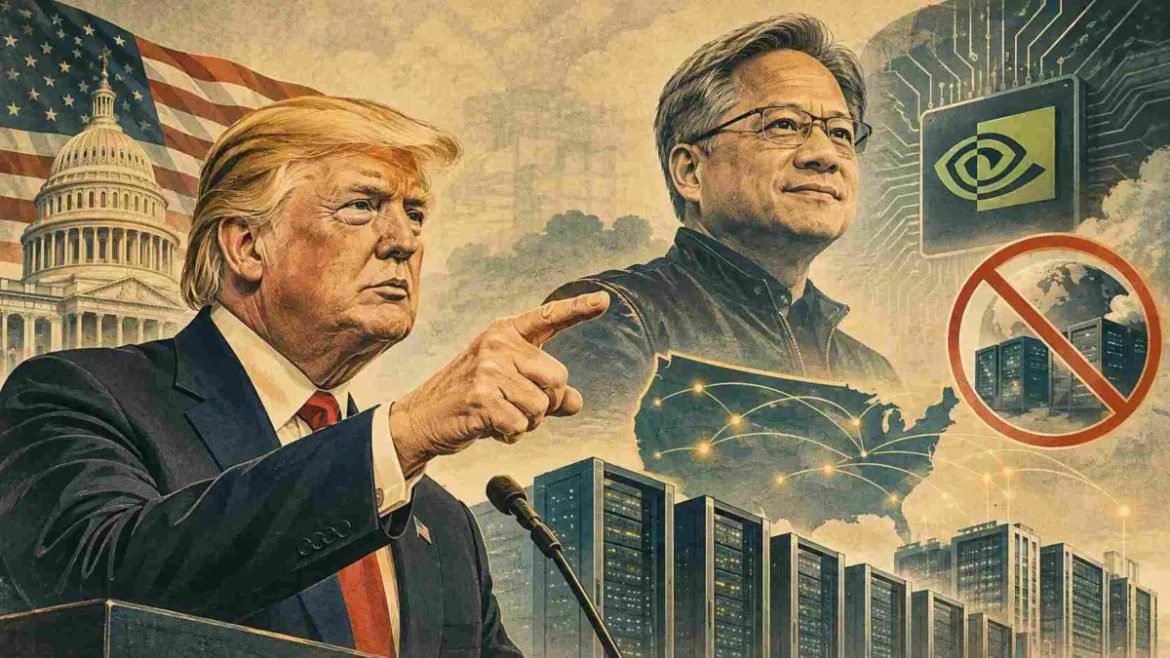
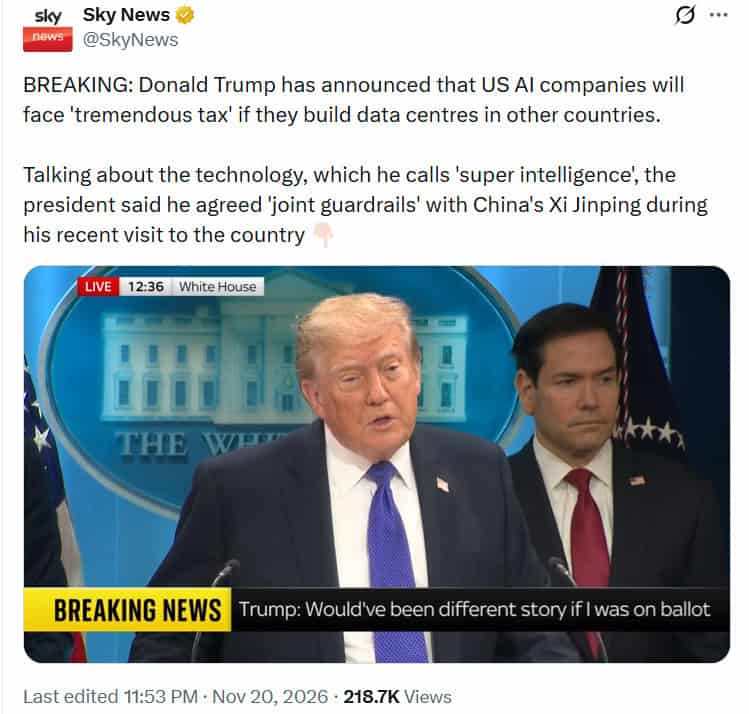
President Donald Trump used a high-profile White House press conference on November 20 to outline a sweeping and aggressive agenda for the domestic artificial intelligence sector, signaling an escalated state intervention in American technology infrastructure. During the address, Trump proposed imposing a substantial financial penalty—described as a "tremendous tax"—on United States-based technology corporations that choose to construct and operate artificial intelligence data centers on foreign soil. The administration frames the measure as a critical safeguard to retain vital computational infrastructure domestically, protect American jobs, and secure a definitive strategic advantage in the ongoing technological race against China.
Simultaneously, the president turned his attention to the corporate governance crisis at Nvidia, publicly lobbying the semiconductor giant’s board of directors to reconsider the sudden departure of former Chief Executive Officer Jensen Huang. Urging the board to accept an apology and offer Huang a second chance, Trump praised the visionary leader’s technical acumen, crediting him with spearheading the development of the Blackwell AI chip platform. This high-profile endorsement, however, places the executive branch at odds with both the Nvidia board’s current transition trajectory and earlier signals from within Trump’s own cabinet. As the technology sector digests these twin developments, the proposals underscore a growing collision between corporate globalization, national security directives, and executive authority.
Chronology of Events and the Nvidia Leadership Crisis
The convergence of trade policy and corporate upheaval traces back to a volatile few weeks in November 2026. The foundation for Trump’s infrastructure warning was laid amid mounting anxieties over the leakage of advanced computing capacity to foreign jurisdictions. Meanwhile, the turmoil at Nvidia erupted on November 12, 2026, when Jensen Huang abruptly resigned from his positions as president, chief executive officer, and board member.
Huang’s departure followed explosive internal and public reports concerning alleged personal relationships, including one with a senior Nvidia executive reporting directly to him and another involving a Chinese businesswoman whom U.S. intelligence circles suspected of having ties to Beijing. While the espionage allegations have not been independently verified as factual—and have been publicly questioned by President Trump himself—the corporate compliance fallout was immediate. Nvidia’s board of directors accepted Huang’s resignation and swiftly appointed Chief Financial Officer Colette Kress as interim CEO while initiating a formal, comprehensive search for a permanent successor.
The abrupt vacuum at the top of the world’s most valuable artificial intelligence chipmaker triggered shockwaves across global financial markets. Industry titans and high-profile investors quickly mobilized; figures such as Elon Musk and Epic Games CEO Tim Sweeney backed a public petition urging the board to pause its punitive measures and reinstate Huang pending an independent investigation.
Despite this external pressure—culminating in Trump’s November 20 endorsement—sources close to the board indicated that directors remain steadfast in executing a leadership transition. Adding to the internal administration dissonance, Treasury Secretary Scott Bessent had previously advocated for a deep leadership overhaul, explicitly suggesting that Nvidia look outside the company for its next chief executive. Consequently, Trump’s call for Huang’s reinstatement highlights a rare public divergence between the Oval Office and his own economic advisors regarding corporate governance best practices.
Strategic Imperatives and the Geopolitical AI Race with China
President Trump’s dual announcements are deeply rooted in the geopolitical rivalry between Washington and Beijing. During his press conference, which followed a diplomatic tour of Asia, Trump referenced discussions with Chinese President Xi Jinping regarding the establishment of "joint guardrails" for artificial intelligence development. Although the specifics of these guardrails remain undefined, the rhetoric reinforces Washington’s aggressive posture aimed at maintaining absolute hegemony over what Trump termed "super intelligence."
For years, the U.S. Department of Commerce has systematically tightened export controls on advanced semiconductors, blocking Chinese entities from acquiring cutting-edge chips directly. However, as artificial intelligence models have scaled in complexity, the strategic bottleneck has shifted from raw chip sales to cloud computing infrastructure and massive data centers. Because data centers allow foreign entities and remote users to tap into immense computational power without owning the physical hardware, overseas facilities have increasingly functioned as a loophole for accessing restricted capabilities. Investigative reports from outlets like Reuters have documented instances where Chinese enterprises bypassed domestic hardware restrictions by routing workloads through third-party data centers in permitted Southeast Asian and European nations.
Trump’s proposed tax on overseas data centers directly targets this vulnerability. By making foreign infrastructure development financially prohibitive for U.S. firms, the administration aims to choke off indirect access channels while ensuring that capital expenditure directly benefits the domestic economy. This policy mirrors historical precedents in the semiconductor manufacturing sector, where decades of outsourcing chip fabrication to overseas foundries left domestic supply chains vulnerable to geopolitical shocks.
Economic Data, Infrastructure Pressures, and Domestic Backlash
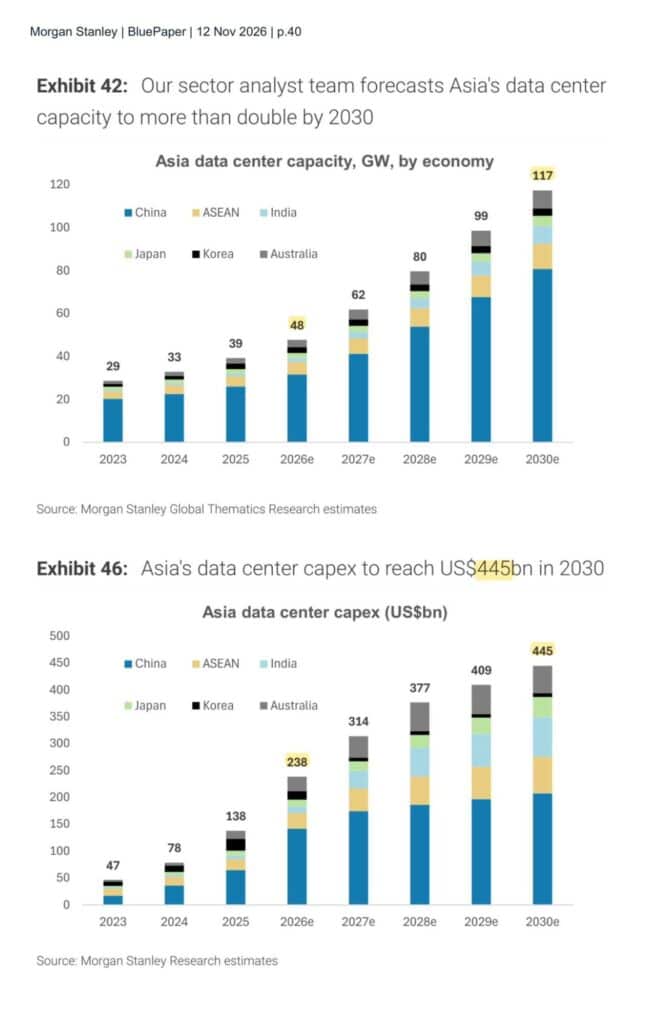
While the strategic rationale for keeping AI infrastructure onshore is clear to policymakers, the execution faces formidable economic and logistical hurdles, not to mention intense local opposition. Modern artificial intelligence data centers are extraordinarily resource-intensive. According to recent projections by financial institutions such as Morgan Stanley, total power capacity dedicated to data centers in the United States is forecast to skyrocket from 48 gigawatts in 2026 to a staggering 117 gigawatts by 2030.
This unprecedented demand has strained regional power grids and municipal water supplies, used heavily for cooling server farms. Consequently, the rapid buildout of domestic AI infrastructure has sparked significant grassroots pushback across numerous American communities. Voters and local planners have voiced deep anxieties regarding skyrocketing household utility bills, grid reliability, and environmental degradation. These local concerns transformed into a potent political issue during the 2026 midterm election cycle, with communities enacting local ordinances, zoning restrictions, and moratoriums on new data center construction.
Thus, President Trump’s decree penalizing overseas construction arrives at an ironic juncture: technology companies are being commanded by Washington to build domestically, even as they face aggressive local resistance, regulatory friction, and environmental scrutiny at home. Furthermore, economic realities dictate that cloud service providers and AI developers prefer positioning data centers close to international client bases to minimize latency and the massive costs associated with cross-border data transmission. Without targeted exemptions or robust federal infrastructure support, a blanket penalty on foreign facilities could penalize multinational enterprises striving to serve global markets efficiently.
Legal Hurdles and Constitutional Realities
From a governance and administrative standpoint, Trump’s data center tax proposal faces substantial constitutional roadblocks. Under the United States Constitution, the authority to levy federal taxes and regulate interstate and foreign commerce rests squarely with Congress.
Reports from political analysts immediately following the press conference revealed that Trump had not consulted with his executive agencies, legal counsels, or legislative allies prior to making the announcement. The president failed to articulate a specific tax rate, an implementation timeline, or precise criteria defining which companies, scales of investment, or structural projects would fall under the punitive measure.
Furthermore, the administration has yet to clarify whether it intends to pursue formal congressional legislation—a difficult path given a polarized legislative branch—or attempt to invoke emergency executive powers under existing trade and national security statutes. Legal scholars note that any attempt to unilaterally impose taxation on foreign capital expenditure via executive order would almost certainly trigger immediate, protracted legal challenges from corporate coalitions and industry advocacy groups on constitutional and statutory grounds.
Fact-Based Analysis of Broader Implications
The unfolding saga involving Nvidia’s leadership and the proposed penalties on foreign AI data centers carries profound implications for the global technology ecosystem.
First, the uncertainty surrounding Nvidia—the undisputed hardware engine of the generative AI boom—demonstrates how corporate stability can be abruptly rattled by executive misconduct and compliance failures. While Colette Kress maintains operational continuity and product roadmaps remain technically unaffected, the prolonged absence of a permanent visionary chief executive leaves the company vulnerable to rising competitors. If the board ultimately rejects President Trump’s call to reinstate Jensen Huang, Nvidia must successfully execute an external executive search without losing its competitive edge or experiencing a brain drain of key engineering talent.
Second, the proposed tax on overseas data centers signals a definitive shift toward economic nationalism in digital infrastructure. Should the administration formalize this policy through legislative or executive channels, U.S. technology giants will be forced to radically restructure their capital allocation strategies. Rather than distributing infrastructure globally to optimize latency and bypass regional regulations, firms will likely concentrate investments inside U.S. borders. However, this domestic concentration will necessitate massive concurrent investments in national power grids, green energy generation, and municipal water management to overcome local public opposition.
Ultimately, President Trump’s November 20 announcements crystallize the administration’s overarching philosophy: national security, technological dominance, and sovereign infrastructure take absolute precedence over corporate globalization. Whether these ambitious proposals translate into enforceable, legally sound public policy—or remain potent political signaling—will depend heavily on Congress, the resilience of the U.S. power grid, and the independent resolve of corporate boardrooms in the months ahead.
