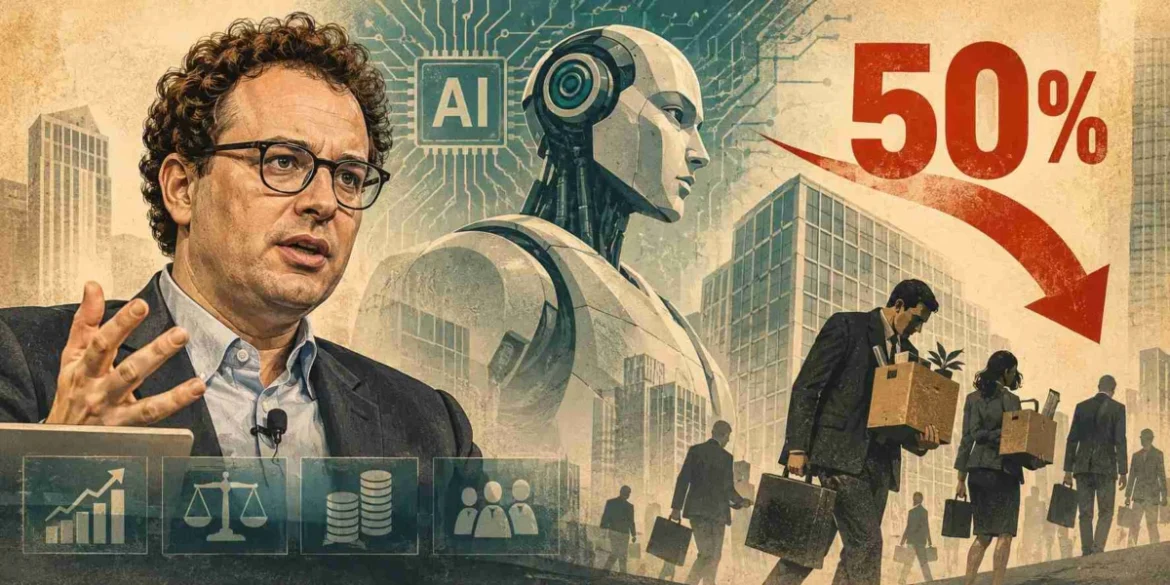
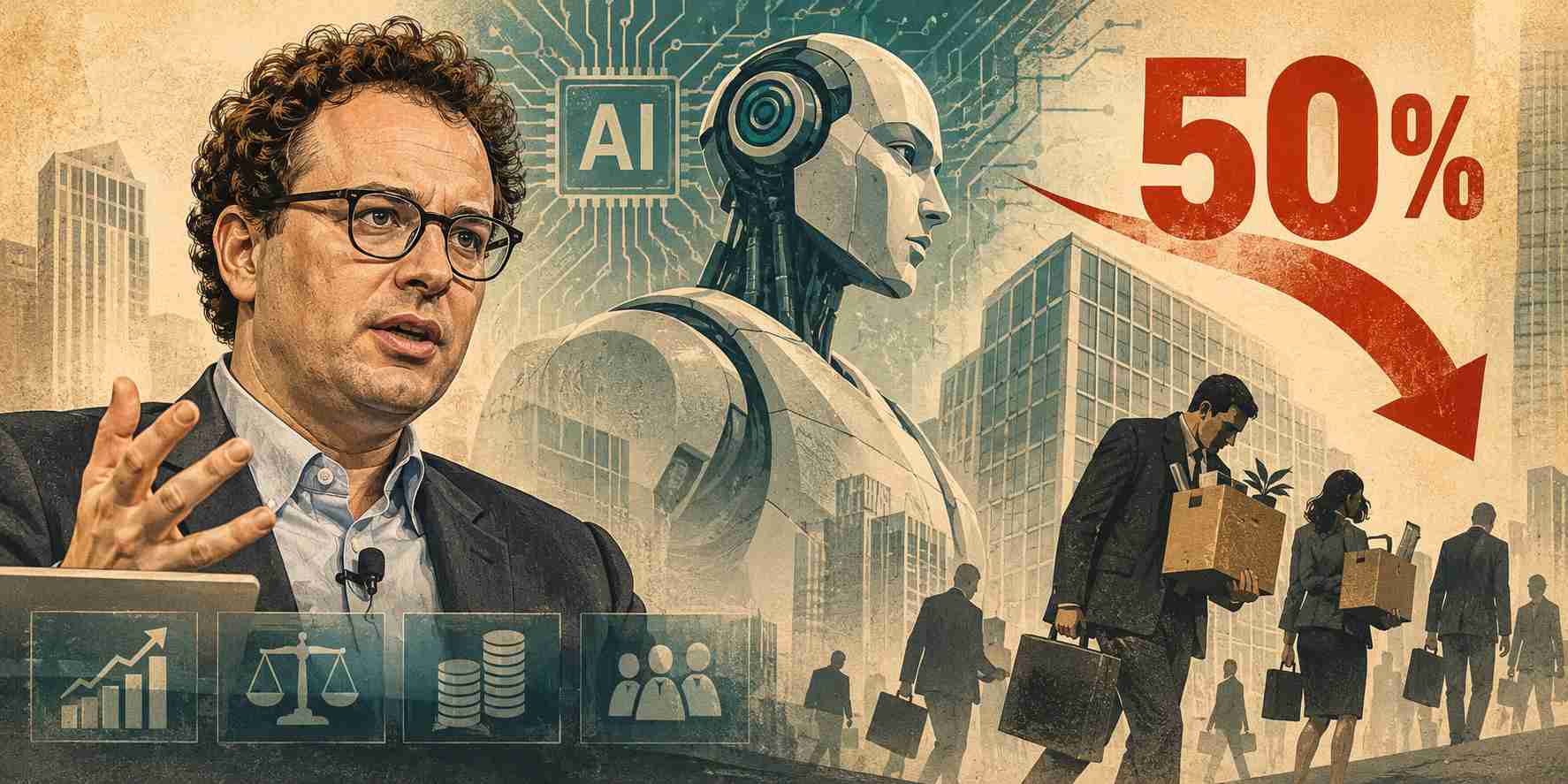
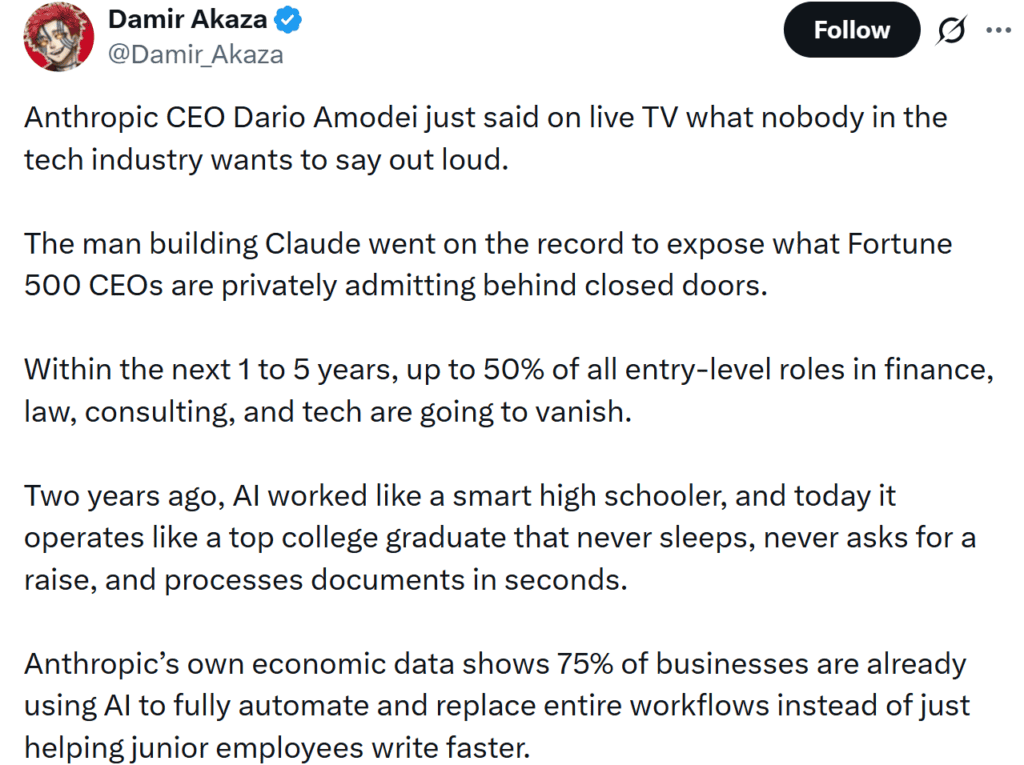
The landscape of modern professional employment is facing an unprecedented paradigm shift as artificial intelligence transitions from a basic workplace productivity aid to an autonomous operational force. Speaking during a widely discussed media appearance in May 2026, Anthropic Chief Executive Officer Dario Amodei issued a stark warning that rapid improvements in generative artificial intelligence could disrupt up to half of all entry-level white-collar positions within the next one to five years. This projection places the future of corporate career pipelines at the center of global economic debates, forcing industries such as finance, legal services, technology, and management consulting to reevaluate how they onboard, train, and utilize junior personnel.
Amodei’s remarks underscore a growing anxiety among technology leaders and economists alike: the foundational tasks traditionally assigned to fresh graduates—including document summarization, foundational research, brainstorming sessions, and baseline financial report preparation—are precisely the areas where modern large language models and autonomous AI agents excel. As these systems scale in capability, moving rapidly from the cognitive level of a high school student to that of an advanced college graduate and beyond, businesses are finding fewer economic incentives to rely entirely on human labor for routine knowledge-based execution.
The Evolution of Workplace Automation: From Assistance to Autonomy
To understand the gravity of Amodei’s forecast, one must examine how corporate adoption of artificial intelligence has matured over recent years. Initially, tools like OpenAI’s ChatGPT and Anthropic’s Claude functioned primarily as conversational assistants. Employees would manually prompt these models to draft emails, refine code segments, or summarize lengthy PDF files. However, the operational reality of the enterprise sector has evolved significantly.
Data compiled through Anthropic’s Economic Index reports highlights a profound structural change in how organizations interact with AI infrastructure. While consumer platforms continue to see significant use for ad-hoc assistance, enterprise API traffic reveals a heavily skewed preference for automation patterns. By late 2025 and into 2026, corporate implementations increasingly involved multi-stage workflows where AI agents independently execute complex sequences of instructions with minimal human intervention.
Surveys of technical leadership conducted throughout 2026 indicate that a majority of enterprise organizations have already deployed AI agents to handle interconnected tasks. Rather than assisting a human worker, these systems are increasingly assigned the ownership of the entire task lifecycle. Consequently, the traditional departmental hierarchy is beginning to flatten. Tasks that once required an entire tier of junior analysts to compile, cross-reference, and format are now generated instantaneously by backend algorithms, leaving smaller, more senior teams responsible solely for quality control, edge-case management, and executive decision-making.
Chronology and Internal Corporate Shifts
The warning delivered by Anthropic’s CEO is not merely speculative; it is supported by observable shifts within the artificial intelligence industry itself, including inside Anthropic. An internal research report released by the company in October 2026, titled How Employment Is Changing at Anthropic, provided a rare empirical window into how a leading AI lab manages its own workforce in the age of advanced automation.
The findings revealed a notable contraction in junior hiring metrics. Junior-level employees accounted for approximately 14% of Anthropic’s technical workforce by late 2026, a significant drop from 21% recorded in early 2025. More striking was the shift in new technical hires: the proportion of junior recruits fell sharply from 27% down to 9%. Anthropic attributed this recalibration directly to efficiency gains driven by its own models, particularly within software engineering, where developers increasingly delegate coding, debugging, and testing duties to autonomous coding agents.
Surveys conducted concurrently among machine learning managers and software engineering leaders in April 2026 corroborated these trends, with roughly one-third of machine learning managers and one-fifth of software engineering managers explicitly reporting that they had reduced their hiring targets due to the integration of AI tools. Despite these internal shifts, Anthropic’s overall technical headcount continued to expand, alongside accelerated hiring in non-technical domains such as sales, legal compliance, and recruitment, demonstrating that automation does not necessarily halt company growth, but rather alters its composition.
Macroeconomic Data and the Realities of Labor Displacement
Despite dire predictions from tech executives, broader labor market data reveals a nuanced reality where widespread, economy-wide unemployment has yet to materialize in the dramatic fashion some fear. Instead, the immediate friction appears concentrated in recruitment metrics for younger demographics entering the workforce.

A study released by the Stanford Digital Economy Lab, which analyzed extensive United States payroll information through mid-2026, identified a distinct softening in employment figures for workers aged 22 to 25 within highly AI-exposed occupations. Specifically, employment levels for young professionals in these sectors lagged nearly 20% behind the growth trajectory observed among their peers in less-exposed industries. Crucially, the researchers noted that this gap was driven primarily by a reduction in new hiring rather than a wave of layoffs among established workers.
Similarly, labor market analyses published by organizations such as the Yale Budget Lab in late 2026 found no definitive evidence of mass structural displacement caused by artificial intelligence. Economists point to several friction points that naturally slow the pace of automation:
- Regulatory and Compliance Standards: Highly regulated industries like finance and healthcare require rigorous audit trails and adherence to legal standards that autonomous agents cannot independently validate.
- Software Integration Costs: Legacy enterprise systems often require extensive, capital-intensive overhauls to safely integrate autonomous AI agents.
- The Imperative for Human Oversight: The risk of "hallucinations" and logical errors necessitates that human professionals remain in the loop to verify high-stakes outputs.
These protective factors explain the disparity highlighted in Anthropic’s March 2026 labor market study, which combined theoretical occupational exposure with actual usage patterns. For instance, while computer and mathematical occupations exhibited a theoretical technical capacity for AI task acceleration of up to 94%, observed enterprise coverage hovered at approximately 33%. The bridge between what AI can do and what businesses safely allow it to do remains wide, creating a crucial window for economic adaptation.
Broader Implications and Strategic Preparation
As the discourse surrounding artificial intelligence shifts from technological marvels to socioeconomic consequences, stakeholders across the public and private sectors are grappling with how to build resilient career pathways. Dario Amodei has emphasized that halting technological progress is neither practical nor geopolitically viable, given intense international competition, particularly between the United States and China.
Consequently, attention must pivot toward workforce preparation, educational reform, and economic policy. Experts suggest that future professionals must move beyond basic digital literacy or superficial prompt engineering. Success in an AI-integrated economy will demand advanced critical thinking, deep domain expertise, the ability to manage complex automated systems, and skills in synthesizing disparate data streams.
Furthermore, economists and policy analysts are beginning to explore structural safety nets, including potential tax frameworks for AI-driven enterprises, to ensure that the massive productivity gains and financial efficiencies generated by automation are distributed equitably across society rather than concentrated within a handful of technology conglomerates.
The warning issued by Anthropic’s leadership serves as a clarifying moment for the modern economy. Whether Amodei’s timeline of one to five years proves precise, the structural contraction of entry-level white-collar opportunities is already reshaping corporate behavior. For upcoming generations of professionals, educational institutions, and corporate leaders, the mandate is clear: the traditional apprenticeship model of professional development must rapidly adapt to coexist with a workforce increasingly driven by autonomous intelligence.