
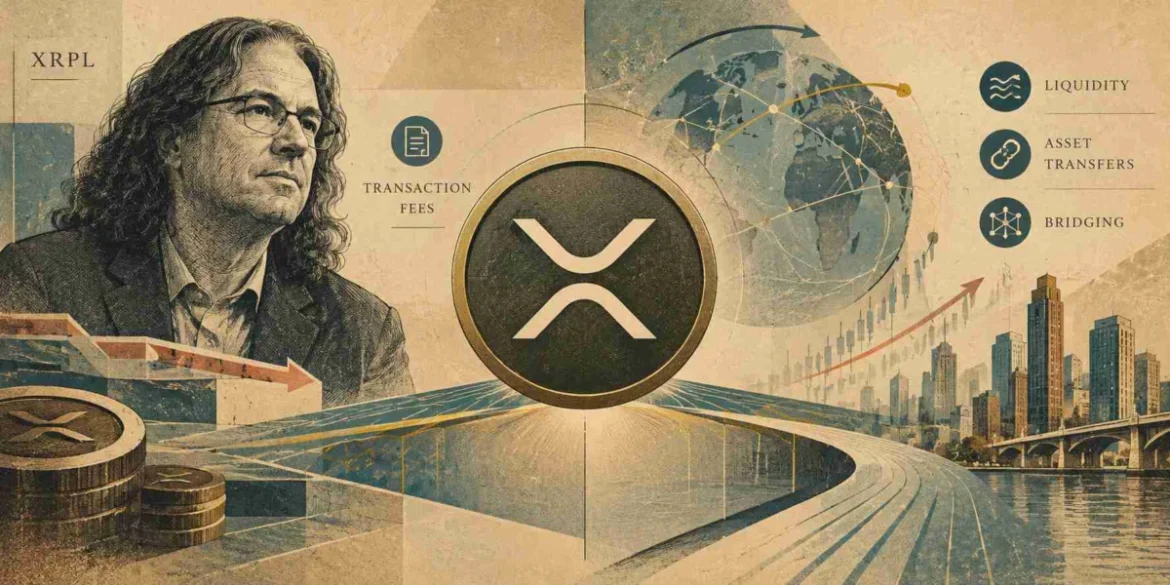
The ongoing debate surrounding the long-term valuation model of native blockchain assets has once again taken center stage within the cryptocurrency community. Ripple Chief Technology Officer Emeritus David Schwartz recently outlined a detailed framework explaining how the broader adoption of the XRP Ledger (XRPL) could fundamentally benefit XRP, the network’s native asset. Rather than resting the token’s value proposition entirely on market speculation, viral hype, or passive holding strategies, Schwartz’s commentary emphasizes structural utility, liquidity facilitation, and infrastructural demand.
As blockchain technology matures and institutional entities increasingly explore distributed ledger technology (DLT) for cross-border settlements, tokenized real-world assets (RWAs), and decentralized finance (DeFi), the relationship between network growth and native token demand has become a critical focal point. Observers and market analysts continually question whether high transactional volume on a base layer automatically translates to appreciating asset prices. Schwartz’s recent insights provide a nuanced perspective, separating the functional utility of the ledger from the economic mechanics that govern its native token.
The Core Thesis: Utility, Value Flow, and Structural Integration
At the heart of Schwartz’s thesis is the intersection of low transaction costs, operational reliability, and value capture. The XRPL has long prided itself on its ability to settle transactions in three to five seconds while maintaining fractions-of-a-penny fee structures. According to Schwartz, these technical advantages make the ledger an exceptionally attractive environment for moving and holding value.
However, attracting transaction volume is only half of the equation. The critical mechanism lies in how the native asset captures a portion of that financial activity. Because XRP serves as the foundational asset of the network, it possesses distinct architectural privileges that other issued tokens and currencies on the ledger do not share.
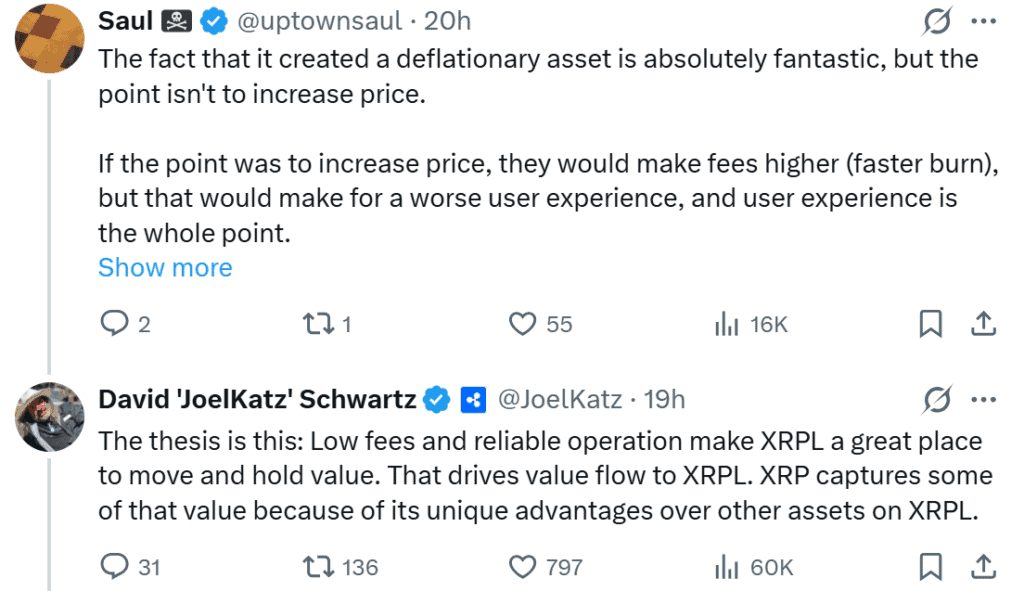
"Low fees and reliable operation make XRPL a great place to move and hold value," Schwartz stated in his public commentary. "That drives value flow to XRPL. XRP captures some of that value because of its unique advantages over other assets on XRPL."
This distinction is vital for understanding modern tokenomics. While platforms can experience surging network activity—measured in daily active addresses, smart contract calls, or token transfers—without seeing a corresponding rise in native token demand, the XRPL’s internal design creates mandatory touchpoints for XRP. Schwartz firmly maintains that a scenario where the XRPL achieves massive, sustained success in global financial applications while XRP fails to command high demand and value is statistically and structurally improbable.
Chronology and Context: The Evolution of the XRPL Utility Debate
The discussion surrounding XRP’s intrinsic utility is not new; it has evolved over more than a decade of blockchain development. When Ripple first deployed the XRPL in 2012, its primary use case was envisioned as a lightning-fast, highly scalable alternative to legacy financial rails like SWIFT, specifically targeting institutional cross-border payments via products like On-Demand Liquidity (ODL).
Over the subsequent years, the conversation expanded significantly. As decentralized finance (DeFi) gained prominence across the broader crypto ecosystem in 2020 and 2021, developers and validators within the XRPL community began heavily focusing on native decentralized exchange (DEX) capabilities, automated market makers (AMMs), and the tokenization of traditional financial instruments.
The recent exchange on social media platforms involving Schwartz, fellow developer community members like XRPL validator Vet, and prominent community figures such as Saul reignited these foundational debates. The dialogue specifically interrogated the mechanics of token burns, reserve requirements, and autobridging. By revisiting these foundational economic layers, industry participants sought to clarify how real-world financial adoption filters down to the asset itself, especially amid shifting market conditions and changing regulatory landscapes across major global jurisdictions.
Mechanics of Demand: Autobridging and the Native DEX
To understand why Schwartz believes XRPL adoption directly influences XRP demand, one must examine the ledger’s unique architectural features, most notably its built-in decentralized exchange and the autobridging mechanism.
Unlike many smart contract platforms where tokens require complex wrapping procedures or third-party liquidity pools to interact, the XRPL features a native DEX embedded directly into the protocol code. This allows users to issue, hold, and trade any asset—ranging from stablecoins like Ripple USD (RLUSD) to tokenized commodities and fiat currencies—directly on the ledger.
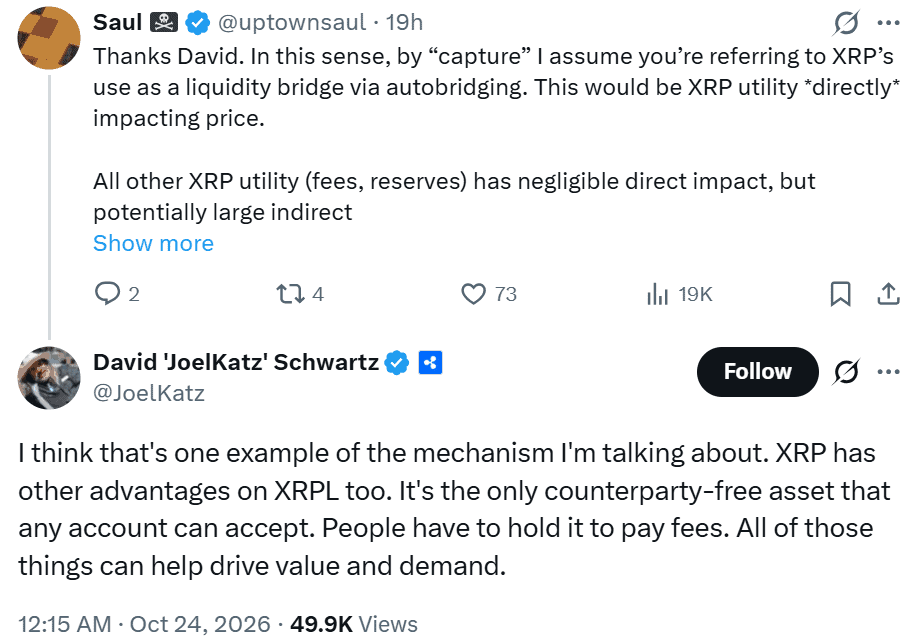
However, trading disparate assets can often suffer from fragmented liquidity. This is where XRP plays a crucial intermediary role. Through a feature known as autobridging, the XRPL’s native DEX can automatically route trades through XRP if doing so provides a more favorable exchange rate than a direct trading pair. For example, if a user wishes to trade a niche token for a specific fiat-backed stablecoin, and direct liquidity is thin, the ledger’s matching engine can seamlessly execute the trade via an asset path: Token A to XRP, and XRP to Stablecoin B.
This mechanism transforms XRP into an omnipresent liquidity bridge within the ecosystem. As institutional adoption grows, and as more stablecoins and real-world asset tokens circulate on the XRPL, the volume of trades leveraging autobridging naturally scales. Consequently, increased economic throughput on the DEX can generate consistent, organic demand for the native asset, completely independent of speculative retail trading cycles.
Fact-Based Analysis of Structural Requirements and Token Burns
Beyond trading mechanics, the XRPL enforces specific protocol-level requirements that mandate the use of XRP, establishing a baseline structural demand.
Every transaction executed on the XRPL requires a minute transaction fee. To prevent malicious actors from spamming the network with millions of valueless transactions (a common denial-of-service vector in distributed systems), these transaction fees are permanently destroyed—or "burned." Furthermore, accounts on the ledger are required to maintain a small reserve of XRP to activate addresses and hold trust lines or custom objects, ensuring that users do not bloat the ledger state with inactive data.
While these mechanisms are frequently cited by community members as bullish supply-reduction catalysts, analysts maintain a balanced, fact-based perspective regarding their direct price impact:
- Fee Burns: The amount of XRP destroyed via standard transaction fees is relatively minuscule compared to the asset’s total circulating supply. Therefore, the deflationary impact of burns alone is generally insufficient to drive major price appreciation unless transaction volume scales by several orders of magnitude. As XRPL supporter Saul pointed out during the community debate, the fee-burning mechanism was fundamentally engineered as an anti-spam and security feature rather than a direct price-manipulation tool. Excessive fee inflation would ultimately harm the network by pricing out legitimate users.
- Reserve Requirements: Account reserves lock up portions of the circulating supply, effectively reducing liquid availability. However, these tokens are not permanently removed from circulation; they remain bound to the user’s account and can be reclaimed if the account requirements change or if reserve minimums are adjusted downward by validator consensus.
Schwartz’s argument deliberately sidesteps relying heavily on these superficial supply-reduction narratives. Instead, his focus remains squarely on operational utility: the continuous, functional requirement for XRP to facilitate institutional liquidity, power cross-asset routing, and sustain ecosystem growth.
Coexistence with Broader Market Dynamics and Bitcoin Dominance
Another critical dimension of Schwartz’s recent commentary addresses the macro-crypto environment, specifically the dominant position of Bitcoin as the primary digital settlement asset and store of value.
Within the crypto industry, maximalist perspectives often suggest that a single asset must conquer all use cases to achieve long-term survival. Schwartz challenges this binary framing. He contends that XRP can maintain a thriving, highly valuable ecosystem role even in a world where Bitcoin retains dominance as the overarching macro settlement asset.
Because the XRPL functions as an independent, highly efficient financial ledger, its value proposition is derived from its utility to enterprises, payment providers, and institutional traders. XRP does not need to displace Bitcoin as a global store of value to succeed; it simply needs to act as the premier medium for liquidity routing, asset exchange, and instant settlement within its own native economic zone.
Validators and developers like Vet have continually underscored this point, highlighting that the introduction of new financial instruments—such as the Ripple USD (RLUSD) stablecoin—serves to enrich the XRPL’s overall utility stack rather than cannibalize the role of XRP. As institutional stablecoins and tokenized assets flow into the ledger, the surface area for autobridging expands, potentially reinforcing the structural necessity of the native token.
Broader Impact and Market Implications
The distinction between speculative demand and utility-driven demand remains one of the most critical challenges facing the digital asset class. As global financial regulators increasingly demand demonstrable real-world utility, compliance, and risk-mitigation frameworks from blockchain projects, statements from foundational architects like David Schwartz carry substantial weight.
By anchoring the long-term thesis of XRP in structural mechanics—such as the native DEX, autobridging, and low-cost value transfer—Ripple’s leadership continues to signal that the asset’s future is tied directly to enterprise adoption of the underlying ledger technology.
However, market analysts advise caution. While architectural utility establishes the capacity for sustainable long-term demand, market prices are ultimately governed by a complex convergence of macroeconomic conditions, regulatory clarity, broader liquidity cycles, and actual adoption metrics. Increased network activity on the XRPL does not automatically guarantee an immediate or proportional rise in market price if users rapidly velocity-churn the asset without sustained accumulation.
Ultimately, Schwartz’s perspective provides a pragmatic roadmap for the blockchain industry. It underscores the reality that for any native token to survive and thrive over decades, its utility must be deeply woven into the functional fabric of the network it powers. Whether the market will fully realize this utility-driven valuation model depends heavily on the pace of institutional adoption, the expansion of tokenized real-world assets on the XRPL, and the continued evolution of global digital finance.
