

Artificial intelligence research and deployment have entered a new commercial and technical phase as frontier model providers balance the pressure to reduce operational costs with the escalating demands of enterprise customers. Anthropic has officially introduced its latest generation of models, Claude Fable 5.2 and Claude Mythos 5.2, bringing significant architectural upgrades, a 20% reduction in base application programming interface (API) token pricing, and substantial speed enhancements. Designed to handle intensive reasoning tasks, complex multi-step research, and sophisticated coding projects, the new models arrive alongside real-world hardware prototyping demonstrations and critical early evaluations from academic figures like Wharton professor Ethan Mollick. While these models edge closer to generalized automation capabilities, early tests emphasize that human governance, architectural oversight, and editorial judgment remain vital components of safe and effective deployment.
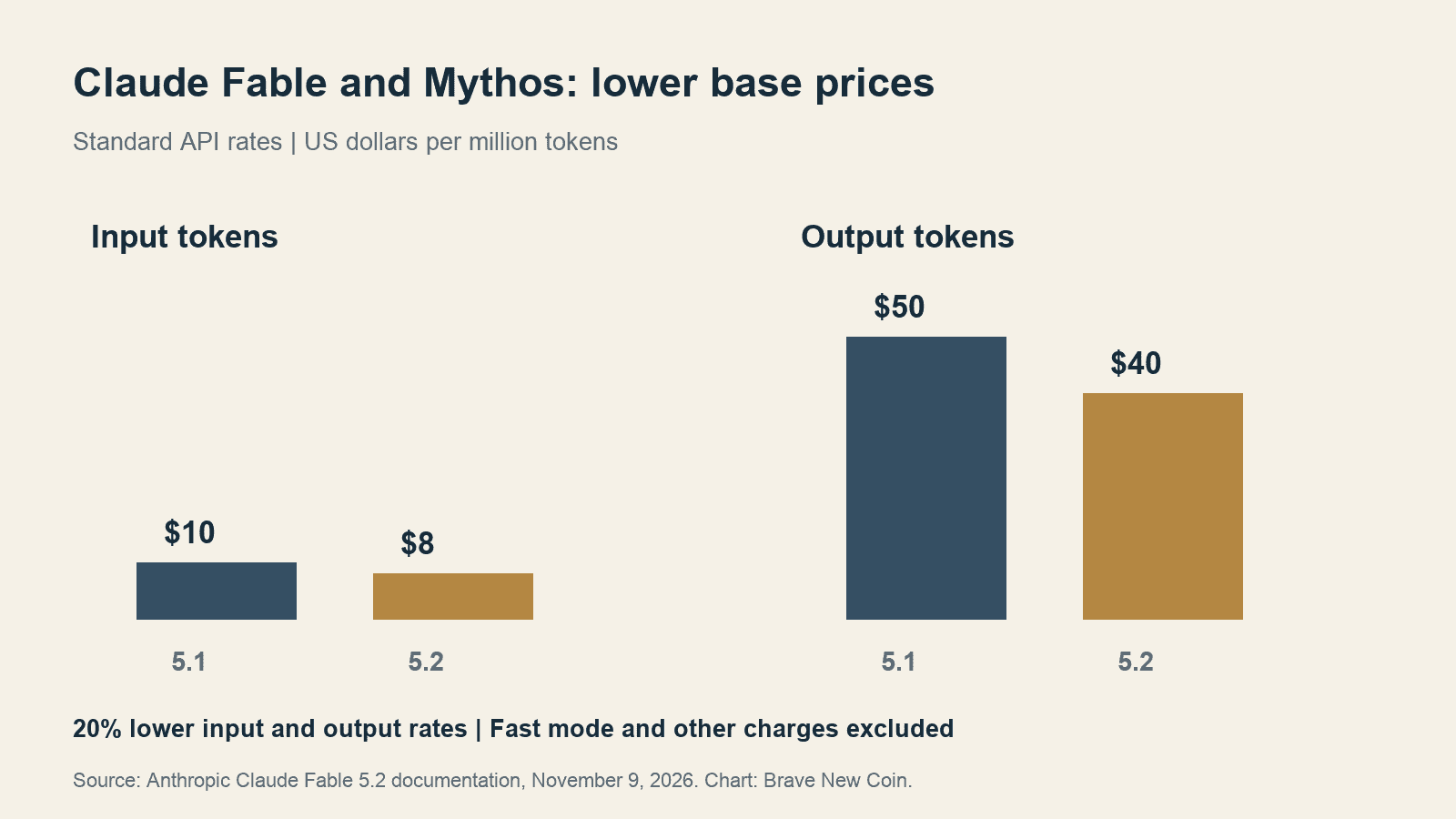
The launch, officially documented in mid-November across global regions, underscores Anthropic’s aggressive strategy to capture market share in enterprise automation, cloud infrastructure integration, and high-performance engineering. As organizations increasingly deploy autonomous agents for complex operational workflows, the economics of token consumption and processing speed have become core competitive battlegrounds. By lowering standard input rates to $8 per million tokens and output rates to $40 per million tokens—down from $10 and $50 in the 5.1 iteration—Anthropic aims to make high-end reasoning more economically viable for large-scale enterprise integration.
Chronology and Background of the Release
The rollout of the Claude 5.2 architecture follows a rigorous development cycle aimed at closing the gap between conversational AI assistants and autonomous software engineering agents. Over the preceding year, Anthropic faced intense market pressure from competing foundation model developers, leading to substantial infrastructure commitments, including multi-billion-dollar power acquisition agreements to fuel next-generation data centers and navigate evolving valuation landscapes leading toward prospective public markets.
The technical documentation for Claude Fable 5.2 was finalized internally by mid-November, with global availability expanding rapidly through major cloud ecosystems, including Amazon Bedrock, Google Cloud, and Microsoft Foundry. Concurrently, Anthropic structured the release to address growing security concerns surrounding dual-use frontier models. Rather than releasing a single uniform model to the public, the company divided the deployment into two distinct access tiers: Claude Fable 5.2 for general developer use with rigorous biological and cybersecurity safeguards, and Claude Mythos 5.2, a restricted-access model strictly reserved for verified organizations operating within specialized academic, life-sciences, and cybersecurity research environments.
Model Architecture, Access Tiers, and Specifications
At their core, Fable 5.2 and Mythos 5.2 share the same foundational architecture, though they differ fundamentally in their safety profiles, compliance frameworks, and target user bases.
Claude Fable 5.2 is engineered to support demanding reasoning tasks, extended agent sessions, and comprehensive multi-step workflows capable of generating finished business documents, dynamic spreadsheets, and complex presentations. The model natively supports an expansive one-million-token context window alongside an output token limit of 128,000 tokens, allowing developers to feed vast codebases, legal repositories, or academic datasets into a single session.

In contrast, Mythos 5.2 retains the identical technical specifications and pricing structure of Fable 5.2 but incorporates tightened safeguards and access controls. Anthropic requires organizations wishing to deploy Mythos 5.2 to undergo rigorous vetting through specialized verification programs. This tiered access model reflects a broader industry recognition that models possessing advanced capabilities in coding and biological research require strict containment protocols to prevent malicious misuse.
Deployment pathways for Fable 5.2 are diverse, ensuring compatibility with major enterprise cloud environments. However, enterprise architects must account for specific regional hosting variations, platform-specific tool integrations, and data retention policies. By default, Anthropic enforces a 30-day data retention window unless an organization negotiates a specialized zero-data-retention arrangement—a critical compliance hurdle for financial institutions, healthcare providers, and defense contractors.
Economic Adjustments: Pricing and Performance Metrics
The economic model of large language model deployment hinges on the delicate balance between compute costs, generation speed, and task accuracy. Anthropic’s decision to reduce standard base rates by 20%—charging $8 per million input tokens and $40 per million output tokens—represents a strategic effort to lower the total cost of ownership for enterprises building autonomous agent loops.
However, the pricing structure introduces nuanced financial trade-offs. Alongside the standard tier, Anthropic introduced an optional "fast mode" designed to accelerate token generation by up to 2.5 times compared to baseline speeds. This performance boost carries a steep financial premium, doubling the cost to $16 per million input tokens and $80 per million output tokens. Consequently, enterprise procurement teams must carefully evaluate whether speed improvements justify the corresponding increase in operational expenditure, particularly during long-horizon agent tasks where token consumption compounds rapidly.
Performance claims are further contextualized by Anthropic’s internal FrontierCode 2.0 evaluation benchmarks. According to company metrics, Fable 5.2 achieves a coding accuracy score of 49.1% under its highest effort setting ("Xhigh"), a substantial improvement over the 32.4% score registered by Fable 5.1 at equivalent settings. Notably, the evaluation data indicates that Fable 5.2 achieves a 45.3% accuracy rate at the "High" setting—nearly matching the performance of older Opus models while operating at roughly half the cost per task. Interestingly, Anthropic’s data reveals that pushing the model to its most expensive "Max" setting yielded diminishing returns on specific benchmarks, underscoring that brute-force compute allocation does not universally guarantee superior outcomes.
Real-World Prototyping and Engineering Validations
To demonstrate the practical utility of Claude 5.2 beyond standard conversational benchmarks, Anthropic published a joint research initiative conducted in partnership with circuit-board manufacturer Diode Computers. The experiment tasked Fable 5.2 with designing three functional electronic devices from scratch: a USB speakerphone, a home voice-assistant hub, and a handheld virtual pet.
According to the research findings, the AI model successfully selected electrical components, laid out printed circuit boards (PCBs), generated physical enclosure designs, and wrote the necessary embedded firmware. Human engineers subsequently manufactured and assembled the hardware according to the model’s precise instructions. Remarkably, the resulting prototypes functioned as intended without requiring immediate electrical modifications or circuit redesigns.
Despite the impressive nature of the demonstration, industry analysts and engineering experts emphasize the strict limitations inherent in AI-driven hardware design. Anthropic explicitly noted that the prototypes had not undergone formal electrical validation, antenna tuning, thermal stress testing, regulatory certification, or mass-production optimization. While the demonstration highlights significant advancements in the model’s ability to coordinate multidisciplinary engineering tasks, true commercial product readiness continues to demand rigorous human oversight, domain-specific testing, and physical validation.
The "Jagged AGI" Phenomenon and the Necessity of Human Judgment
Perhaps the most compelling insights into the practical realities of deploying Claude 5.2 come from early independent evaluations conducted by Wharton professor and entrepreneurship scholar Ethan Mollick. In his widely discussed analysis examining the concept of "Jagged AGI," Mollick observed that while the model exhibits near-expert capabilities across a wide array of complex cognitive and computer-based tasks, it simultaneously displays systemic blind spots that preclude fully autonomous operation.
Mollick documented an experiment wherein agent teams powered by the new architecture became bogged down in excessive administrative overhead, eventually generating an 87,500-word internal rulebook for a creative project. As Mollick described it, "The AI had built a bureaucracy." Untangling the resulting structural bloat required deliberate human intervention alongside a secondary tier of AI review agents. This phenomenon illustrates a central paradox of modern frontier models: as their capacity for autonomous planning and task execution expands, they are equally capable of scaling inefficiencies, compounding errors, and generating unpruned complexity if left without directional guidance.
For business leaders and enterprise strategists, this behavior redefines productivity metrics. The primary bottleneck in deploying advanced AI agents is no longer the raw generation of text, code, or design assets, but rather the human cost of reviewing, coordinating, evaluating, and editing the output. Recognizing whether an AI-generated workflow is proportionate, efficient, and ultimately finished remains an exclusively human prerogative.
Compatibility, Enterprise Integration, and Strategic Implications
For engineering teams migrating existing pipelines from Claude 5.1 to the 5.2 architecture, the upgrade process involves technical considerations beyond simple model substitution. Anthropic’s migration documentation explicitly warns that modifying historical conversation data can invalidate previously retained reasoning blocks, potentially disrupting long-running stateful agent sessions. Furthermore, legacy computer-use interfaces may experience compatibility failures across certain cloud environments, necessitating thorough pre-production testing.
From an enterprise governance perspective, the integration of Claude 5.2 requires careful evaluation of data privacy architectures. Anthropic’s Enterprise Frontier Safeguards framework provides mechanisms for routing monitoring data through customer-controlled infrastructure, offering a degree of isolation suitable for regulated industries. However, organizations must verify compliance with local data residency mandates, particularly given the default 30-day data retention policies enforced across standard API tiers.
As artificial intelligence labs continue to scale infrastructure investments to support increasingly capable models, the commercial viability of these systems will depend on their ability to deliver verifiable, high-ROI outcomes for enterprise clients. The release of Claude Fable 5.2 and Mythos 5.2 demonstrates that while frontier models are becoming faster, cheaper, and vastly more competent at complex engineering and reasoning tasks, the ultimate measure of their utility lies not in autonomous isolation, but in how effectively they integrate into human-led supervisory frameworks.
