

The global Bitcoin network experienced a significant recalibration on November 14, 2026, as mining difficulty plummeted by 9.13%. This adjustment, the most substantial single-period reduction since June of the same year, was initially interpreted by market observers as a reactionary response to softening cryptocurrency valuations. However, granular data analysis of energy markets reveals that the primary catalyst was not the price of Bitcoin itself, but rather a localized, severe power supply squeeze within the Electric Reliability Council of Texas (ERCOT) grid.

For Bitcoin miners, the fundamental operational equation is governed by the relationship between the cost of electricity and the revenue generated per unit of computing power, known as energy hashprice. When real-time power costs exceed the revenue potential of mining hardware, rational operators in competitive markets like Texas are incentivized to curtail operations to avoid operating at a net loss. The events of early November 2026 provided a definitive case study in how energy infrastructure limitations can exert more immediate pressure on global hashrate than fluctuations in digital asset spot prices.
Chronology of the Grid Squeeze
The instability began in early November, primarily concentrated in West Texas, a region that serves as one of the world’s most dense hubs for industrial-scale Bitcoin mining operations. On November 4, wind energy output in West Texas was robust, recording 12.6 gigawatts (GW). By November 7, that figure had plummeted to roughly 1 GW.

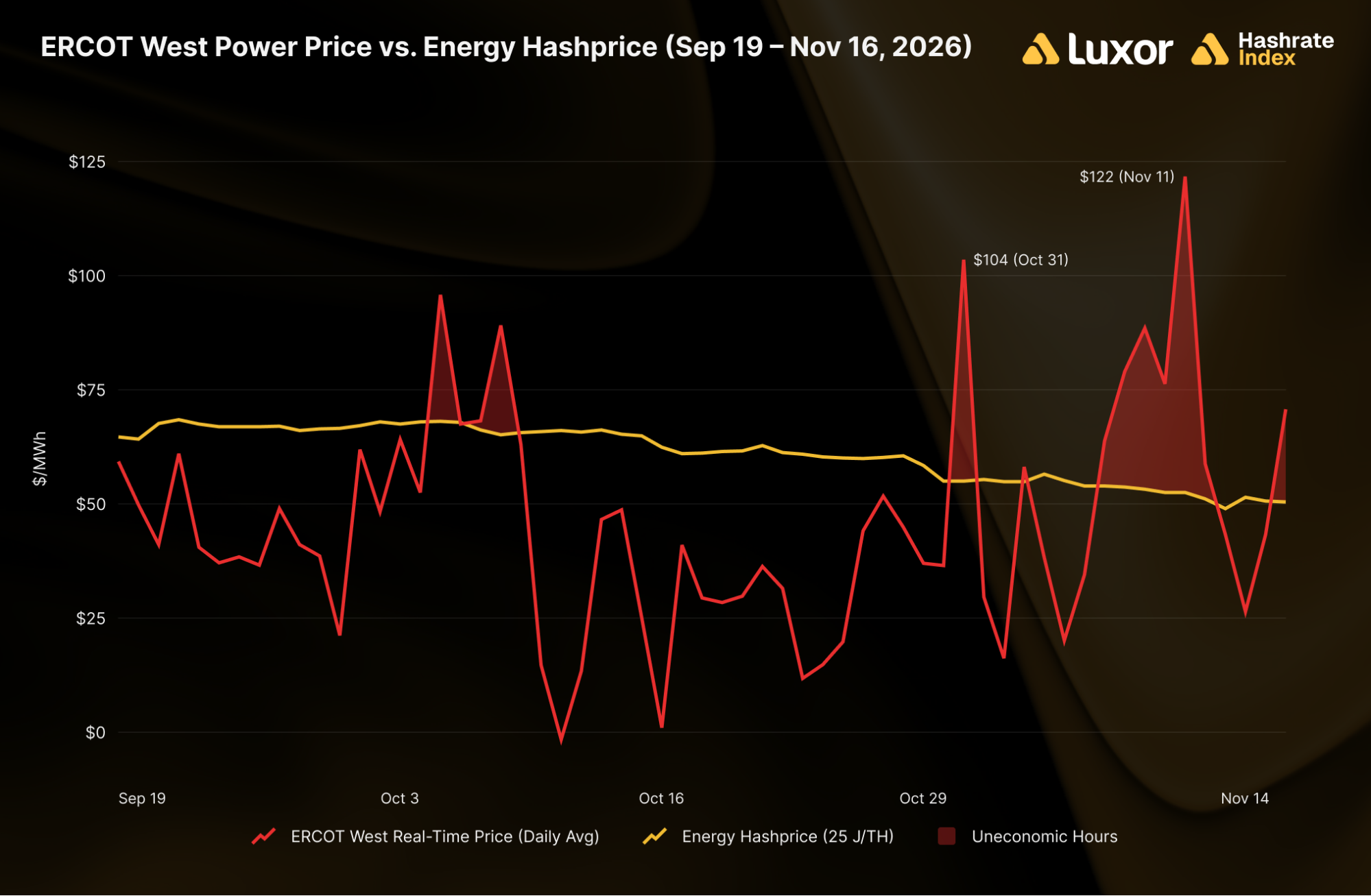
This dramatic collapse in renewable generation was exacerbated by the physical limitations of the regional transmission infrastructure. The 345-kV transmission lines, which facilitate the transport of power from the resource-rich plains of West Texas to the high-demand urban centers, reached their capacity limits. Consequently, a "bottleneck" effect occurred, causing power prices in West Texas to decouple from the rest of the state. On November 9, West Texas electricity prices spiked, trading at a premium of $47/MWh above the statewide average.
The crisis intensified during evening hours. As solar generation faded with the sunset, the grid’s reliance on thermal and battery storage increased, driving power prices to between $80 and $98/MWh during the 5 p.m. to 11 p.m. window. By November 11, the localized volatility expanded into a statewide phenomenon. Wind output dropped to between 2 and 4 GW after dusk, triggering extreme price spikes in the North, South, and West hubs, where hourly clearing prices reached between $500 and $650/MWh.
Economic Impact on Mining Operations
To quantify the impact, industry analysts utilize the "25 J/TH" benchmark, which represents the efficiency of modern, high-performance mining rigs. During the epoch spanning October 29 to November 14, this machine class averaged an energy hashprice of $54/MWh.
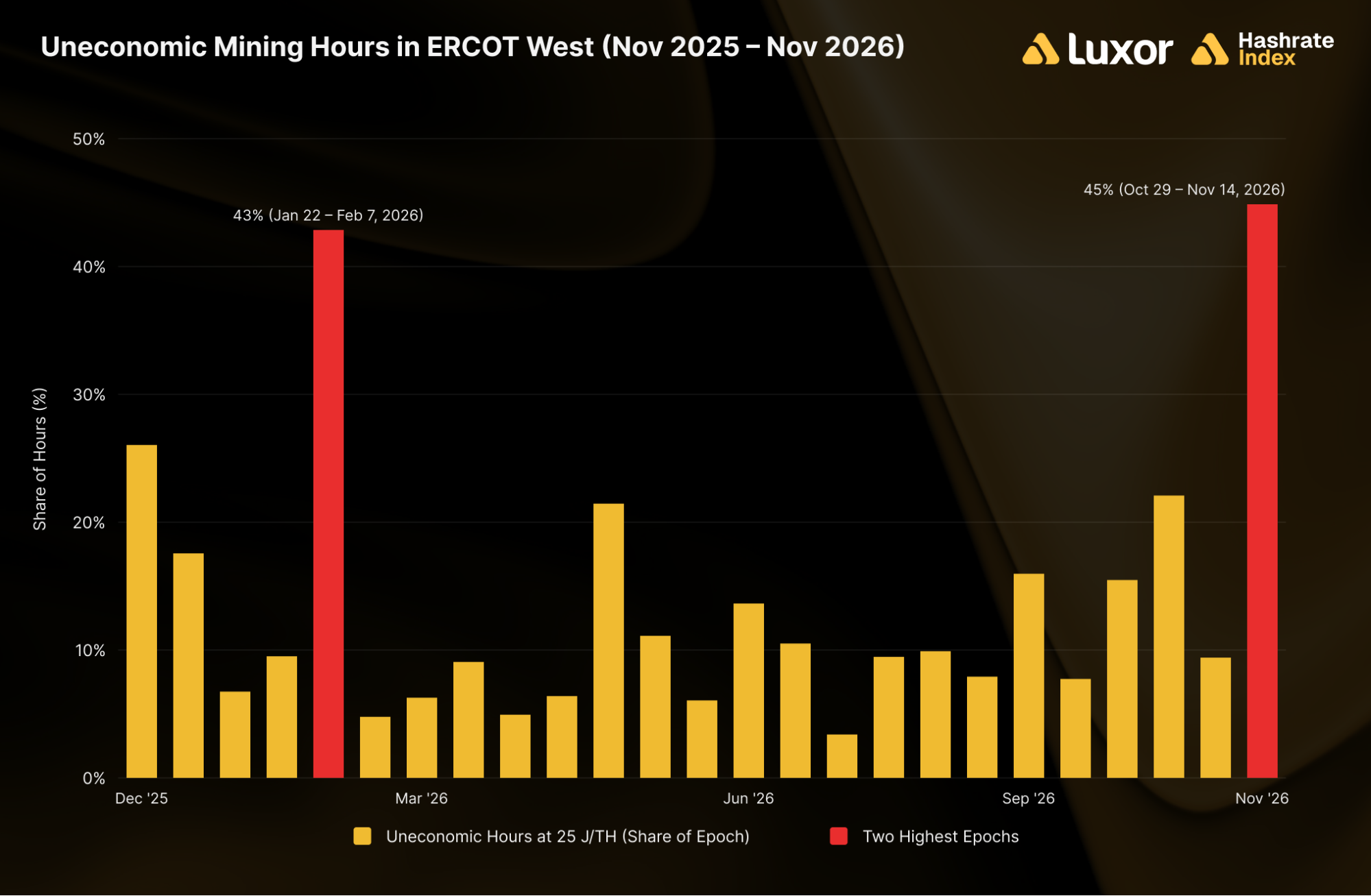
Data from ERCOT indicates that from October 29 to November 14, power costs exceeded the earnings potential of a 25 J/TH machine for 45% of the hours in West Texas. For context, this figure stood at only 9% during the preceding epoch (October 16 to 29). This 36-percentage-point surge represents the most difficult economic environment for Texas-based miners in at least a year, surpassing even the operational challenges posed by the severe winter storm in January 2026.
Disentangling Price Drivers: Power vs. Bitcoin
A critical analytical challenge lies in distinguishing between the impact of declining Bitcoin prices and the impact of rising energy costs. To isolate these factors, analysts held the energy hashprice constant at October 16–29 levels and modeled the effect of the November power price spikes alone. The simulation showed that power price volatility accounted for approximately 30 of the 36-point increase in uneconomic hours. Conversely, holding power prices constant and adjusting only for the decline in Bitcoin’s market price would have only increased the share of uneconomic hours by 8 percentage points.
Statistically, power market dynamics were responsible for roughly four-fifths of the total downward pressure on mining profitability. Furthermore, the network-level response supports this conclusion. Texas is estimated to host approximately 17% of the global Bitcoin hashrate—roughly 180 EH/s. By calculating the correlation between curtailed capacity and the total network hashrate drop, it becomes evident that the Texas shutdown accounts for approximately 75% of the total 91 EH/s reduction in the 14-day moving average of global hashrate.
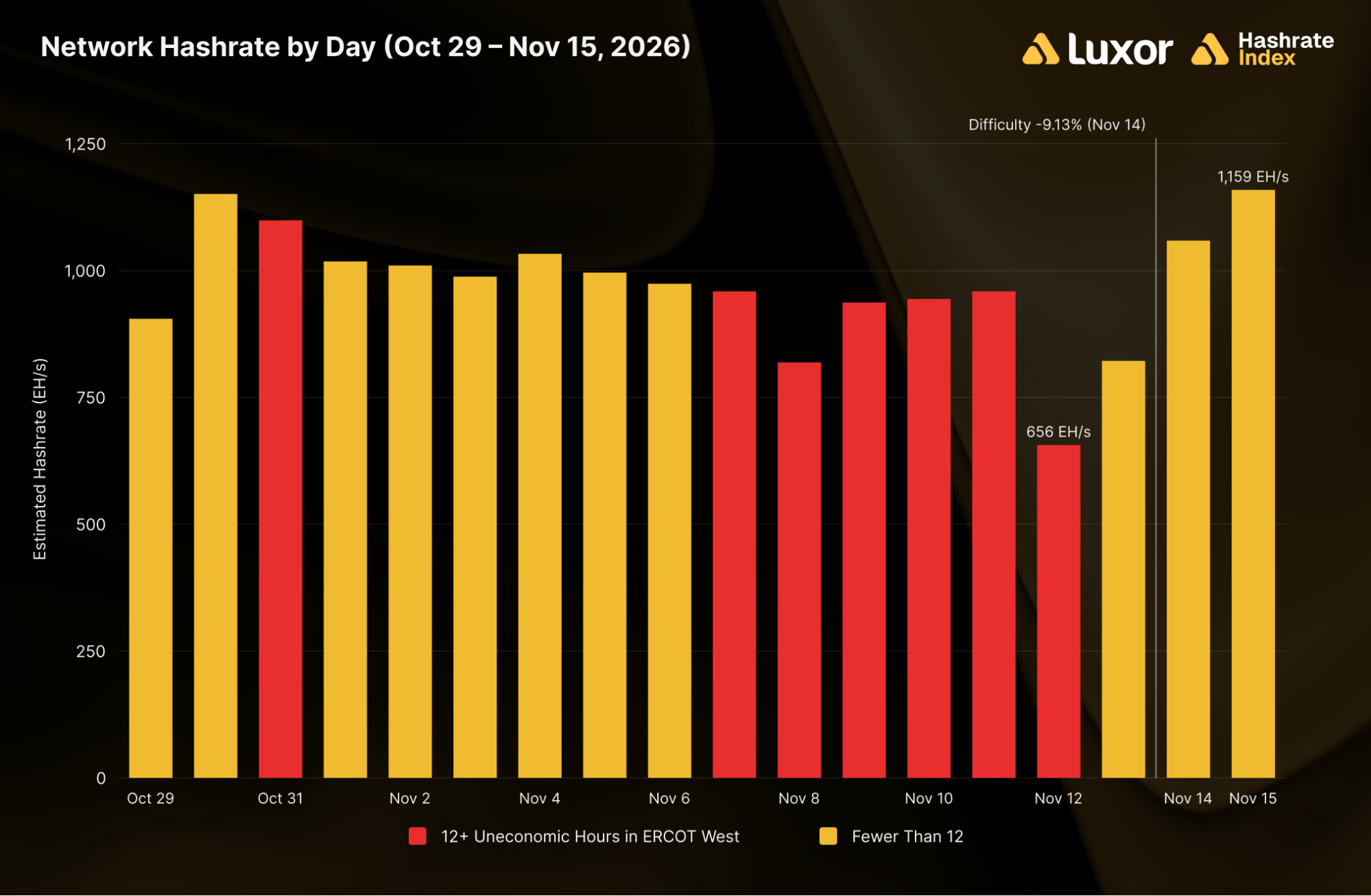
The "weekend test" provided further empirical verification. Between November 11 and November 16, the price of Bitcoin fell by 13%, dropping from $73,900 to $64,500. Under a theory where Bitcoin price is the primary driver of curtailment, one would expect the hashrate to continue its decline. Instead, as the weather-related power volatility in West Texas subsided—with prices falling to a range of $26–$43/MWh—the global hashrate rebounded to near 1,100 EH/s within 24 hours, despite the lower price of the underlying asset.
Broader Implications and Future Outlook
The November 2026 event underscores the evolving relationship between the Bitcoin mining industry and energy markets. Modern mining fleets are increasingly managed as flexible "demand-response" assets. While the temporary shutdown led to a significant difficulty adjustment, the structural integrity of the network remained robust. Because mining operations are highly modular, they can cycle back online the moment power prices return to sustainable levels.
Blocks have averaged 9.1 minutes since the adjustment, suggesting that the network is already primed for an upward difficulty correction of approximately 10% in the next cycle, provided current energy conditions persist. However, the market remains cautious. With 538 of 2,016 blocks processed as of mid-November, the trajectory of the next adjustment is not yet certain. Volatility remains a permanent fixture, evidenced by West Texas prices briefly exceeding $120/MWh again on November 16.
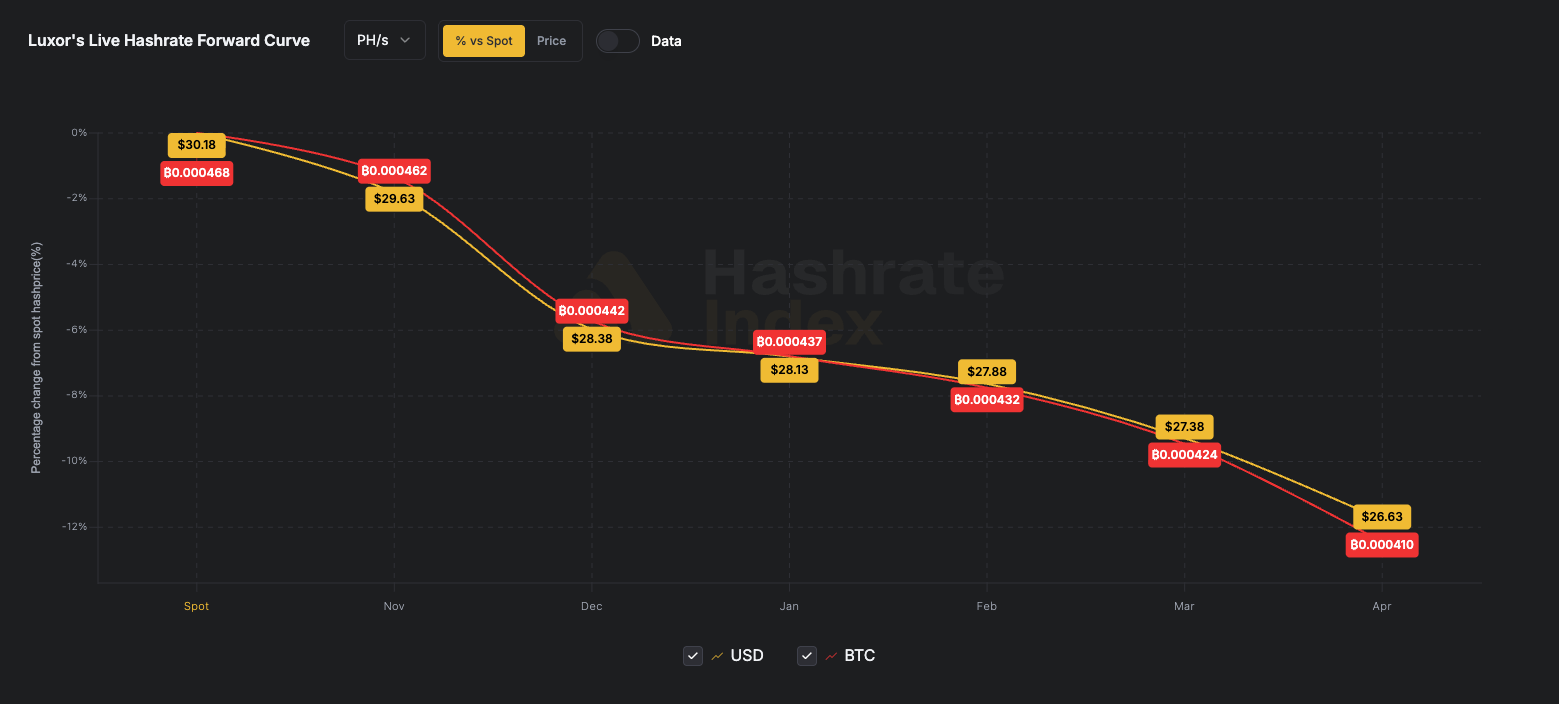
For institutional participants, these events have accelerated the adoption of financial risk management tools. Luxor’s hashrate forward market is currently pricing in an average hashprice of $28.23—or 0.000437 BTC per PH/s/day—over the coming six-month period. Such derivatives allow miners to hedge against the volatility of both electricity prices and Bitcoin, providing a mechanism to lock in operational margins regardless of localized grid instability.

As the industry matures, the integration of mining with energy grid management is likely to deepen. Rather than viewing Bitcoin miners solely as energy consumers, utility providers and grid operators are increasingly recognizing them as a "flexible load" that provides essential stability to power grids during periods of supply-demand mismatch. The events of November 2026 demonstrate that while power grid constraints can cause short-term ripples in the global mining landscape, the fundamental nature of the network—self-correcting and highly competitive—ensures that it remains a resilient, decentralized, and responsive system. The shift from manual to automated, data-driven curtailment strategies is expected to define the next phase of industrial-scale Bitcoin mining in energy-volatile regions like Texas.
