
In the fast-evolving landscape of digital asset security and cybercrime investigation, the recent breach of cryptocurrency exchange Bitget has marked a significant watershed moment. On September 24, 2026, malicious actors—subsequently attributed by cybersecurity intelligence and blockchain analytics firms to state-sponsored entities from North Korea (DPRK)—perpetrated one of the largest digital heists of the year, siphoning an astounding $387 million from the platform. The sheer scale and speed of the exploit presented an unprecedented challenge to traditional financial investigators, who historically relied on painstaking, manual transactional tracing. However, the response by blockchain intelligence firm Chainalysis showcased a paradigm shift in how high-profile cryptocurrency thefts are handled, leveraging bespoke artificial intelligence agents to compress weeks of investigative labor into mere minutes.
The anatomy of the attack underscored the growing sophistication of cyber syndicates targeting the decentralized finance ecosystem. In the immediate aftermath of the breach, the threat actors demonstrated an exceptional degree of operational agility, fracturing the stolen capital into a web of complex, multi-chain transactions designed to obfuscate the origin and destination of the funds. As the global regulatory and law enforcement communities watched anxiously, the imperative to map the movement of capital in real-time became paramount. Through the deployment of advanced, in-house AI automations operating on top of a decade’s worth of cross-chain attribution data, investigators were able to pierce through the veil of digital obscurity, establishing a blueprint for how modern forensic operations must evolve to counter technologically advanced adversaries.
Anatomy of a Multichain Heist: The First Three Hours
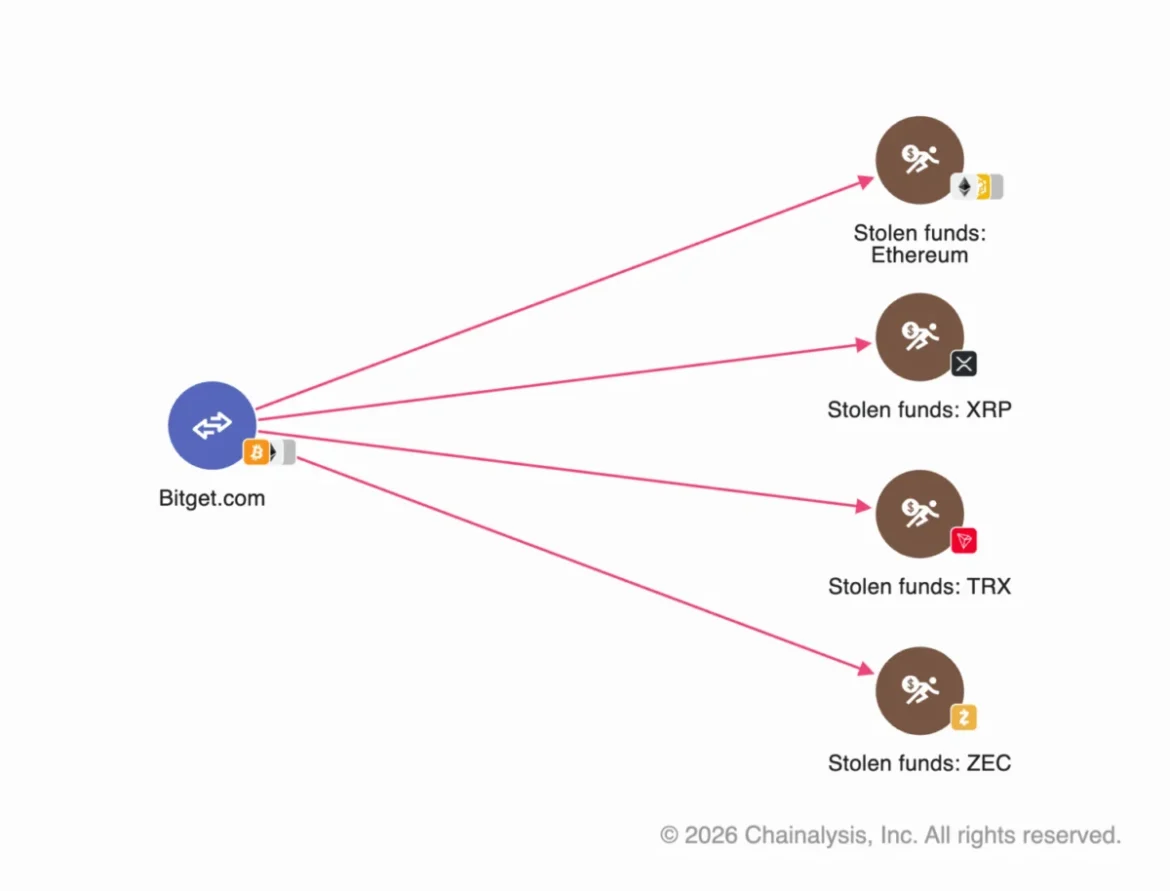
The chronology of the Bitget exploit unfolded with ruthless efficiency. Within the first three hours following the initial breach, the $387 million in stolen digital assets was entirely evacuated from the exchange’s reserves across 23 distinct initial transfers. Rather than consolidating the funds into a single cryptocurrency or network, the perpetrators immediately diversified their holdings across four disparate blockchains, complicating tracking efforts from the outset.

According to forensic breakdowns provided by blockchain intelligence platforms, the distribution of the stolen funds immediately following the extraction was heavily weighted toward Ethereum and XRP. Ethereum accounted for the largest single share, absorbing 49.7% of the total stolen capital, closely followed by XRP at 40.8%. Privacy-centric cryptocurrency Zcash captured 7.6% of the illicit funds, while Tron accounted for the remaining 1.8%. This deliberate fragmentation was engineered to exploit the inherent friction between different blockchain architectures, making traditional, single-chain monitoring tools largely ineffective without extensive manual intervention.
Once the assets landed on these diverse ledgers, the threat actors initiated a series of sophisticated laundering mechanisms. These included the deployment of cross-chain liquidity protocols, encrypted messaging systems, instant decentralized exchanges (DEXs), and various illicit laundering services. Of particular note was the handling of the stolen XRP. Instead of dumping the asset onto centralized exchanges where KYC (Know Your Customer) protocols could trigger immediate freezes, the attackers funneled the XRP through advanced cross-chain liquidity protocols. By utilizing these mechanisms, the perpetrators were able to deposit XRP on one chain and seamlessly extract native Bitcoin on the other side, bypassing the need for traditional intermediary accounts or centralized order books.
The Operational Response: How AI Transformed the Investigation
In a traditional financial investigation, tracing cross-chain liquidity swaps and bridging activities of this magnitude represents a massive bottleneck. Reconciling transaction hashes, verifying ledger states across disparate consensus mechanisms, and matching deposits to corresponding payouts typically requires teams of human analysts working around the clock for days or even weeks. In the case of the Bitget incident, Chainalysis estimated that manual bridge reconciliation alone would have consumed upwards of 20 hours of intensive labor per major transactional pathway.
To match the breakneck speed of the threat actors, Chainalysis mobilized a round-the-clock war room, deploying a novel investigative framework powered by custom-built artificial intelligence agents. Unlike standard AI tools designed merely to visualize data graphs or summarize text, this agentic platform empowered human investigators to directly interrogate internal and external data sources. The AI was tasked with writing and executing custom automations tailored specifically to the unique topologies of the Bitget exploit.

By automating the routine tasks of cross-chain reconciliation and transaction matching, the platform compressed a projected 20-hour manual workflow into less than 10 minutes. Crucially, the deployment of artificial intelligence did not supplant human expertise; rather, it served as an exponential force multiplier. Human investigators retained total control over defining analytical logic, reviewing algorithmic outputs, and directing the overarching strategy of the investigation. The AI merely eradicated the latency associated with manual data entry and multi-ledger verification, allowing analysts to focus their cognitive bandwidth on interpreting complex laundering patterns and predicting the final destination of the assets.
Operationalizing Intelligence for Law Enforcement and Compliance
Speed is the ultimate currency in the realm of cryptocurrency asset recovery. When stolen funds can traverse international borders, convert between asset classes, and pass through privacy mixers in a matter of hours, forensic discoveries lose their utility if they cannot be operationalized rapidly.
Recognizing this reality, Chainalysis integrated its findings into its core intelligence platform within minutes of verification. Destination addresses, intermediary wallet clusters, and newly identified transactional pathways associated with the Bitget exploit were instantly tagged with platform labels flagging them as illicitly obtained funds. This immediate data provisioning furnished global compliance teams, centralized cryptocurrency exchanges, asset issuers, and international law enforcement partners with the actionable intelligence required to interdict the flow of capital before it could be fully laundered into fiat currency or untraceable privacy coins.
Throughout the multi-day tracing process, investigators successfully tracked tens of millions of dollars through cross-chain protocols, following the capital through a maze of decentralized exchanges and privacy-enhancing services until it finally coalesced into attacker-controlled Bitcoin addresses. These terminal addresses have since been placed under continuous, real-time surveillance by forensic experts and law enforcement agencies alike.

Broader Industry Implications and the North Korean Cyber Threat Nexus
The Bitget breach does not exist in a vacuum; it represents a continuation of an alarming macro-trend defining the contemporary cybersecurity landscape. With the addition of the $387 million stolen from Bitget, the aggregate volume of cryptocurrency misappropriated by North Korea-attributed threat actors throughout the year surpassed the grim milestone of $1 billion.
State-sponsored hacking syndicates operating out of Pyongyang—most notably organizations such as the Lazarus Group—have systematically industrialized cryptocurrency theft as a core mechanism for state revenue generation, bypassing international economic sanctions to fund strategic military programs. What makes these state-sponsored actors particularly formidable is their early and aggressive adoption of automation. DPRK-linked syndicates increasingly rely on sophisticated, automated scripts to split, route, and launder stolen funds across multiple blockchains simultaneously, minimizing human error and operational dwell time.
The successful mitigation and rapid tracing demonstrated during the Bitget incident illustrate that the cybersecurity community is entering a new era of technological arms race. As threat actors scale their operations using automated tooling, defensive infrastructure must evolve in lockstep. The deployment of agentic AI platforms in forensic investigations signals a necessary maturation of blockchain intelligence, proving that defenders can successfully leverage machine speed without sacrificing human investigative rigor.
Looking Ahead: The Road to Asset Recovery and Future Capabilities

As the investigation enters its subsequent phases, the focus remains firmly on disruption and recovery. In the coming weeks, forensic teams will continue to deploy custom tooling to monitor the residual balances of the stolen funds, dynamically update address labels as new consolidation wallets emerge, and coordinate closely with global judicial authorities.
Furthermore, the methodologies validated during the Bitget crisis offer a clear preview of the next generation of investigative technologies. As decentralized finance continues to expand in complexity and multi-chain interoperability becomes the industry standard, the ability to synthesize disparate ledger data autonomously will define the success or failure of future asset recovery operations. The lessons learned from the defense of Bitget will undoubtedly reshape industry standards, establishing a new benchmark for public-private collaboration, automated forensics, and the defense of the global digital asset economy against state-backed cyber warfare.
