

Despite mounting bearish pressure threatening to push Ethereum’s price back to the $1,500 support level, the network is demonstrating remarkable resilience and robust fundamental growth, with on-chain activity revisiting and even surpassing historic highs. This divergence between price performance and underlying network health presents a complex picture for investors and analysts alike, highlighting Ethereum’s enduring utility and adoption as a foundational layer of the decentralized web.
Ethereum’s Unprecedented Network Resurgence Amidst Market Volatility
While the market sentiment around Ethereum (ETH) has leaned bearish, with its price slowly losing stability and retesting key support levels like $1,600, the network itself is experiencing a powerful resurgence in activity. Reports from leading market experts, including Leon Waidmann, head of research at Lisk, indicate that activity across the Ethereum blockchain has climbed to record levels, signaling growing engagement across its vast ecosystem. This surge in activity underscores the network’s critical role as a fundamental layer for decentralized finance (DeFi), tokenization, and a wide array of blockchain-based applications. The sustained growth points to increasing demand from a diverse group of participants, including individual users, developers, and even institutional entities.
Historically, periods of significant price appreciation in cryptocurrencies have been accompanied by spikes in network activity. However, Ethereum’s current trajectory presents a unique scenario where robust engagement persists despite downward price momentum. This suggests a deepening intrinsic value and utility that transcends short-term market fluctuations. The network’s architecture, continuous development, and the expansion of its Layer 2 scaling solutions contribute significantly to its capacity to handle increased transaction volumes and user interactions, making it more attractive for practical applications.
Surpassing Previous Bull Market Peaks
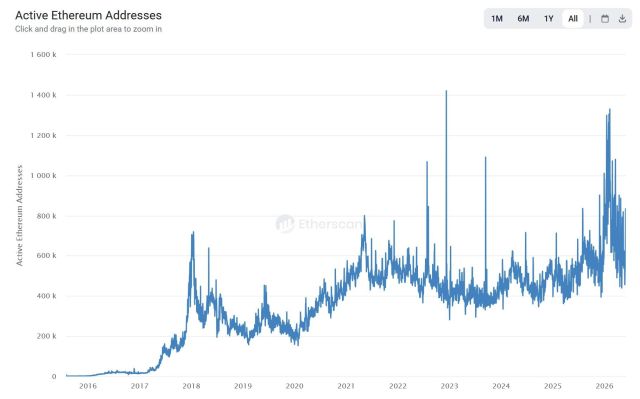
Detailed data on daily active addresses further illustrates this extraordinary trend. While ETH’s price may appear stagnant or "dead" to some observers, the number of daily active addresses on the network is consistently hovering near its highest range ever. To put this into perspective, during the 2018 bull market cycle, active wallet addresses on Ethereum peaked at approximately 720,000. The subsequent bull run in 2021 saw this figure rise to a peak of around 800,000 active addresses.
In the current market cycle, spanning from late 2025 into 2026, Ethereum has consistently pushed past the 1 million daily active address mark, at times peaking above an impressive 1.3 million. This substantial increase signifies that the network is processing a significantly higher volume of real economic activity and user interactions today than it did during the euphoria of previous bull market tops. This sustained engagement during a period of price consolidation suggests a maturing ecosystem where utility, rather than pure speculation, is becoming a more dominant driver of network usage. The growing complexity and diversity of dApps, from decentralized exchanges (DEXs) and lending protocols to NFT marketplaces and blockchain gaming platforms, all contribute to this elevated baseline of activity.

The Engine of Decentralized Finance and Innovation
Ethereum’s position as the bedrock of the decentralized finance (DeFi) sector is a primary driver of its enduring network activity. The vast majority of DeFi protocols, stablecoins, and non-fungible tokens (NFTs) are built on or heavily integrated with Ethereum. This makes the network indispensable for anyone participating in these burgeoning digital economies. Even with the rise of alternative Layer 1 blockchains, Ethereum’s established security, developer community, and network effects continue to attract substantial capital and innovation.
Furthermore, the continuous development roadmap for Ethereum, including ongoing improvements to its scalability, security, and sustainability (such as through sharding and further upgrades post-Merge), instills confidence among developers and users. This forward-looking approach ensures that the network remains competitive and capable of handling future demand, reinforcing its status as a critical global public utility for digital assets and decentralized applications.
Historic ETH Withdrawals Signal Strong Conviction
Further reinforcing the narrative of underlying strength is a significant trend observed in Ethereum’s supply dynamics: a massive withdrawal of ETH from centralized cryptocurrency exchanges. As of recent data, the total amount of ETH held on crypto exchanges has plummeted to approximately 14.5 million ETH, marking its lowest level in history. This historic low is particularly notable because it occurred during a period of market instability, rather than preceding it, which is an unusual market dynamic.
Typically, during periods of heightened volatility or price uncertainty, exchanges tend to experience steady inflows of assets as users prepare to sell or trade. However, the opposite has transpired with Ethereum. This phenomenon suggests a strong conviction among holders, who are moving their assets off exchanges into self-custody wallets. This action usually indicates a long-term holding strategy, reducing immediate selling pressure and signaling a belief in Ethereum’s future value.
A Divergence from Volatility Norms
Examining the timeline of these withdrawals provides even greater context. In October 2023, the ETH exchange balance stood at around 21 million ETH. Over the past two and a half years, an astonishing 6 million ETH have been pulled off centralized exchanges. This sustained outflow, particularly against a backdrop of general market bearishness, is a powerful indicator. As Leon Waidmann aptly summarized, "Whoever is buying here isn’t selling back." This statement implies that the ETH being acquired, likely by long-term investors, institutions, or those engaging in staking, is being immediately secured off-exchange, effectively removing it from the readily tradable supply and limiting its exposure to short-term market fluctuations.

This trend has significant implications for future price action. A reduced supply on exchanges, coupled with increasing demand driven by network activity and potential institutional adoption (such as through spot Ethereum ETFs), could create a supply shock scenario. Should market sentiment shift positively, the limited available supply on exchanges could lead to rapid price appreciation, as buyers would have fewer tokens to acquire from sellers. This dynamic highlights a quiet accumulation phase, where smart money may be positioning itself for the next market cycle, viewing current price levels as opportune for long-term investment.
Decoding Ethereum’s Price Bottom: The Delta Price Metric
While fundamental network metrics paint a bullish long-term picture, the immediate price outlook for Ethereum remains a subject of intense analysis. Seasoned crypto analyst Ali Charts has provided insight into Ethereum’s potential price bottom, anchoring his analysis on the Ethereum Delta Price metric. This sophisticated on-chain indicator has a notable track record, having accurately identified the last two major market bottoms for the altcoin.
Historical Precedent and Accumulation Zones
The Delta Price metric is designed to reflect the intricate connection between investors’ aggregated cost basis and the estimated cost of miner production. By synthesizing these two crucial components, it consistently highlights "deep accumulation zones"—periods where the price is considered to be at or near its lowest point before a significant reversal. These zones represent optimal entry points for long-term investors, as they typically coincide with periods of maximum pain for short-term holders but strong conviction for those with a longer time horizon.
After a thorough examination of this metric, Ali Charts has highlighted that Ethereum’s potential price bottom could sit near the $700 mark. This projection suggests that if historical patterns hold true, ETH could experience a retest of this $700 level before embarking on its next sustained upward trend. It’s crucial for investors to understand that while historical performance provides valuable insights, it does not guarantee future results. However, the reliability of the Delta Price metric in past cycles lends significant weight to this analysis, offering a potential roadmap for understanding Ethereum’s cyclical behavior.
Such a retest, while potentially painful for current holders, could represent a capitulation event that cleanses the market of weaker hands, paving the way for a more robust and sustainable recovery. The confluence of declining exchange balances, unprecedented network activity, and a historically reliable bottom indicator creates a compelling, albeit complex, narrative for Ethereum’s near-term price action and long-term potential.
Broader Market Context and Ethereum’s Strategic Position
Ethereum’s current situation unfolds within a broader cryptocurrency market grappling with various macroeconomic headwinds, including inflation concerns, interest rate policies, and geopolitical uncertainties. These external factors often contribute to bearish sentiment across the entire digital asset landscape, affecting even fundamentally strong projects like Ethereum. However, Ethereum’s ability to maintain and even increase network activity during such challenging times speaks volumes about its inherent utility and its growing role in the global financial infrastructure.
Macroeconomic Headwinds and Fundamental Strength
The current bearish pressure on Ethereum’s price cannot be isolated from the broader economic climate. Traditional financial markets have experienced periods of contraction, which often spill over into risk-on assets like cryptocurrencies. Despite these macro pressures, Ethereum’s ecosystem continues to expand, driven by innovation in areas like enterprise blockchain solutions, real-world asset tokenization, and the ongoing development of Layer 2 scaling solutions such as Arbitrum and Optimism, which enhance transaction speed and reduce costs, making the network more accessible and efficient. This continuous evolution provides a strong counter-narrative to short-term price concerns, illustrating the network’s long-term viability and growth potential.
The Evolving Landscape of Institutional Adoption
Another significant factor influencing Ethereum’s future trajectory is the increasing institutional interest. The approval and launch of spot Bitcoin Exchange-Traded Funds (ETFs) in the United States have paved the way for similar products for other major cryptocurrencies, with spot Ethereum ETFs being a highly anticipated next step. While Bitcoin funds have experienced periods of outflows, Ethereum ETFs have already seen significant inflows, such as the reported $82 million in inflows for certain Ethereum funds, highlighting growing institutional appetite. Should spot Ethereum ETFs gain regulatory approval, it would unlock a new wave of capital from traditional finance, providing easier access for institutional investors and potentially driving substantial demand for ETH. This institutionalization aligns perfectly with the observed trend of ETH being withdrawn from exchanges, as large entities often prefer to hold assets in self-custody or through regulated vehicles.
The long-term implications of these combined factors suggest that Ethereum, despite its current price struggles, is not merely surviving a bear market but is actively strengthening its foundational utility and market position. The sustained high network activity, the significant reduction in exchange supply, and the growing interest from institutional players all point to a robust ecosystem that is maturing beyond speculative trading.
In conclusion, Ethereum is navigating a complex phase where its market price is under pressure, yet its fundamental network health and user engagement are soaring to unprecedented levels. This unique divergence highlights the network’s profound utility and its growing integration into the global digital economy. While a potential retest of the $700 price level, as indicated by historical metrics, might present a short-term challenge, the underlying strength—demonstrated by record network activity and historic exchange withdrawals—underscores Ethereum’s resilience and its long-term potential for sustained growth and recovery. The ongoing development, expanding ecosystem, and looming prospect of increased institutional adoption position Ethereum as a critical and enduring force in the future of decentralized technology.
