
On July 1, 2026, the U.S. Department of the Treasury’s Office of Foreign Assets Control (OFAC) announced a significant expansion of its sanctions against ISIL Khorasan (ISIS-K), the Islamic State’s affiliate operating in Pakistan and Afghanistan. This latest action added 134 cryptocurrency wallets to the existing designation, underscoring the persistent use of digital assets by terrorist organizations for funding and operational purposes. In a separate, but equally impactful move, OFAC also designated two Brazilian nationals and four associated companies for their involvement with the notorious criminal organization, Primeiro Comando da Capital (PCC), revealing the intricate pathways through which illicit proceeds are laundered via cryptocurrency.
ISIS-K: A Persistent Threat Utilizing Digital Assets
ISIS-K, first designated as a Specially Designated Terrorist Group in September 2015, has established itself as a formidable and violent regional branch of the Islamic State. Its operational theater spans Afghanistan, Pakistan, and extends into several former Soviet Union countries in Central Asia. The group has been directly linked to a string of devastating terror attacks that have tragically claimed the lives of countless civilians across multiple nations, including Afghanistan, Pakistan, and Russia.
Central to ISIS-K’s persistent operational capacity is its sophisticated propaganda apparatus, spearheaded by its media branch, the al-Azaim Media Foundation. Through publications like the "Voice of Khorasan," the group disseminates extremist ideology and actively solicits financial support. Historically, these solicitations have increasingly leveraged cryptocurrency, with donation campaigns appearing on various websites and messaging platforms. Blockchain analytics firm Chainalysis has been instrumental in tracking these activities, compiling a historical record of donation addresses across networks such as TRON, Monero, and Bitcoin.
The recent OFAC update specifically targets 3 Monero (XMR) addresses and 131 TRON (TRX) addresses. Notably, Tether, a major stablecoin issuer, has confirmed the freezing of balances on all 131 TRON addresses, a crucial step in disrupting the flow of illicit funds. While historical donation campaigns by groups like al-Azaim often involved smaller individual contributions, these donations collectively demonstrate a significant incentive for individuals to support the group’s agenda, reflecting a persistent, albeit decentralized, financial ecosystem.
On-Chain Analysis Reveals ISIS-K’s TRON Network Exposure
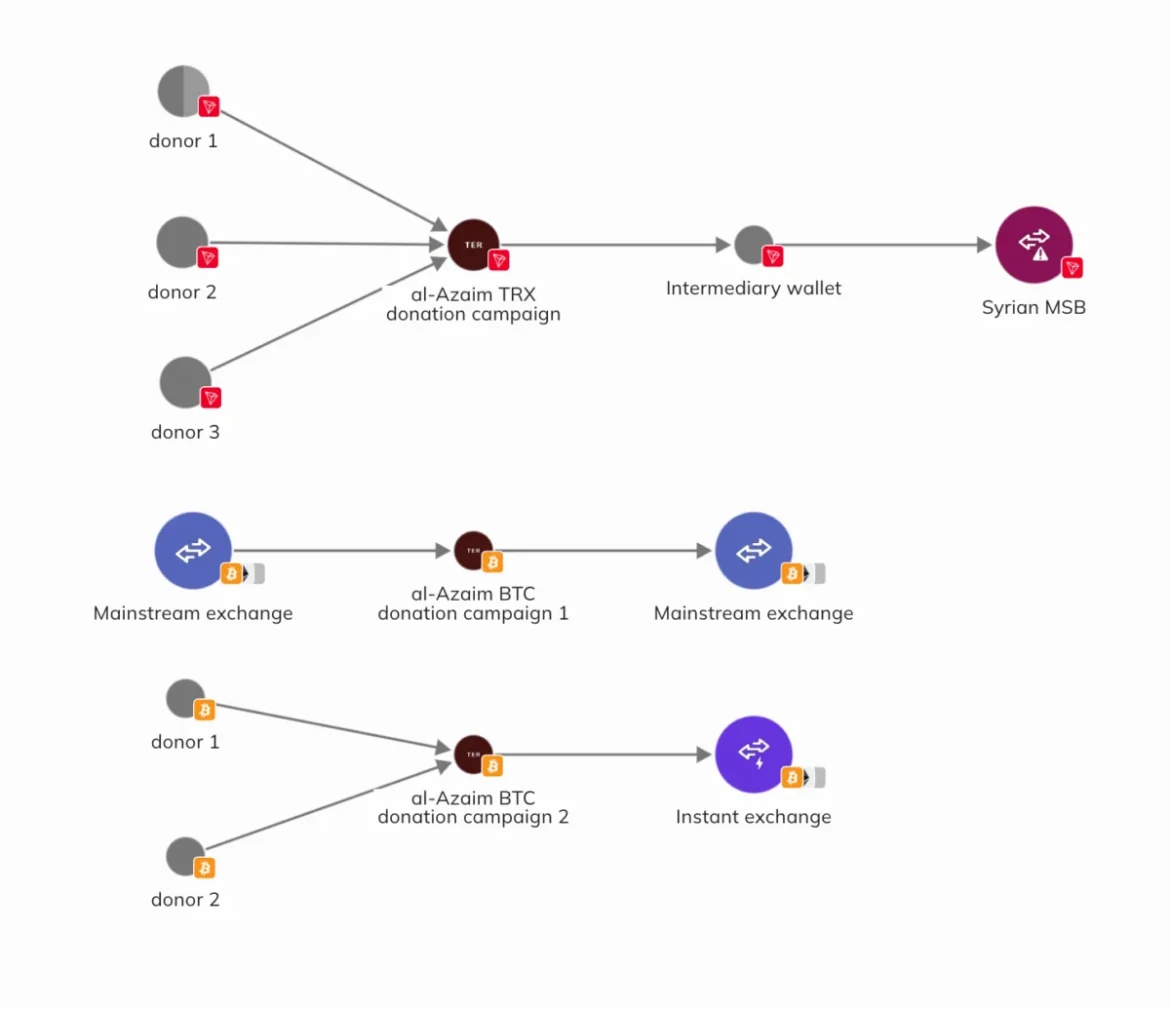
The 131 TRON (TRX) addresses at the core of Wednesday’s sanctions represent a critical nexus of ISIS-K’s financial operations. Chainalysis’s in-depth on-chain analysis, visualized through its Chainalysis Reactor platform, reveals that these wallets have been remarkably active since 2023. Cumulatively, they have received over $1.4 million in cryptocurrency and disbursed more than $880,000.
A key finding from this analysis is the significant exposure of these designated wallets to mainstream cryptocurrency services. This indicates that ISIS-K is not operating in a complete vacuum but is interacting with established exchanges and platforms, albeit often indirectly or through intermediary services. Furthermore, the investigation has identified instances where these wallets have transferred funds to cryptocurrency exchangers based in Syria, a region known for its complex and often opaque financial networks that can be exploited by illicit actors. This connection to Syrian exchangers suggests a potential pathway for cashing out or further laundering funds.

A Pattern of U.S. Action Against Terrorist Cryptocurrency Financing
The latest sanctions against ISIS-K are not an isolated event but part of a broader, evolving strategy by the U.S. government to counter the use of cryptocurrency by terrorist organizations. These designations serve as a stark reminder of how both established terrorist groups and their affiliates are increasingly integrating digital assets into their global financing operations.
In 2023, OFAC took action against Ali Shafiu, a Maldives-based ISIS-K operative. Chainalysis’s investigation at the time revealed that Shafiu’s TRON transactions interacted with exchange deposit addresses that also showed ties to Iranian exchanges, highlighting a potential nexus between ISIS-K financing and state-sponsored entities or networks operating under sanctions.
More recently, in June 2026, OFAC sanctioned a network of Syrian money service businesses that were identified as crucial cash-out points for ISIS financiers. The investigation into the operative at the center of that action, Miloud Abderrahmane, demonstrated a pattern of moving funds from mainstream exchanges to Middle Eastern donation campaigns, further illustrating the sophisticated methods employed to obscure the origin and destination of illicit funds. These ongoing actions demonstrate a commitment to disrupting the entire financial chain, from donation to eventual use.
The Primeiro Comando da Capital (PCC) Syndicate: Cryptocurrency as a Laundering Tool
In a parallel and significant action, OFAC also designated two Brazilian nationals, Victor Henrique de Oliveira Shimada and Stella Stefanie Nunes Henrique de Oliveira, along with four associated companies: Victory Trading, Pixwave, and Wave (all based in Brazil), and Avenidas Flutuantes (based in Portugal). These individuals and entities are linked to Primeiro Comando da Capital (PCC), a powerful and sprawling Latin American criminal organization with a significant presence not only in its home base of São Paulo, Brazil, but also with operatives extending into the United States.
According to OFAC’s findings, PCC’s drug trafficking operations have generated substantial illicit proceeds. The syndicate has reportedly laundered more than $30 million in illegal earnings generated within the U.S. and its surrounding regions. Critically, cryptocurrency has emerged as a primary tool for moving these vast sums of illicit funds back to Brazil, facilitating the integration of dirty money into the legitimate economy.
This marks the third major action taken by OFAC against the PCC and its associated operatives. The U.S. government initially designated the PCC as an organization in December 2021. Subsequently, in March 2024, OFAC sanctioned Diego Macedo Gonçalves do Carmo for his pivotal role in laundering significant sums of money for the group. The current designations underscore the persistent threat posed by the PCC and the Treasury Department’s resolve to dismantle its financial infrastructure.
Implications for Cryptocurrency Compliance and Global Financial Security

These coordinated actions by OFAC have immediate and far-reaching implications for Virtual Asset Service Providers (VASPs) and financial institutions worldwide. The designations necessitate an urgent and thorough review and update of existing sanctions screening and transaction monitoring protocols. Institutions must ensure their systems are capable of identifying and flagging transactions involving the newly designated entities and addresses.
Chainalysis, a leading blockchain analysis firm, has proactively responded by labeling the cryptocurrency addresses associated with these designations within its product suite. This crucial step enables their customers, which include financial institutions and government agencies, to proactively identify exposure to these high-risk networks. By doing so, organizations can bolster their compliance efforts, mitigate risks, and maintain adherence to evolving global regulatory standards.
The use of both privacy-focused cryptocurrencies like Monero and more mainstream blockchains like TRON by illicit actors highlights the diverse challenges in tracking and preventing illicit finance. While Monero’s inherent privacy features make tracing difficult, the extensive on-chain data available on TRON, coupled with sophisticated analytical tools, can still reveal critical patterns of activity, especially when combined with traditional intelligence gathering. The freezing of Tether on the TRON network demonstrates the increasing effectiveness of collaboration between regulatory bodies and private sector stablecoin issuers in combating illicit finance.
The broader impact of these designations extends beyond mere financial disruption. They signal a continued commitment from the U.S. government to leveraging all available tools, including financial sanctions and advanced analytics, to combat terrorism and organized crime. The successful disruption of illicit financial flows, whether through traditional banking channels or cryptocurrency networks, is paramount to undermining the operational capacity of terrorist groups and criminal syndicates.
The Treasury Department’s actions also serve as a warning to foreign financial institutions. The designations carry secondary sanctions risks, meaning that foreign entities found to be facilitating transactions for these designated parties could face severe repercussions, including being cut off from the U.S. financial system. This underscores the extraterritorial reach of U.S. sanctions policy and the imperative for global financial institutions to maintain robust compliance programs.
Looking Ahead: The Evolving Landscape of Crypto and Illicit Finance
As cryptocurrency continues to evolve and gain wider adoption, so too will the methods employed by illicit actors to exploit its features. The ongoing efforts by OFAC and other regulatory bodies, supported by the analytical capabilities of firms like Chainalysis, are crucial in staying ahead of these threats. The dual focus on both terrorist financing and organized crime, as demonstrated by these recent actions, reflects a comprehensive approach to safeguarding global financial security. The ability to track, analyze, and disrupt illicit financial flows across diverse blockchain networks is becoming increasingly vital in the fight against those who seek to exploit the digital economy for nefarious purposes.
