
MUTSAMUDU, COMOROS — Leading digital asset trading platform MEXC has officially released its Proof of Reserves (PoR) report for September 2026. Audited by prominent blockchain security firm Hacken, the report confirms that the exchange maintains robust asset backing well exceeding a 1:1 ratio across all major holdings. The disclosure highlights a significant increase in the platform’s Bitcoin reserve ratio, alongside comprehensive details regarding user fund safety mechanisms, institutional security architectures, and overarching industry standards for transparency.
Chronology and Audit Methodology
The audited data is based on a snapshot taken on September 10, 2026. This monthly publication forms part of MEXC’s ongoing transparency initiative, designed to provide its user base with verifiable data regarding platform solvency. Independent audits of digital asset exchanges have become a foundational pillar of the modern cryptocurrency economy, particularly in the wake of historical industry failures where opaque financial management led to catastrophic losses for retail and institutional participants.
To execute the September 2026 audit, Hacken performed a rigorous, multi-layered evaluation of MEXC’s financial standing. The assessment encompassed a Proof of Liabilities verification, a Proof of Ownership confirmation, an independent Reserves Calculation, and a comprehensive PoR Assessment. By leveraging Merkle Tree cryptographic verification technology, MEXC allows individual users to independently verify that their specific account balances are accurately accounted for within the global reserve pool. This mechanism operates without compromising individual privacy, ensuring that no user data is exposed during the verification process.
Breakdown of September 2026 Reserve Ratios
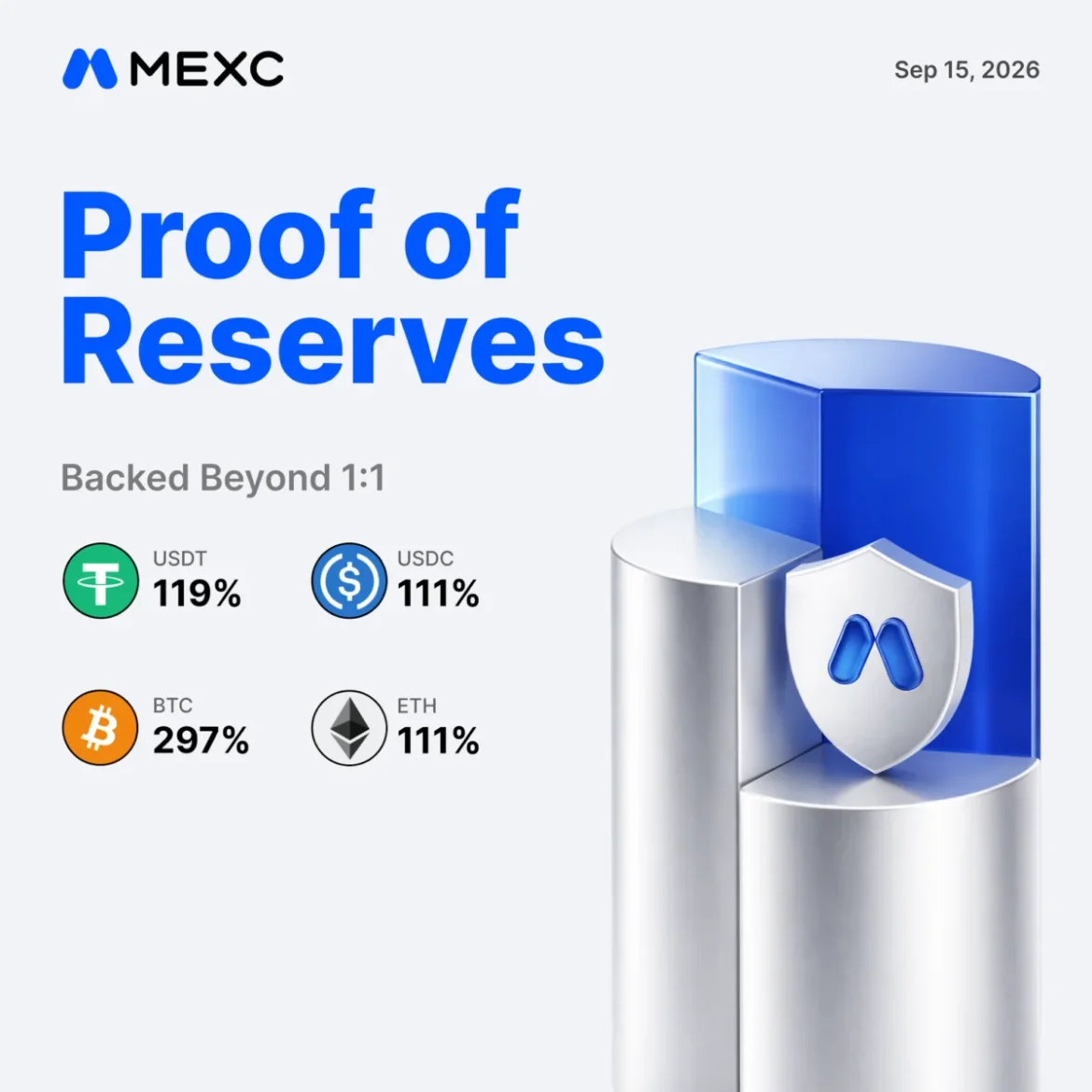
The newly published figures indicate that MEXC maintains surplus reserves across all major cryptocurrency categories tracked in the audit. The detailed breakdown from the September 10 snapshot is as follows:
- Bitcoin (BTC): The BTC reserve ratio climbed to 297%, marking a substantial increase from the 288% reported in August 2026. Platform reserves of 12,202.13 BTC are held against total user liabilities and holdings of 4,106.57 BTC.
- Tether (USDT): The USDT reserve ratio stands at 119%. Total reserves of 1,818,202,910.24 USDT fully cover user holdings of 1,526,526,878.38 USDT.
- USD Coin (USDC): The USDC reserve ratio is recorded at 111%. Reserves totaling 299,925,929.77 USDC back user liabilities amounting to 269,894,125.25 USDC.
- Ethereum (ETH): The ETH reserve ratio is 111%, with reserves of 58,917.60 ETH covering user holdings of 53,243.98 ETH.
Hacken’s final assessment officially verified that MEXC’s asset holdings exceed user liabilities by a wide margin across every monitored category, reinforcing the platform’s financial stability and readiness for high-volume market activity.
Executive Commentary and Industry Accountability
In an official statement accompanying the report, MEXC CEO Vugar Usi emphasized the critical importance of proactive financial disclosure in the contemporary digital asset ecosystem.
"Protecting user assets and earning their trust are fundamental responsibilities, not optional commitments," Usi stated. "In an industry where confidence has been tested time and again, transparency must be demonstrated through actions that users can independently verify. That is why we publish verifiable Proof of Reserves every month, giving users the ability to validate their asset data at any time rather than simply relying on our assurances. Our commitment is to continue raising the standard for transparency, accountability, and asset protection, and to build the kind of trust that is earned consistently over time."
The leadership’s focus on monthly audits aligns with a broader industry push toward cryptographic accountability. As regulatory frameworks mature globally, centralized exchanges are increasingly evaluated not merely on their trading volume and fee structures, but on their risk management infrastructure and the verifiability of their balance sheets.
Risk Mitigation and Supplementary Safeguards
Beyond standard reserve backing, MEXC maintains multiple internal financial buffers designed to protect traders against extreme market volatility and systemic anomalies.

Chief among these is the Futures Insurance Fund, which is engineered to absorb losses arising from position liquidations during severe market downturns or unexpected liquidity crunches. As of press time for the September report, the Futures Insurance Fund held a balance of approximately 798 million USDT.
Additionally, the exchange operates The Guardian Fund, a specialized dual-reserve structure comprising both USDT and BTC holdings. Established to provide comprehensive compensation coverage for any platform-related issues or unforeseen disruptions, The Guardian Fund held a balance of $101 million at the time of publication. MEXC has announced strategic plans to scale this dual-reserve fund to $500 million over the next two years, further insulating its user base from macroeconomic and operational risks.
Broader Implications for the Digital Asset Ecosystem
The publication of the September 2026 PoR report arrives at a time of significant convergence between traditional financial markets (TradFi) and the digital asset economy. Founded in 2018, MEXC has expanded its operational footprint across more than 170 global markets, positioning itself as a zero-fee multi-asset gateway. The platform currently provides retail and institutional participants with access to spot cryptocurrencies, equities, tokenized assets, derivatives, and various TradFi-linked financial instruments through a unified account structure.
As exchanges expand their product offerings to bridge traditional finance and blockchain-based assets, the complexity of risk management increases correspondingly. Industry analysts note that maintaining high solvency ratios—such as Bitcoin reserves approaching 300%—provides an essential cushion against sudden asset price depreciations and correlated market sell-offs. By combining cryptographic verification technologies like Merkle Trees with third-party institutional audits by firms like Hacken, platforms aim to mitigate counterparty risk and foster a more mature trading environment.
Users and independent researchers seeking to review the complete, unedited audit data, verify individual account inclusions via Merkle Tree paths, or examine historical snapshots can access the dedicated documentation directly through the official MEXC Proof of Reserves portal.
