
The decentralized finance (DeFi) ecosystem has been struck by another high-profile security breach as AFX, a decentralized exchange (DEX) and Layer 1 blockchain protocol, confirmed a major exploit on July 23. The incident, which centered on a proprietary bridge operating on the Arbitrum network, resulted in the unauthorized withdrawal of approximately 24.15 million USDC. Based on current exchange rates, the loss is valued at nearly 3.9 billion Japanese yen, marking one of the most significant security failures in the decentralized derivatives sector this year.
Initial reports of the anomaly were flagged by blockchain security firms, including Blockaid and PeckShield, before being officially acknowledged by the AFX team via their social media channels. The exploit has once again cast a spotlight on the inherent risks associated with cross-chain bridges, which have historically been the "Achilles’ heel" of the decentralized finance landscape.
Technical Breakdown of the AFX Bridge Exploit
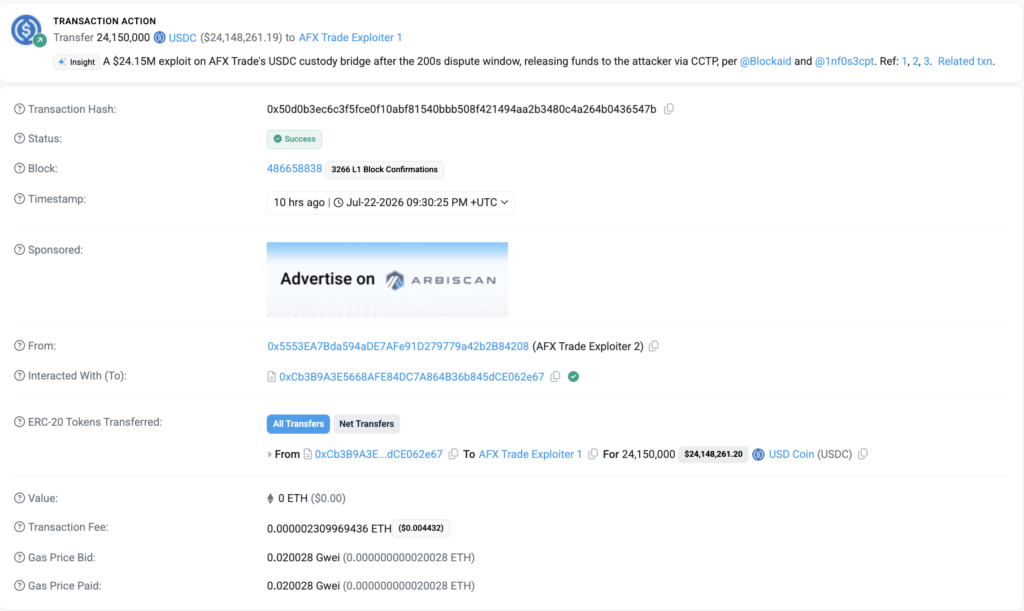
The breach occurred in the early hours of July 23. According to data retrieved from Arbiscan, the Arbitrum blockchain explorer, a series of suspicious transactions were initiated at approximately 6:30:25 AM JST. The attacker targeted the AFX bridge contract, which was designed to facilitate the movement of assets between the Arbitrum Layer 2 environment and AFX’s specialized Layer 1 blockchain, which focuses on perpetual futures trading.
Blockchain forensics indicate that the attacker successfully bypassed the bridge’s security protocols to trigger a massive outflow of USDC. Specifically, 24,150,000 USDC was transferred from the AFX bridge contract directly to a wallet address controlled by the exploiter. The precision and speed of the transaction suggest that the attacker may have identified a critical vulnerability in the bridge’s smart contract logic or gained unauthorized access to administrative functions.

Following the initial drainage of funds, the exploiter moved quickly to obfuscate the trail and secure the stolen assets. PeckShield reported that the 24.15 million USDC was moved from the Arbitrum network to the Ethereum mainnet. Once on Ethereum, the attacker utilized decentralized liquidity pools to swap the stablecoins for approximately 12,467.5 ETH. By converting the assets into Ether, the attacker likely sought to prepare the funds for further laundering through mixers or to hedge against the possibility of the USDC being frozen by its issuer, Circle.
Chronology of the Incident
The timeline of the exploit reveals a rapid sequence of events that left the AFX team and the broader community in a state of high alert:
- Detection (July 23, 06:30 AM JST): Automated monitoring systems and security firms like Blockaid detect a massive, unauthorized withdrawal of USDC from the AFX bridge contract on the Arbitrum network.
- Asset Conversion (July 23, 07:15 AM JST): The exploiter bridges the stolen USDC from Arbitrum to Ethereum. Shortly thereafter, the funds are swapped for 12,467.5 ETH to prevent centralized intervention.
- Official Acknowledgment (July 23, Morning): AFX issues a statement on X (formerly Twitter), confirming that an "incident" had occurred involving their proprietary USDC bridge.
- Emergency Response: AFX developers immediately pause the bridge functionality to prevent further loss of funds. The team begins a forensic audit in collaboration with external security partners.
- Arbitrum Ecosystem Clarification: Steven Goldfeder, co-founder of Offchain Labs (the developers behind Arbitrum), issues a statement clarifying that the exploit was limited to the third-party AFX protocol and did not involve the official Arbitrum bridge or the security of the Arbitrum network itself.
Financial Impact and TVL Analysis
The scale of the exploit is particularly devastating when viewed in the context of AFX’s Total Value Locked (TVL). Data from DefiLlama, a leading DeFi analytics platform, showed that prior to the attack, the AFX bridge held approximately 24.18 million dollars in assets. The withdrawal of 24.15 million USDC effectively drained nearly the entire liquidity pool of the bridge.
This "near-total" drainage suggests a catastrophic failure in the contract’s withdrawal limits or authorization checks. For users of the AFX platform, this means that the collateral and liquidity intended to back their trades on the AFX Layer 1 may no longer be accessible through the Arbitrum bridge. The immediate impact on the AFX ecosystem has been a sharp decline in user confidence and a halt in trading activities as the protocol attempts to assess the damage.
Background on AFX and the Vulnerability of Bridges
AFX is part of a growing trend of "AppChains"—blockchains built specifically for a single application. In this case, AFX operates as a Layer 1 network optimized for high-speed, low-cost perpetual futures trading. To connect this specialized network with the broader liquidity of the Ethereum ecosystem, AFX developed its own proprietary bridge to Arbitrum.

Cross-chain bridges are essential infrastructure in a multi-chain world, allowing users to move assets between different blockchain environments. However, they are notoriously difficult to secure. Bridges often hold large amounts of locked collateral in smart contracts on one chain to mint "wrapped" versions of those assets on another. If the smart contract holding the collateral is compromised—as appears to be the case with AFX—the entire system collapses.
The AFX incident joins a long list of bridge-related exploits, including the Ronin Bridge hack ($625 million), the Poly Network exploit ($611 million), and the Nomad Bridge drain ($190 million). These events highlight a recurring pattern where the complexity of cross-chain communication creates "edge cases" that sophisticated hackers can exploit.
Official Responses and Recovery Efforts
In the wake of the exploit, AFX has maintained a line of communication with its stakeholders. The protocol’s developers have stated that they are working around the clock with security firms to conduct a "root cause analysis." While the exact nature of the vulnerability has not been publicly disclosed, the team is investigating whether the breach was a result of a code bug, a compromised private key, or a sophisticated logic error in the bridging mechanism.
"We are tracking the movement of the stolen funds and are in contact with major exchanges to flag the attacker’s addresses," a spokesperson for AFX noted in a community update. "Our primary focus is the recovery of assets and the restoration of the protocol’s integrity."
Importantly, the AFX team emphasized that the exploit was localized to the USDC bridge. According to their internal assessment, the AFX trading engine, the mainnet core, and the broader Arbitrum network remain secure and uncompromised. This sentiment was echoed by Steven Goldfeder of Offchain Labs, who sought to reassure the Arbitrum community that the L2’s foundational security remained intact. Goldfeder’s quick response was aimed at preventing a "contagion" of fear that could lead to mass withdrawals from other Arbitrum-based protocols.
Broader Implications for the DeFi Industry
The AFX exploit serves as a stark reminder of the risks inherent in "bespoke" or proprietary bridge solutions. While building a custom bridge allows a protocol to tailor the user experience and reduce fees, it also requires the protocol to maintain its own security perimeter—a task that often exceeds the resources of smaller development teams.
Industry analysts suggest that this event may accelerate the move toward standardized, battle-tested bridging solutions like the Cross-Chain Interoperability Protocol (CCIP) by Chainlink or the LayerZero protocol. By leveraging established infrastructure rather than building proprietary bridges, new protocols can significantly reduce their attack surface.
Furthermore, the incident raises questions about the insurance and "safety fund" models in DeFi. Currently, most DEXs do not have a centralized "insurance fund" equivalent to the FDIC in traditional banking. When a bridge is drained, the losses are often socialized among users or result in the permanent loss of capital. The AFX community is now closely watching to see if the protocol has a plan for restitution or if the exploit marks a terminal blow for the project.
Conclusion and Current Status
As of the latest updates, the stolen 12,467.5 ETH remains in the attacker’s wallet, with security firms monitoring for any attempts to move the funds to centralized exchanges or privacy-preserving protocols like Tornado Cash. The AFX bridge remains offline, and users are advised not to interact with the protocol’s bridging contracts until a full security clearance is issued.
The AFX exploit is a sobering chapter in the ongoing evolution of decentralized finance. It underscores the necessity of rigorous, multi-layered security audits and the potential dangers of centralized points of failure in decentralized systems. For the investors and traders affected by the 24 million dollar loss, the focus remains on whether the AFX team can successfully recover the funds or secure the backing to make users whole. In the meantime, the DeFi industry continues to grapple with the reality that as long as billions of dollars are locked in smart contracts, the incentive for sophisticated actors to find and exploit vulnerabilities will remain at an all-time high.