Planet-X has officially unveiled its comprehensive strategic roadmap for an upcoming multi-platform Web3 gaming ecosystem, positioning itself at the intersection of high-performance decentralized infrastructure and AAA-grade digital entertainment. Built on the Immutable zkEVM network, the project aims to bridge the gap between traditional mainstream gaming and blockchain-based digital asset ownership. With expected platform rollout beginning in 2026, Planet-X is designed to support cross-platform accessibility across iOS, Android, personal computers, and console systems such as the PlayStation 5, marking a significant step forward in the evolution of decentralized application (dApp) gaming architectures.

The announcement comes at a time when the broader blockchain gaming sector is experiencing a transitional phase, moving away from purely speculative token models toward sustainable, gameplay-driven economies. Industry analysts have increasingly pointed to the necessity of seamless user experiences, low transaction latency, and cross-platform compatibility for blockchain titles to achieve mass adoption. By leveraging advanced layer-2 scaling solutions, Planet-X addresses long-standing bottlenecks in transaction speed and gas fees, thereby offering a frictionless environment for both crypto-native users and traditional gamers who may be unfamiliar with underlying blockchain mechanics.
Ecosystem Overview and Technical Architecture
At the core of Planet-X’s technical infrastructure is its integration with Immutable zkEVM, a scaling solution tailored specifically for gaming applications. This architecture allows developers to maintain high throughput and near-instant transaction finality without compromising security or decentralization. Traditional blockchain games have often struggled with network congestion and prohibitively high gas fees during peak usage periods, which severely degrades the user experience. By utilizing Immutable zkEVM, Planet-X ensures that in-game asset transfers, marketplace transactions, and token exchanges occur efficiently and transparently.

The platform’s technical framework is augmented by a dual-token model consisting of the native platform utility token, $GLX (Gallax Coin), and specialized governance assets. This economic design separates day-to-day in-game utility from long-term platform governance, helping to stabilize the internal economy against hyper-inflationary pressures. Furthermore, the integration of account abstraction technologies simplifies onboarding for new users, removing the traditional barriers of managing private keys and funding gas fees manually.
Multi-Platform Strategy and Cross-Device Accessibility
A defining feature of the Planet-X ecosystem is its commitment to cross-platform parity. While many early blockchain projects focused exclusively on browser-based or mobile interfaces, Planet-X is engineering its titles to run natively on high-end hardware, including personal computers, mobile devices, and home consoles like the PlayStation 5. This hardware versatility is supported by cloud-rendering capabilities and optimized game engines that ensure consistent visual fidelity and performance across diverse operating environments.

Industry observers note that expanding onto traditional gaming hardware is crucial for capturing the mainstream gaming demographic. By offering AAA-quality graphics alongside decentralized asset ownership, Planet-X seeks to attract gamers who prioritize engaging gameplay mechanics over financial speculation. The project’s developers have emphasized that blockchain features will enhance, rather than dictate, the core gaming experience, allowing players to choose whether they wish to engage with the digital asset economy or simply enjoy the narrative-driven campaigns.
Chronology and Development Milestones
The development of Planet-X has followed a structured timeline, beginning with early conceptualization and smart contract auditing. Throughout preceding quarters, the project team focused on foundational infrastructure development, securing partnerships with key infrastructure providers, and conducting closed alpha testing phases. These early milestones were critical for stress-testing the Immutable zkEVM integration and refining the user interface based on community feedback.

Looking ahead, the project roadmap outlines a series of public beta tests, community-driven tournaments, and phased token generation events. The upcoming rollout schedule includes targeted regional beta tests designed to evaluate server stability under heavy load conditions. These phased releases allow the development team to dynamically adjust economic parameters and patch potential vulnerabilities before the official global launch.
Integration of Non-Fungible Tokens (NFTs) and Digital Ownership
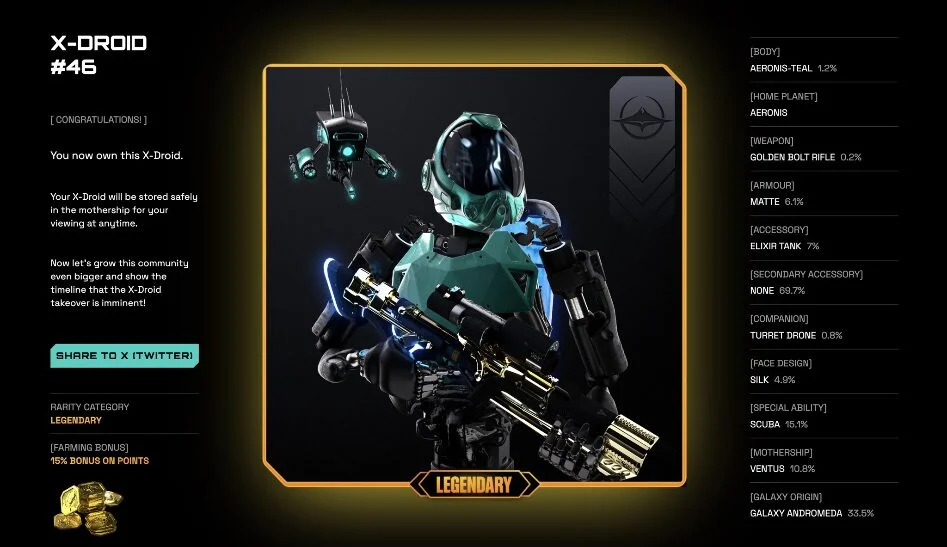
Central to the Planet-X economy is the integration of Non-Fungible Tokens (NFTs) that represent verifiable digital ownership of in-game items, characters, and virtual real estate. The ecosystem features two primary digital asset collections designed to reward early supporters and active participants: X-Droid and X-Key.

X-Droid consists of a fixed supply of 10,000 algorithmic avatars minted via X-Pod smart contracts. These digital assets serve as functional profile pictures and grant holders exclusive access to specialized gameplay modes, such as the X-treme Hunt events. Participants in these events have opportunities to earn high-value rewards, with total prize pools scaling alongside ecosystem adoption. X-Pod tokens have been actively traded on secondary marketplaces like OpenSea, establishing a liquid market for early-stage supporters.
Complementing X-Droid are X-Key NFTs, which act as master access tokens for advanced game modes and high-tier loot distribution. X-Key holders gain priority access to upcoming land sales, exclusive tournament entries, and governance voting rights within the decentralized autonomous organization (DAO) structure. The scarcity model for X-Key is algorithmically enforced to prevent over-saturation, ensuring that long-term holders retain exclusive privileges as the ecosystem expands.

Gallax Coin ($GLX) and Economic Utility
The native utility token of the Planet-X ecosystem, Gallax Coin ($GLX), serves as the primary medium of exchange and value accrual within the platform. $GLX is utilized for marketplace transactions, governance participation, and the acquisition of rare in-game assets. Additionally, the token is integrated with X-Armoury, a specialized subsystem that allows players to upgrade and customize weapons and gear using decentralized finance (DeFi) mechanics.
Economic analysts have observed that the integration of a robust utility token within a high-fidelity gaming environment helps align the incentives of players, developers, and investors. By tying token demand directly to active gameplay and utility rather than pure speculation, Planet-X attempts to build a resilient economic structure capable of withstanding broader cryptocurrency market volatility.

Strategic Implications and Future Outlook
The launch of Planet-X represents a notable milestone in the ongoing convergence of traditional video game development and decentralized ledger technology. As the industry matures, projects that successfully combine engaging gameplay with transparent, player-owned economies are expected to set new standards for digital entertainment.
While challenges remain regarding regulatory compliance across different global jurisdictions and the widespread adoption of crypto-native mechanics by mainstream audiences, Planet-X’s methodical approach to infrastructure development positions it as a noteworthy ecosystem to watch. Through its commitment to cross-platform accessibility, high-performance layer-2 scaling, and robust digital asset utility, Planet-X is laying the groundwork for the next generation of interactive entertainment. Further updates regarding beta testing schedules, token generation events, and partnership announcements will be released through the project’s official communication channels as the global launch approaches.