
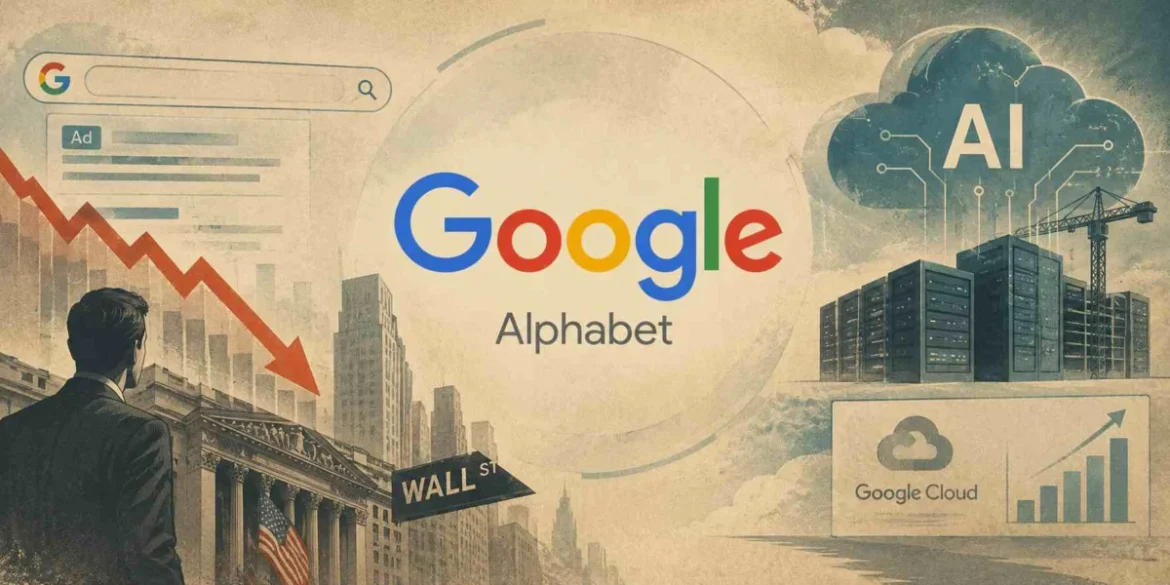
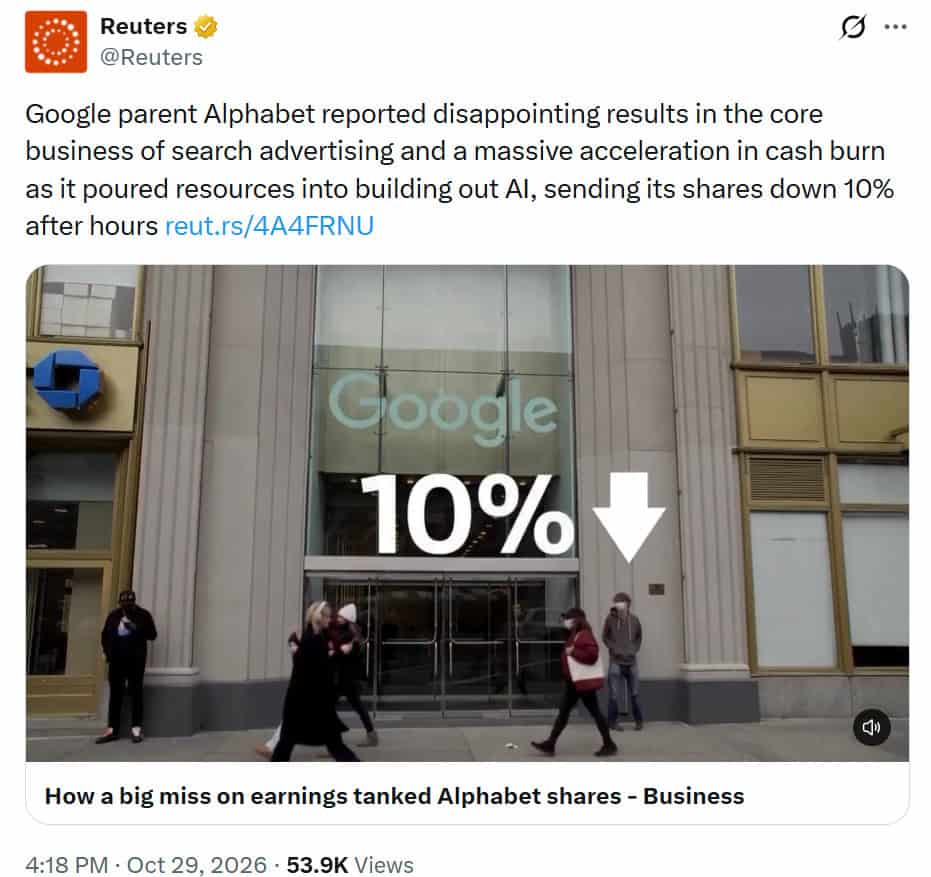
Alphabet Inc., the parent company of technological titan Google, experienced a catastrophic trading session on October 29, witnessing its Class C shares plummet nearly 13%. The staggering sell-off obliterated roughly half a trillion dollars from the company’s market capitalization in a single day, marking one of the most severe valuation adjustments in the corporation’s history. The downward spiral was triggered by a third-quarter earnings report that missed Wall Street consensus forecasts across several key metrics, combined with an unexpected deceleration in Google Search advertising growth and a jaw-dropping deficit in free cash flow driven by aggressive, multi-billion-dollar investments in artificial intelligence infrastructure.
While segments of the tech giant’s empire—most notably Google Cloud—posted record-breaking numbers, investors proved unwilling to look past the escalating costs and margin pressures associated with the ongoing artificial intelligence arms race. The market’s sudden loss of confidence reflects a broader recalibration on Wall Street regarding the timeline and profitability of generative AI deployments. As capital expenditure forecasts stretch well into 2027, shareholders are demanding concrete proof that Alphabet’s monumental outlays can eventually translate into sustainable, high-yield revenue streams without cannibalizing its traditional cash cows.
Chronology of a Market Shock and the Q3 Financial Breakdown
The seeds of the October 29 market rout were planted during the release of Alphabet’s third-quarter 2026 financial results. For the quarter, Alphabet reported total revenue of $127.6 billion. Although this figure represented a robust 25% increase compared to the $102.3 billion recorded during the same period in the previous year, it fell short of Wall Street estimates compiled by LSEG, which had anticipated approximately $128.2 billion.
The top-line miss, while relatively modest in percentage terms, exposed underlying vulnerabilities within Google’s core monetization engines. Total Google advertising revenue reached $82.01 billion, missing market projections by roughly $1.4 billion. Within that critical segment, Google Search and other advertising revenues grew by 12% to $63.35 billion—a noticeable slowdown from the 17% growth rate achieved in the preceding quarter. YouTube advertising revenue also saw expansion, rising 9% to $11.2 billion, but it failed to calm broader jitters regarding the health of digital ad spending.
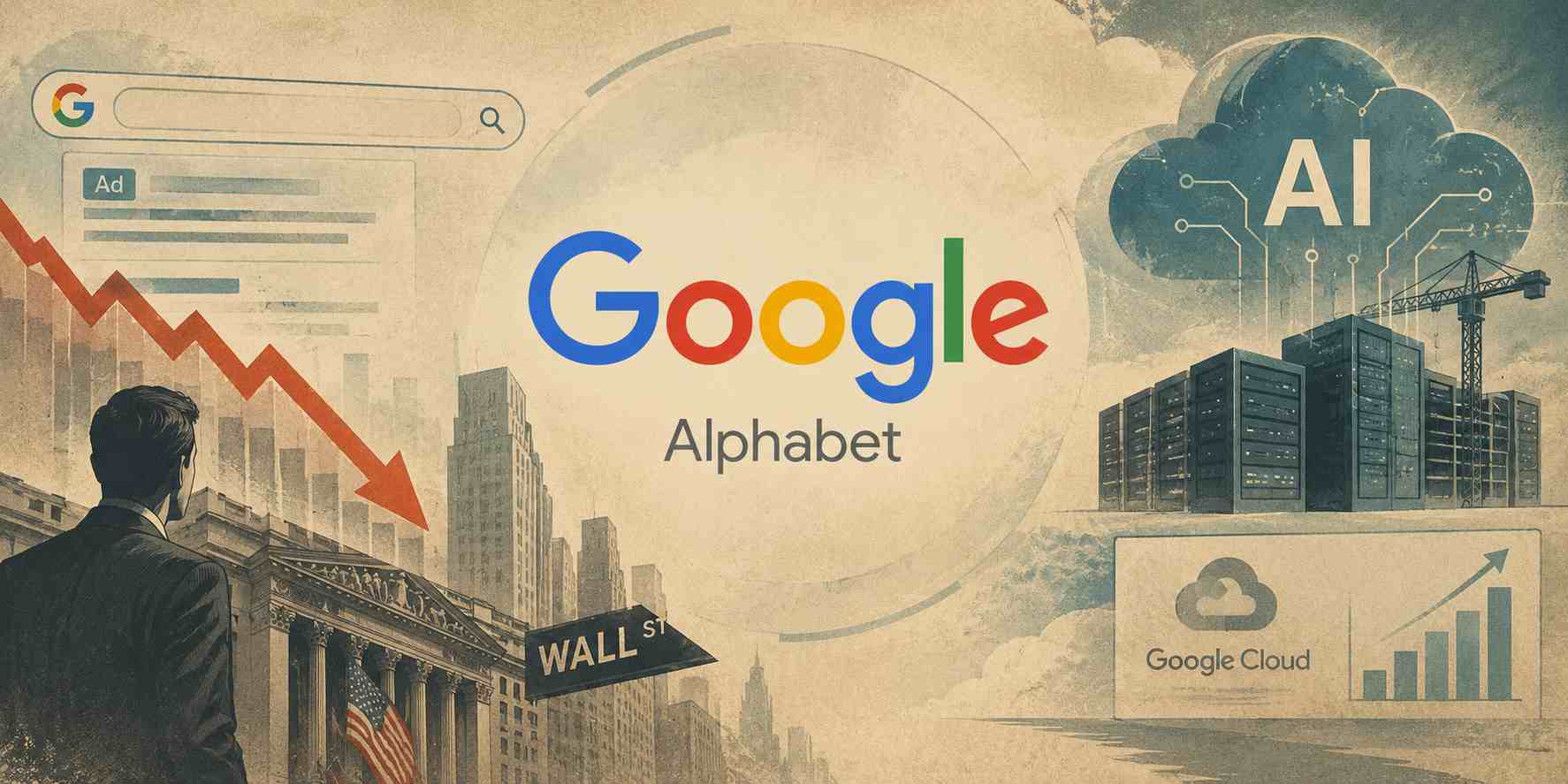
Profitability metrics further exacerbated investor anxieties. Alphabet’s net income available to common shareholders tumbled 25% year-over-year down to $26.17 billion. Diluted earnings per share (EPS) settled at $2.12, while adjusted EPS came in at $2.67, significantly missing the $3.02 average analyst estimate. Compounding these operational hurdles was an unrealized investment loss of $8.2 billion categorized under other income and expenses, largely driven by a markdown in the valuation of the company’s private stake in SpaceX. Additionally, a $5.2 billion cash payment stemming from a regulatory fine levied by the European Commission weighed heavily on the company’s liquidity ledger.
The AI Paradox: Search Deceleration and the Monetization Dilemma
At the heart of the investor sell-off lies a profound structural tension: Alphabet is aggressively rolling out AI-driven products that fundamentally alter how users interact with the internet, yet these new experiences currently generate less advertising revenue per query than traditional search interfaces.
During the earnings call, Chief Business Officer Philipp Schindler acknowledged that the growing adoption of "AI Mode"—Google’s conversational, generative search interface—contributed directly to the deceleration in search advertising growth. While AI Mode encourages longer, multi-turn user engagement and has helped drive year-over-year search query growth to a five-year high, these conversational sessions do not display traditional sponsored ad slots with the same frequency or efficacy as standard keyword search results.
This dynamic validated long-standing fears among market analysts that generative AI tools could cannibalize Google’s hyper-lucrative legacy franchise. Dave Wagner, a portfolio manager at Aptus Capital Advisors, captured the prevailing sentiment among institutional investors, noting that in a market already jittery about AI disrupting established tech moats, stakeholders need to see search revenue accelerating, not decelerating.
The strategic challenge for CEO Sundar Pichai and his executive team is twofold: they must maintain dominance in a rapidly evolving, AI-first search landscape while simultaneously inventing new monetization frameworks that can match or exceed the profit margins of classic keyword advertising. Failure to bridge this gap threatens to decouple user engagement growth from bottom-line financial expansion.
Historic Negative Free Cash Flow and Escalating CapEx
Perhaps the most alarming headline to emerge from the Q3 report was Alphabet’s cash flow statement. The company recorded negative free cash flow of approximately $9.07 billion for the quarter, following a $5.9 billion deficit in the previous three-month period. This marked the second consecutive quarter of negative free cash flow—an unprecedented occurrence for a corporate entity that has historically operated as a formidable cash-generating machine, marking its first negative free cash flow period in over two decades.
The cash drain was driven primarily by astronomical capital expenditures. Alphabet plowed $51.4 billion into capital projects during the third quarter alone. The vast majority of this capital was directed toward building out the technical infrastructure required to support generative AI development, training massive foundational models, expanding cloud computing capacity, and accumulating inventory for custom Tensor Processing Unit (TPU) hardware systems.
Looking ahead, Chief Financial Officer Anat Ashkenazi reaffirmed the company’s full-year 2026 capital expenditure guidance, which ranges between $195 billion and $205 billion. More alarmingly for cost-conscious investors, Ashkenazi warned that infrastructure spending would accelerate significantly in 2027, declining to provide a specific ceiling for those future outlays. This open-ended commitment to heavy spending has fueled apprehension that Alphabet’s return on invested capital (ROIC) may face prolonged compression before the payoff from its AI infrastructure materializes.
Google Cloud and Gemini Ecosystem Provide a Silver Lining
Despite the dark cloud hanging over advertising and cash flow, Alphabet’s third-quarter report was not without major operational triumphs. Google Cloud delivered an exceptional performance, standing out as a primary engine of growth and validation for the company’s enterprise strategy.
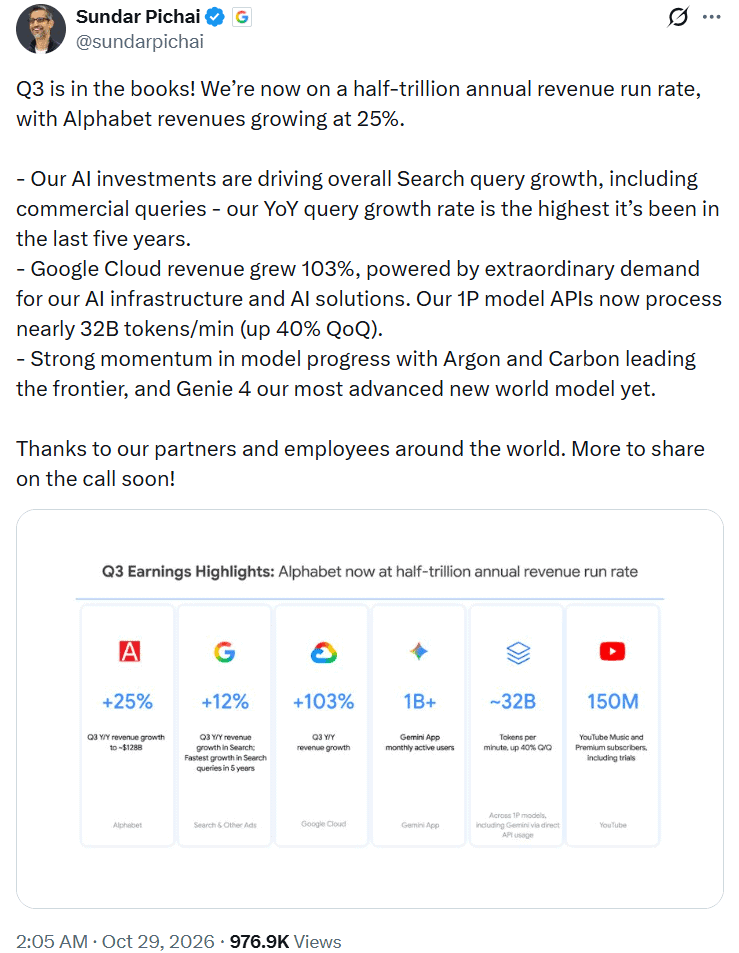
Google Cloud revenue surged 103% year-over-year to reach $30.71 billion, supercharged by insatiable enterprise demand for specialized AI infrastructure, cloud computing capacity, and machine learning developer tools. Cloud operating income more than tripled to $11.1 billion, while the segment’s operating margin expanded dramatically to 36.2%, up from 23.7% in the same quarter of the previous year. Furthermore, Google Cloud reported a staggering $561 billion backlog in contracted future revenue, demonstrating deep customer commitment to its ecosystem.
The broader Gemini artificial intelligence ecosystem also demonstrated massive scaling. Alphabet’s first-party model APIs were processing nearly 32 billion tokens per minute—a 40% quarter-over-quarter increase. Meanwhile, the consumer-facing Gemini application crossed the milestone of one billion active users, bolstered by the introduction of advanced model iterations such as the Gemini 4 Argon and Carbon lineups, which feature native audio capabilities and photorealistic simulations.
Sundar Pichai emphasized that these usage metrics prove the company’s heavy investments are successfully driving user adoption and embedding Google deeply into the fabric of modern digital workflows. However, the market’s ruthless reaction underscores the reality that enterprise cloud success and high user counts are not yet fully offsetting the immediate drag of infrastructure depreciation and search ad headwinds.
Technical Analysis: The Battle for the $280 Support Zone
From a technical perspective, the October 29 sell-off severely damaged Alphabet’s near-term market structure. Class C shares (NASDAQ: GOOG) closed the session down 12.29% at $282.32, after carving out an intraday low of $278.29.
The violent downward momentum sliced through multiple critical short- and medium-term moving averages, establishing a clearly bearish near-term technical trend. According to market data from TradingView, the Relative Strength Index (RSI) dropped sharply toward oversold territory. Market technicians caution, however, that an oversold RSI reading does not automatically signal an imminent bullish reversal; traders typically require confirmation of price stabilization and a reclaim of overhead resistance levels before declaring a bottom.
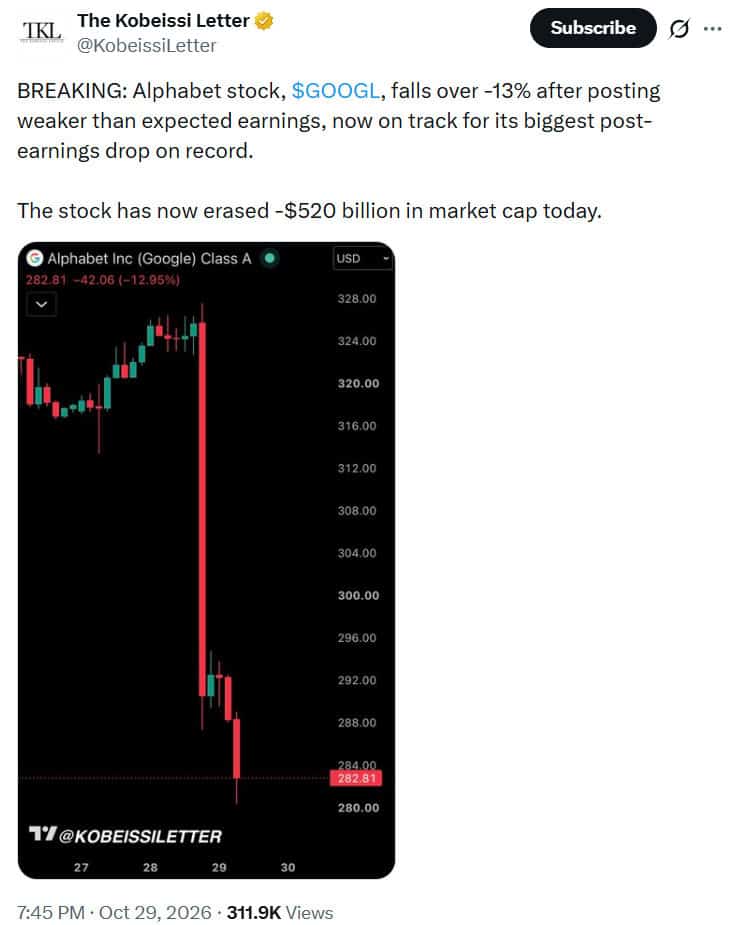
On the downside, the immediate battleground lies within the $275 to $280 support zone. If macroeconomic conditions or ongoing institutional repositioning drive a sustained break below this threshold, the stock could encounter deeper historical demand zones.
Conversely, initial resistance is pegged at the $290 level, followed by the psychologically significant $300 mark. A more formidable resistance band looms near $328.50, representing previously broken support levels that will likely act as a ceiling during any recovery attempts. Market strategists note that a sustained move back above $300 is essential to signal that panic selling has subsided and that institutional buyers are willing to re-accumulate shares.
Broader Industry Implications and Future Outlook
Alphabet’s Q3 watershed moment serves as a bellwether for the entire technology sector, highlighting the immense financial tightrope major players must walk during technological transitions. Companies like Microsoft, Amazon, and Meta Platforms—all of which have committed hundreds of billions of dollars to generative AI data centers—will face similar scrutiny from shareholders who are increasingly unwilling to fund capital expenditure sprees without clear line-of-sight to monetization.
The fundamental dilemma facing Alphabet is no longer about whether it can build world-class artificial intelligence. Products like Gemini, advanced TPU clusters, and Google Cloud’s hyper-growth prove that the company remains at the absolute bleeding edge of technological innovation. Rather, the test is purely financial: proving that the multi-billion-dollar cost of powering the AI revolution can coexist with the high-margin profitability that Wall Street has historically demanded from the world’s premier digital advertising monopoly.
As Alphabet steps into the final quarters of 2026 and prepares for an even more capital-intensive 2027, management must convince the financial community that its monumental bets on AI infrastructure will ultimately yield superior shareholder value. Until those monetization metrics catch up with capital expenditures, Alphabet’s stock price is likely to remain locked in a volatile holding pattern, dictated by the delicate balance between technological ambition and fiscal discipline.
