
The dynamic and often unpredictable nature of cryptocurrency markets presents both opportunities and significant challenges for traders. Volatility, rapid price swings, and the need for constant market monitoring can be overwhelming, leading to emotional trading decisions and missed opportunities. In response to these persistent issues, 1inch, a leading decentralized exchange (DEX) aggregator, has significantly advanced its limit order swap functionality, offering users a powerful tool to navigate these complexities with greater precision, control, and security. This innovation is not merely an incremental update; it represents a crucial step in maturing the decentralized finance (DeFi) ecosystem, bridging the gap between the sophisticated trading tools found on centralized exchanges (CEXs) and the core principles of self-custody and autonomy inherent in DeFi.
Understanding Limit Orders: A Foundation for Strategic Trading
At its core, a limit order is a fundamental trading instruction that allows an investor to buy or sell a security at a specified price or better. Unlike a market order, which executes immediately at the best available current price, a limit order provides control over the execution price. For instance, a "buy limit" order will only execute if the asset’s price falls to or below the specified limit price, while a "sell limit" order will only execute if the asset’s price rises to or above the specified limit price. This mechanism is invaluable for traders who have a specific price target in mind and wish to avoid the slippage often associated with market orders during periods of high volatility or low liquidity.
In traditional financial markets, limit orders are a cornerstone of strategic trading, enabling participants to manage risk, optimize entry and exit points, and execute pre-defined strategies without continuous manual intervention. Their application within the cryptocurrency space is even more critical given the heightened volatility compared to conventional assets. Bitcoin, for example, has historically exhibited annualized volatility significantly higher than major equity indices or commodities. This inherent characteristic makes the ability to set precise entry and exit points a non-negotiable feature for serious traders and long-term investors alike, allowing them to capitalize on market dips or secure profits at predefined levels without being tethered to their screens.
The Decentralized Imperative: 1inch’s Approach to Risk and Custody
The rise of decentralized finance has been predicated on the principles of self-custody, transparency, and censorship resistance, offering an alternative to the centralized model that has dominated finance for centuries. Centralized exchanges, while convenient, require users to deposit their assets into the exchange’s custody. This "not your keys, not your crypto" paradigm introduces significant counterparty risk, as users are reliant on the exchange’s security measures, operational integrity, and regulatory compliance. High-profile incidents of exchange hacks, insolvency, and regulatory scrutiny have repeatedly underscored these risks, prompting a mass exodus of users towards decentralized alternatives.
Decentralized exchanges (DEXs), conversely, operate on smart contracts, enabling peer-to-peer trading without an intermediary holding user funds. This non-custodial model is a foundational pillar of DeFi, granting users full control over their assets at all times. However, early DEXs, primarily utilizing Automated Market Maker (AMM) models, often lacked the advanced order types prevalent on CEXs. Market orders were the norm, making strategic trading challenging and susceptible to price fluctuations.
1inch’s implementation of limit orders on its DEX aggregator represents a crucial evolution, effectively bridging this functionality gap without compromising DeFi’s core tenets. Unlike centralized platforms where orders are placed on an internal order book managed by the exchange, 1inch’s limit orders remain non-custodial. Funds stay securely in the user’s personal wallet, controlled by their private keys, until the precise conditions of the limit order are met. This innovative approach eliminates counterparty and custody risk entirely, a significant advantage for users prioritizing security and autonomy. The smart contract only facilitates the swap once the predefined price condition is achieved, ensuring that user assets are never at the mercy of a third party.
1inch’s Limit Order Mechanism: Aggregation, Efficiency, and Automation
The sophistication of 1inch’s limit order functionality extends beyond mere non-custodial execution. It leverages the platform’s renowned aggregation logic to ensure optimal trade execution. As a DEX aggregator, 1inch scans multiple decentralized exchanges and liquidity sources across various blockchain networks to find the most efficient trading paths and the best possible prices for a given swap. This intelligent routing mechanism, often referred to as Pathfinder, is applied to limit orders as well, meaning that when a user’s target price is reached, the order is executed with the highest possible efficiency, minimizing slippage and maximizing value.
The technical execution of a 1inch limit order involves an off-chain signing process and an on-chain settlement. When a user places a limit order, they sign a message with their wallet confirming the terms of the trade. This signed message, representing the order, is then submitted to 1inch’s infrastructure, where it waits for the market price to align with the user’s specified conditions. Crucially, this off-chain signing means that users do not incur gas fees for placing or cancelling an order that does not get filled. Gas fees are only paid upon the successful execution of the swap, offering a cost-effective solution for traders experimenting with various price points or setting long-term targets.
This architecture offers a robust framework for automation, catering to a diverse spectrum of cryptocurrency participants:
- For Active Traders: Limit orders are indispensable tools for implementing complex trading strategies. They allow for precise entry and exit points, enabling techniques like dollar-cost averaging (DCA) into a position at specific price dips or taking profit incrementally as an asset rises. Traders can set multiple orders, automating their strategy execution and freeing themselves from constant market monitoring, thereby reducing the psychological burden of trading and promoting disciplined decision-making.
- For Passive Investors: Individuals with limited time to monitor volatile markets can leverage limit orders to set long-term investment goals. They can place buy orders for desired tokens at attractive lower prices, anticipating future market corrections, or set sell orders at target profit levels, ensuring they don’t miss opportunities while offline or otherwise engaged. This "set it and forget it" capability empowers users to remain disciplined and avoid impulsive reactions to short-term market fluctuations.
- Enhanced Accessibility and Convenience: The ability to execute trades even when offline or during non-standard trading hours is a significant advantage. Cryptocurrency markets operate 24/7, transcending geographical time zones. Limit orders ensure that users in different parts of the world can participate strategically without being constrained by their waking hours or physical presence.
A Step-by-Step Guide to Placing a 1inch Limit Order
Utilizing 1inch’s limit order functionality is designed to be intuitive and user-friendly, integrating seamlessly into the existing 1inch platform. Here is an expanded, chronological guide to placing a limit order:
-
Accessing the Platform and Initiating Trade Mode:
The process begins by navigating to the official 1inch website, 1inch.com. Upon arrival, users will typically find a clear navigation menu at the top of the page. From this menu, select "Trade" and then, from the subsequent dropdown options, choose "Limit." This action will direct the user to the dedicated interface for placing limit orders, presenting a clear swap form designed for this specific purpose.
-
Connecting the Wallet: The Gateway to Decentralized Trading:
The cornerstone of any DeFi interaction is a secure wallet connection. Users must click the "Connect wallet" button, which will present a comprehensive list of supported non-custodial wallets. 1inch boasts broad compatibility, supporting a wide array of popular mobile and hardware wallets crucial for the DeFi ecosystem. These include the native 1inch Wallet, Ledger Wallet for enhanced hardware security, Binance Wallet, WalletConnect (a widely adopted open protocol for connecting DApps to mobile wallets), Trust Wallet, OKX Wallet, Crypto.com Wallet, Bitget Wallet, and Coinbase Wallet, among others. Users select their preferred wallet, often by scanning a QR code with their mobile wallet app or confirming a browser extension prompt. This step is critical as it establishes the secure, non-custodial link between the user’s funds and the 1inch platform, without ever relinquishing control of the assets. -
Selecting Chains and Tokens: Defining the Swap Parameters:
Once the wallet is securely connected, the user proceeds to define the parameters of their desired swap. This involves selecting the cryptocurrency they wish to sell (the "from" token) and the cryptocurrency they wish to receive (the "to" token). 1inch’s extensive support for various blockchain networks is a key differentiator, allowing users to trade across major chains such as Ethereum, BNB Chain, Polygon, Arbitrum, Optimism, Base, and many others. This multi-chain capability provides unparalleled flexibility and access to diverse liquidity pools.
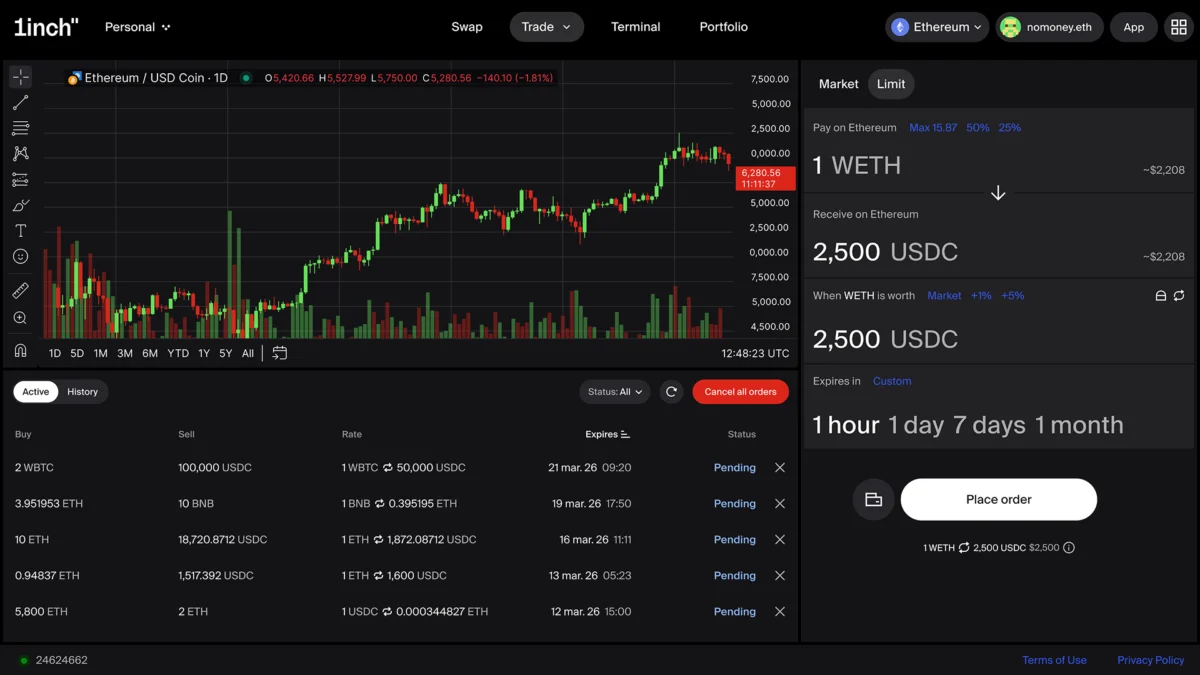
Accompanying the swap form, typically on the left side of the interface, is a dynamic candlestick chart. This integrated charting tool provides real-time and historical price performance of the selected token pair over configurable time periods (e.g., 1 hour, 1 day, 1 week, 1 month). This visual aid is invaluable for users to conduct immediate technical analysis, observe price trends, identify potential support and resistance levels, and inform their decision on the optimal limit price. -
Defining the Target Price: Precision in Execution:
This is the core of the limit order. Users specify the exact price at which they wish their swap to execute. The 1inch interface provides several convenient options for setting this price:- Manual Input: Users can directly type in their desired target price, offering maximum precision.
- Presets: For quick adjustments or common scenarios, 1inch offers presets such as "Spot" (the current market price), "+1%" or "+5%" (to set a sell limit order above the current market price), or "-1%" or "-5%" (to set a buy limit order below the current market price). These presets simplify the process for users who want to quickly set orders based on a percentage deviation from the current spot price. Strategic traders will use the chart and their analysis to determine the most advantageous price point.
-
Setting the Expiry Period: Time-bound Control:
A crucial aspect of managing limit orders is defining their validity period. An order cannot remain open indefinitely. 1inch provides clear options for setting an expiry period, after which the order will automatically cancel if it has not been filled.- Presets: Common durations include "1 hour," "1 day," "7 days," and "1 month," catering to short-term speculative trades, daily adjustments, or longer-term accumulation strategies.
- Custom Period: Users also have the flexibility to define a custom expiry date and time, allowing for highly tailored order management.
The choice of expiry period depends on the trader’s strategy and market outlook. A shorter period might be used for volatile assets where market conditions change rapidly, while a longer period could be suitable for accumulating an asset at a specific target price over an extended timeframe.
-
Finalizing the Swap: Confirmation and Activation:
With all parameters set—tokens, network, target price, and expiry—the user proceeds to finalize the order by clicking the "Swap" or "Place Limit Order" button. This action triggers a prompt in the connected wallet application, requesting confirmation. It is paramount for users to meticulously review all the displayed data within their wallet interface, ensuring that the token amounts, target price, and associated network are correct before proceeding. Any discrepancy should prompt a cancellation and re-evaluation of the order parameters.
Once confirmed and signed in the wallet, the limit order is activated. It enters a pending state within the 1inch system, awaiting the market conditions to align with the user’s specified price. If the market price reaches or surpasses the target price (for a sell order) or falls to or below it (for a buy order) within the defined expiry period, the smart contract automatically executes the swap, sending the desired tokens directly to the user’s wallet.
A significant advantage, as previously mentioned, is that if the chosen price is not reached before the expiry period ends, the order will automatically cancel without incurring any gas fees. This "fill or kill" or "good ’til cancelled" (depending on expiry) model ensures that users only pay for successful trades, making experimentation and strategic placement of multiple orders more economically viable.
Broader Market Impact and Implications of Decentralized Limit Orders
The introduction and robust implementation of features like decentralized limit orders by platforms such as 1inch carry profound implications for the broader cryptocurrency ecosystem and the future trajectory of DeFi:
-
Democratization of Advanced Trading Tools: Traditionally, sophisticated trading tools were the domain of professional traders on institutional platforms. Decentralized limit orders democratize access to these tools, empowering a wider base of retail investors and casual users to employ more nuanced and disciplined trading strategies. This levels the playing field, making advanced financial instruments accessible to anyone with an internet connection and a crypto wallet.
-
Enhancing DEX Competitiveness: The feature gap between centralized exchanges and DEXs has historically been a barrier to broader DeFi adoption. By offering non-custodial limit orders, 1inch significantly reduces this disparity. This not only attracts more liquidity and users to the decentralized space but also puts pressure on other DEXs to innovate, fostering a competitive environment that ultimately benefits the end-user through improved functionality and efficiency. The growing market share of DEXs, which processed over $1 trillion in volume in 2021, indicates a clear demand for these features within the non-custodial paradigm.
-
Improved Market Efficiency and Liquidity: The ability for traders to place precise, non-custodial limit orders contributes to overall market health. It allows for the creation of deeper and more stable order books (even if virtual or aggregated), leading to better price discovery and reduced volatility. As more participants use limit orders to express their buy and sell intentions, the market gains greater depth and resilience against large market orders that can cause significant price swings. This enhanced efficiency benefits all participants by ensuring fairer prices and more reliable execution.
-
Reinforcing Security and Trust in DeFi: In an industry grappling with trust issues stemming from centralized failures, 1inch’s non-custodial limit orders reaffirm the core value proposition of DeFi: user control and security. By eliminating the need to deposit funds with an intermediary, the risk of hacks, mismanagement, or regulatory freezes is mitigated. This strengthens the overall narrative of DeFi as a secure and transparent alternative, fostering greater confidence among potential users and institutions.
-
Future of Decentralized Finance: The successful implementation of advanced order types like limit orders on DEXs paves the way for further innovation. It sets a precedent for the development of more complex decentralized financial instruments, including options, futures, and other derivatives, all while adhering to the non-custodial ethos. This evolution is crucial for attracting institutional capital and truly mainstreaming DeFi, as sophisticated investors require a full suite of trading tools to manage their portfolios effectively. The continuous growth of total value locked (TVL) in DeFi, which has seen peaks exceeding $100 billion, underscores the industry’s potential for further expansion driven by such innovations.
-
Regulatory Landscape Considerations: While decentralized solutions offer inherent advantages in terms of user control, the evolving global regulatory landscape remains a significant consideration. Non-custodial solutions inherently reduce certain regulatory burdens associated with centralized intermediaries, as they do not hold user funds. However, regulators are increasingly scrutinizing the broader DeFi ecosystem, and innovations like decentralized limit orders demonstrate the industry’s capacity to build robust, compliant-by-design financial infrastructure that respects user privacy and autonomy.
1inch’s commitment to innovation is evident in its continuous development of features that enhance user experience and strategic trading capabilities. The refined limit order functionality is a testament to this dedication, offering a powerful, secure, and automated solution for navigating the complexities of decentralized cryptocurrency markets. By empowering users with greater control over their trades and their assets, 1inch continues to solidify its position as a vital infrastructure provider within the rapidly expanding DeFi landscape. The ongoing evolution of such tools is essential for the maturation and widespread adoption of decentralized finance, promising a future where advanced trading is accessible, secure, and entirely within the user’s command.
For the latest 1inch news, updates, and deeper insights into their evolving ecosystem, users are encouraged to subscribe to their official newsletter.
