The cryptocurrency market peak of October 2025 marked the absolute high-water mark for the personal fortune of Michael Saylor, co-founder and executive chairman of corporate treasury giant Strategy. In the months that followed, a severe crypto winter and sliding asset prices have systematically dismantled a substantial portion of that wealth. Forbes estimates indicate that Saylor’s net worth has plummeted by approximately $6 billion, retreating from a robust $9.3 billion peak to hover around $3.3 billion. This dramatic contraction has effectively wiped out nearly two-thirds of his total estimated fortune in a little over a year.
Yet, despite mounting paper losses and a deteriorating macroeconomic backdrop for digital assets, Strategy has shown absolute unwavering resolve. The company continues to aggressively accumulate Bitcoin, ignoring short-term market volatility and treating every market dip as an institutional buying opportunity. However, for Saylor, the ongoing downturn presents a systemic challenge that extends far beyond the spot price of Bitcoin. Because a vast majority of his personal wealth is tied directly to the performance, valuation, and market perception of Strategy, his financial standing is inextricably linked to the company’s ability to convince institutional and retail investors to continue financing its relentless accumulation strategy.
Tracing the Decline: A Chronology of Saylor’s Wealth Compression
To understand the current scale of Michael Saylor’s financial recalibration, it is necessary to examine the trajectory of his wealth since the broader crypto market peaked in late 2025. The initial signs of strain became glaringly apparent in early 2026. By February 2026, Forbes data revealed that Saylor’s net worth had already shed $4.7 billion, dropping precipitously from its $9.3 billion pinnacle down to roughly $4.6 billion. This made him one of the digital asset industry’s single largest individual financial casualties of the early-year market correction.
Following this initial shock, Saylor’s fortune experienced a brief period of stabilization. By June 2026, minor market recoveries pushed his estimated net worth back up to approximately $4.7 billion. This plateau, however, proved to be fleeting. As macroeconomic pressures mounted and the cryptocurrency market faced renewed selling pressure—with Bitcoin dipping back toward the $60,000 threshold—Saylor’s fortunes resumed their downward trajectory.
By September 2026, valuations dipped back down to $4.6 billion. The situation deteriorated further heading into the final stretch of the year. By late November 2026, Forbes updated its valuation metrics, placing Saylor’s net worth at an estimated $3.3 billion. This milestone represented a staggering 64.5% drop from the October 2025 peak. Financial analysts emphasize that these figures represent calculated reductions in estimated wealth based on equity stakes and asset holdings rather than confirmed cash losses or forced liquidation events. Nevertheless, the velocity of the decline highlights the high-beta nature of tying personal net worth entirely to a single corporate treasury vehicle.

Personal Holdings Versus Corporate Exposure: A Critical Distinction
A frequent point of confusion among retail market observers involves the differentiation between Michael Saylor’s personal cryptocurrency portfolio and the massive corporate treasury maintained by Strategy. While the two are often conflated in public commentary, their underlying financial dynamics differ significantly.
In October 2020, during the nascent stages of his corporate treasury pivot, Saylor publicly disclosed that he personally owned 17,732 BTC, which he had acquired at an aggregate cost of approximately $175 million. Assuming he has maintained his exact position without executing significant personal sales—a detail that remains unverified by independent audits but widely accepted by market trackers—those personal holdings retain a vastly different risk profile than corporate shares.
With Bitcoin trading around $60,325—a baseline figure reported by Strategy in late November 2026—those initial 17,732 personal coins would be valued at roughly $1.07 billion. This means that even after suffering billions in estimated wealth destruction driven by corporate stock devaluations, Saylor’s original personal Bitcoin investment remains comfortably in the black, sitting on an unrealized gain of approximately $895 million. This paradox illustrates a fundamental reality of modern digital asset wealth: an individual can experience multi-billion-dollar losses in estimated net worth while simultaneously retaining massive, highly profitable foundational holdings.
The Corporate Balance Sheet: Strategy Sits on Nearly $13 Billion in Paper Losses
While Saylor’s personal entry point into Bitcoin was early and remarkably profitable, the same cannot be said for the entirety of Strategy’s corporate treasury. Over the past several years, the company has aggressively scaled up its market exposure, regularly purchasing Bitcoin at progressively higher market valuations.
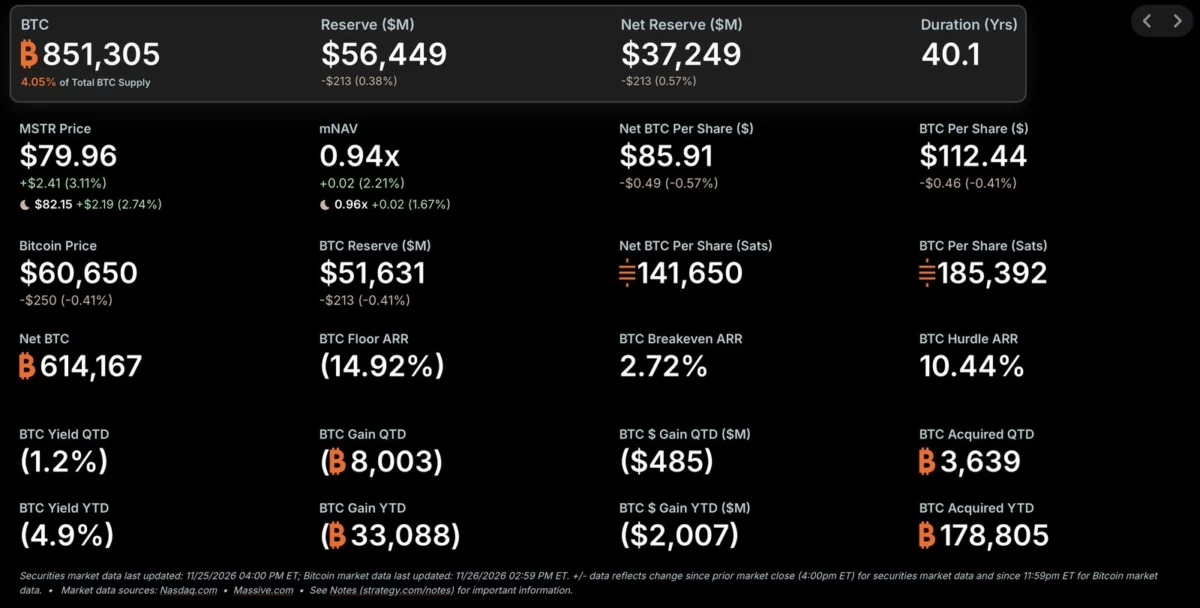
According to official regulatory filings submitted to the United States Securities and Exchange Commission (SEC) on November 23, Strategy expanded its massive reserves once again by acquiring an additional 457 BTC for roughly $29.6 million. This purchase brought the firm’s total cumulative holdings to an unprecedented 851,305 BTC. Across its entire acquisition history, the company has deployed approximately $64.23 billion to build this digital treasury, resulting in a lifetime average purchase price of $75,446 per coin.

When measured against the spot market valuations recorded in late November 2026—where the company’s internal dashboard valued its total reserves at approximately $51.35 billion—a glaring delta emerges. Strategy is currently sitting on an unrealized paper loss of nearly $12.9 billion between its cumulative capital outlays and current market values.
Corporate executives and financial analysts are quick to point out that these figures do not represent realized trading losses, nor do they capture the operational performance or long-term solvency of the enterprise. Strategy does not face immediate forced liquidation triggers tied to these paper losses, as the firm has structured its capital raising to avoid margin calls. However, these figures starkly illustrate how the economics of corporate-scale Bitcoin accumulation shift dramatically during extended market downturns.
The Disappearing Premium: Why Strategy Stock Faces New Pressures
For years, institutional and retail investors were more than willing to pay a substantial premium to own shares of Strategy. The core investment thesis was never merely about holding the underlying Bitcoin directly; rather, it was the unique financial engineering deployed by management. Investors bought into the prospect that Strategy could continually leverage its equity and debt markets to raise fresh capital, issuing new shares at a premium to net asset value (NAV) to acquire more Bitcoin on a per-share accretive basis.
Today, that foundational premium is no longer guaranteed. Strategy’s internal dashboard revealed an mNAV (net Bitcoin value per share) ratio of 0.94 at the close of the market on November 25, 2026. This metric indicates that the stock was trading at a slight discount to the actual value of the Bitcoin held on its balance sheet—a stark departure from the lucrative premiums commanded during bull market cycles.
In its official investor briefings, corporate leadership has openly acknowledged the structural implications of this shift, noting that a widening discount can cause the stock to underperform relative to spot Bitcoin even during periods when the cryptocurrency itself begins to appreciate. This dynamic places Saylor’s leveraged business model under its most severe stress test to date.
When market participants are eager to pay a premium for equity, raising capital to stack more sats creates an upward flywheel effect. Conversely, when that premium evaporates or flips into a discount, issuing additional shares dilutes existing shareholders and complicates capital-raising efforts. Sensitivity analyses published in Strategy’s investor materials underscore this vulnerability: a further drop in Bitcoin’s price to $40,000 would reduce the estimated net reserve value per share down to $45.37, compared to $163.17 if Bitcoin climbs back to $100,000.
Pathways to Recovery: Can Strategy and Saylor Bounce Back?
Despite the steep paper losses and the erosion of his personal net worth, financial analysts point out that a credible pathway to recovery remains intact for both Michael Saylor and Strategy. The foundational strength of the company lies in the sheer scale of its holdings. Owning upwards of 850,000 Bitcoin provides the firm with immense, unmatched leverage to any sustained macroeconomic or structural rebound in the cryptocurrency markets.
Furthermore, Strategy is not operating entirely bare. The company reported holding approximately $4.82 billion in combined cash and dollar reserves in its most recent investor briefing. This substantial liquidity buffer provides critical breathing room, ensuring the firm can comfortably service its financing obligations, debt coupons, and operational expenses without needing to offload any of its prized digital treasury assets.
However, industry observers emphasize that a simple recovery in the spot price of Bitcoin will not automatically translate into a proportional recovery for Michael Saylor’s personal net worth. The future valuation of Strategy—and by extension, Saylor’s fortune—will depend heavily on corporate debt structures, preferred stock obligations, ongoing capital market access, and the willingness of Wall Street to assign a growth multiple to its unique treasury model.
The immediate test for Michael Saylor is no longer about proving his long-term conviction by acquiring the next thousand Bitcoin. Instead, the ultimate challenge is demonstrating that the firm can continue financing its treasury accumulation strategy on terms that protect and benefit existing shareholders, proving that corporate America’s most ambitious Bitcoin experiment can weather the harshest storms of the digital asset cycle.