
The Anatomy of the Trust Gap
The current security model of Ethereum is binary: a signature provides authorization for a specific set of instructions, but the EVM executes those instructions against the state of the network at the exact moment of inclusion. Because the state is fluid and subject to the actions of other participants—such as searchers, sandwich bots, and malicious actors—the final outcome of a transaction is rarely guaranteed by the signature alone.
This vulnerability manifests in two primary forms: intent mismatch and outcome mismatch. An intent mismatch occurs when the transaction request presented to the user does not match the actual code being executed. This has been the hallmark of several high-profile security breaches, most notably the 2021 BadgerDAO attack and the more recent Bybit/Safe incident. In the case of BadgerDAO, users were misled into granting permissions that allowed attackers to drain their wallets, despite believing they were interacting with legitimate protocols. Similarly, the Bybit incident involved the unauthorized modification of contract implementations, demonstrating that even sophisticated users are susceptible when the frontend interface becomes a vector for deception.
Outcome mismatch, by contrast, occurs when the transaction itself is technically valid, but the execution environment produces a result that is economically disastrous. The Aave and CoW Swap incident serves as a primary case study for this phenomenon. A user attempted a massive $50.4 million collateral swap, only to find that the liquidity depth was insufficient to support such a volume. Despite warnings, the system’s architecture failed to provide an onchain enforcement mechanism to prevent the trade from executing at a ruinous price. The lack of an independent, onchain rule-set—enforced during the execution phase—meant that the system was effectively "blind" to the user’s desired economic outcome.
Chronology and the Evolution of Defense
The history of Ethereum security is one of reactive measures. Initially, developers relied on basic client-side warnings. As the ecosystem matured, the industry introduced "Clear Signing," which allows hardware wallets to decode calldata and present a human-readable summary of the transaction. While this is a significant improvement over "blind signing," it is inherently limited by its reliance on external data accuracy.
Simulation tools emerged as the next line of defense, allowing wallets to "dry run" a transaction before it is sent to the mempool. However, simulation is a snapshot-in-time calculation. By the time a transaction is included in a block, the state of the blockchain may have shifted, rendering the simulation obsolete. The Radiant Capital exploit highlighted this exact weakness, where simulation showed a safe transaction, but the underlying execution was manipulated by malicious payloads injected at the last possible moment.

The transition toward native transaction assertions represents a shift from "pre-transaction warnings" to "onchain enforcement." By integrating the logic of "expected outcomes" directly into the EVM, the EF is attempting to move security from the application layer down to the protocol layer.
The Role of EIP-7906 and Technical Frameworks
Central to this transition is EIP-7906, a proposal that leverages the concept of "Frame Transactions," as detailed in EIP-8141. The vision is to divide the transaction process into distinct stages: validation, execution, and a post-execution assertion check.
The proposed POST_TX frame is designed to act as a final arbiter. After the main execution body completes, the POST_TX frame runs as a read-only static call. It is empowered by three new opcodes:
TXTRACE: A tool for enumerating the net changes to balances, storage, and events.TXDIFF: A mechanism for retrieving specific starting and final values for storage slots or address balances.EVENTDATACOPY: A way to pull event data directly into memory for verification.
This design is conceptually elegant. If the POST_TX assertion fails—meaning the final state of the blockchain does not match the rules defined by the user or the protocol—the entire transaction reverts. Importantly, the transaction is not discarded from the block; it is recorded as a failed attempt, and the user is charged for the gas consumed. This economic disincentive is crucial, as it prevents malicious actors from spamming the network with "assertion-failing" transactions that could otherwise burden block builders or create denial-of-service vectors.
Economic Implications and Strategic Necessity
The necessity of these assertions is underscored by the sheer scale of the Ethereum economy. As decentralized finance (DeFi) continues to integrate with institutional capital, the margin for error effectively vanishes. The "Trillion Dollar Security" initiative is not merely a technical upgrade; it is a prerequisite for the mass adoption of Ethereum in regulated environments.
Current defenses, such as amountOutMinimum in Uniswap or Safe’s checkAfterExecution hook, are siloed. They require developers to build custom guards for every individual contract, and they are restricted by the visibility of the contract’s internal state. A unified, protocol-level assertion mechanism would democratize security, allowing a retail user to set a global "safety policy" that follows them across every protocol they interact with.
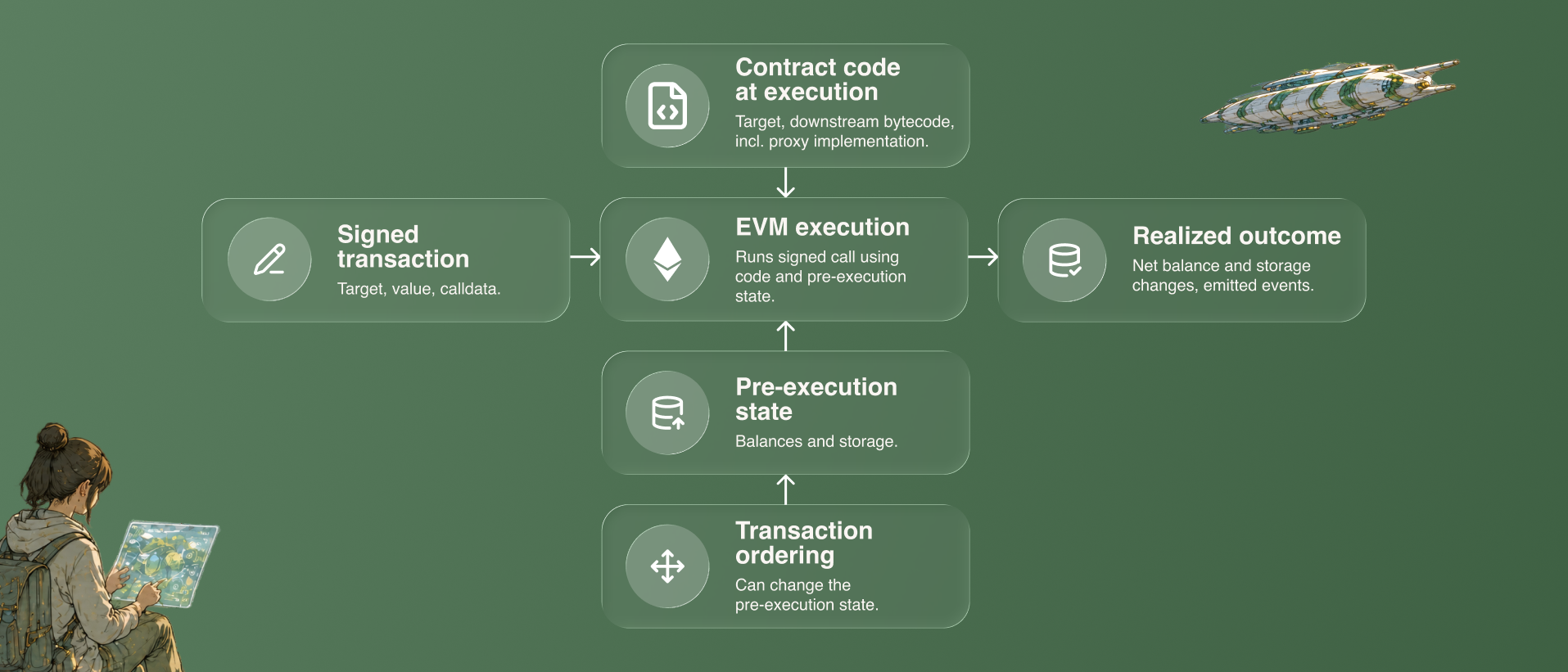
Moreover, the implication for delegated accounts and account abstraction is profound. In a world where agents, bots, and smart contracts act on behalf of users, the ability to define the "bounding box" of an outcome becomes the primary method of risk management. Assertions allow a user to say: "I authorize this agent to swap my tokens, provided that I do not lose more than 2% of the market value and no new contracts are deployed from my account." This level of granular control, enforced by the consensus layer, would represent the most significant security advancement in Ethereum’s history since the transition to Proof of Stake.
Industry Responses and Future Outlook
The response from the broader developer community has been one of cautious optimism. While technical hurdles regarding gas overhead and EIP scheduling remain, the consensus among core contributors is that the current status quo—where a signature is a "blank check" on state manipulation—is unsustainable.
The Ethereum Foundation has invited feedback from wallet providers and protocol teams, recognizing that the success of EIP-7906 depends on universal implementation. Wallet providers must transition to a standard that enforces these assertions by default, and protocols must be willing to update their architecture to recognize and validate these frame-based calls.
As the industry looks toward the "Hegot" upgrade and beyond, the research being conducted under the Trillion Dollar Security umbrella will likely serve as the blueprint for the next generation of Ethereum’s user experience. By transforming the transaction from a blind request into a rule-bound agreement, Ethereum is taking the final step toward institutional-grade reliability.
The path forward requires a delicate balance between maintaining the permissionless nature of the network and providing the safeguards necessary for global finance. The move toward native assertions signals that the Ethereum ecosystem is maturing, transitioning from the "wild west" era of experimental code to a robust, verifiable, and secure infrastructure. For developers and users alike, the integration of these assertions will not only prevent future losses but will also unlock entirely new modalities of complex, safe, and automated financial interaction.