
The cryptocurrency market is currently navigating a period of pronounced bearish sentiment, with Ethereum (ETH), the world’s leading altcoin and foundational smart contract platform, bearing a substantial share of downward pressure. As market values slip and key technical supports are repeatedly tested, analysts are warning that ETH could retest the $1,500 threshold, or even explore deeper historical valuation floors. However, this downward price action presents a striking paradox. Beneath the subdued surface of spot prices, the Ethereum network is experiencing an unprecedented surge in organic usage, developer engagement, and long-term investor accumulation. On-chain metrics, exchange reserve depletions, and structural adoption indicators suggest that the underlying health of the Ethereum ecosystem has never been stronger, even as short-term traders grapple with macroeconomic headwinds and persistent volatility.
Main Facts and Current Market Dynamics
Ethereum’s price action over recent weeks has tested the patience of retail and institutional holders alike. As bearish momentum builds across the broader digital asset landscape, ETH has gravitated toward crucial support levels, hovering near the $1,600 mark with potential structural targets pointing toward $1,500. This downward trajectory reflects a broader cooling-off period following cyclical peaks, driven by macroeconomic tightening, shifting risk appetites, and compressed liquidity across global financial markets.
Yet, this price contraction stands in stark contrast to the network’s operational reality. While token valuations have stagnated, the underlying blockchain infrastructure is busier than ever. Data compiled by prominent market researchers indicates that daily active addresses, transaction volumes, and total value locked (TVL) across layer-1 and layer-2 scaling solutions are breaking historical records. Rather than fleeing the ecosystem during a downturn, users, developers, and institutional entities are actively leveraging Ethereum’s capabilities for decentralized finance (DeFi), real-world asset (RWA) tokenization, and complex smart contract execution.

Chronology of Network Growth and Adoption
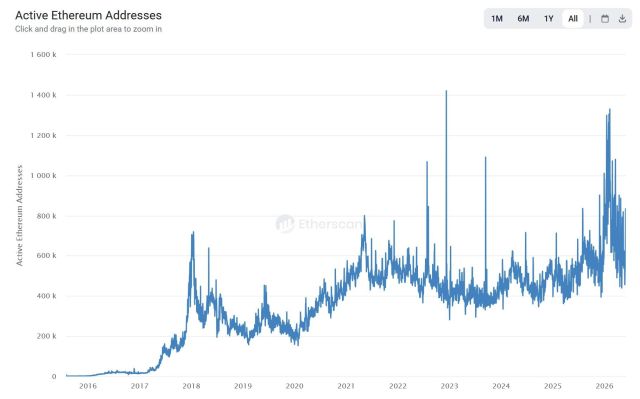
To fully appreciate the scale of Ethereum’s current network activity, it is instructive to examine the historical trajectory of its user base across successive market cycles. During the 2018 bear market—a period colloquially known as the "crypto winter"—daily active wallet addresses on the Ethereum network peaked at approximately 720,000. As the market matured and entered the explosive bull run of 2021, driven by the rise of DeFi and non-fungible tokens (NFTs), daily active addresses reached a new high-water mark of roughly 800,000.
In the current market cycle spanning 2025 and 2026, those historical peaks have been decisively shattered. On-chain data reveals that daily active addresses on Ethereum have consistently pushed past the 1 million threshold, with periodic spikes peaking above 1.3 million. This sustained increase demonstrates that the network is currently processing significantly more organic, day-to-day activity than it did during the height of the 2021 speculative frenzy. This structural evolution illustrates that Ethereum has successfully transitioned from a speculative retail play into an entrenched global settlement layer and economic engine.
Supporting Data: Supply Shock and Exchange Depletions
Perhaps the most compelling argument against the prevailing bearish narrative is the aggressive withdrawal of ETH from centralized cryptocurrency exchanges. According to reports shared by Leon Waidmann, Head of Research at Lisk, the total balance of Ethereum held on centralized trading platforms has plummeted to historic lows.
As of recent data, exchange reserves have dwindled to approximately 14.5 million ETH. To contextualize this decline, exchange balances sat at roughly 21 million ETH in October 2023. Over the span of roughly two and a half years, over 6 million ETH—valued at billions of dollars—have been systematically pulled off exchanges and moved into private wallets, cold storage, staking contracts, and institutional custody solutions.

Historically, periods of heightened market volatility and downward price pressure are characterized by a surge of inflows into centralized exchanges as panic-driven investors position themselves to liquidate holdings. However, the current cycle has inverted this trend entirely. The steady, relentless outflow of coins indicates a strong conviction among buyers. As Waidmann succinctly noted in his market commentary, "Whoever is buying here isn’t selling back." This supply squeeze heavily restricts the liquid circulating supply available for immediate spot trading, laying the groundwork for a potential supply-side shock once buying demand returns to the market.
Analytical Perspectives on Price Bottoms and Valuation Metrics
While long-term fundamentals present an overwhelmingly bullish picture for network utility and supply distribution, short-term technicians and quantitative analysts continue to evaluate where the absolute macro bottom for ETH’s price might lie. A recent valuation framework shared by crypto analyst Ali Charts utilizes the Ethereum Delta Price metric to pinpoint historical market bottoms.
The Delta Price metric is a specialized on-chain indicator that calculates the difference between the average price at which all coins were last moved on-chain (investor cost basis) and the aggregated cost of production (miner/validator economics). Historically, this metric has proven remarkably accurate in identifying deep accumulation zones and ultimate cycle troughs for Ethereum.
Following a comprehensive analysis of the Delta Price model, Ali Charts highlighted that Ethereum’s structural bottom could theoretically reach as low as $700 under extreme macro stress conditions. While a drop to $700 would represent a severe drawdown from current levels, analysts emphasize that such historical flushes often serve as the ultimate springboard for multi-year secular bull markets. Whether ETH undergoes a sharp wick down to these historical value floors or establishes a higher low above $1,500 depends heavily on external macroeconomic catalysts and broader liquidity inflows into the digital asset class.
Broader Impact and Market Implications
The divergence between Ethereum’s depressed price action and its record-breaking network activity carries profound implications for the broader blockchain industry. On one hand, short-term investors facing unrealized losses may feel disconnected from the optimistic narrative of on-chain growth. The prospect of retesting lower support levels or navigating prolonged consolidation can dampen speculative enthusiasm.
On the other hand, the institutionalization and deep-pocketed accumulation occurring behind the scenes signal a mature market transition. Large funds, corporate treasuries, and sophisticated market participants are treating the current price weakness as a generational accumulation phase. By removing millions of ETH from liquid circulation through staking and long-term cold storage, these entities are systematically reducing market elasticity.
Furthermore, Ethereum’s unwavering status as the preeminent settlement layer for decentralized applications ensures its continued relevance regardless of short-term price volatility. As layer-2 networks absorb high-frequency transactions and lower gas fees for everyday users, the mainnet continues to secure billions of dollars in economic value daily.
Ultimately, the current phase of the Ethereum market cycle highlights a classic tension between short-term price sentiment and long-term fundamental adoption. While traders brace for potential volatility and the possibility of testing deeper support zones, the structural pillars supporting the Ethereum ecosystem—ranging from unprecedented active address counts to historic exchange supply drains—suggest that the network is building a formidable foundation for its next major historical expansion.