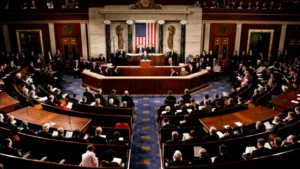
The United States House Committee on Ways and Means convened for a high-stakes legislative markup regarding a comprehensive cryptocurrency tax reform package, drawing intense scrutiny from digital asset advocacy groups. While the proposed legislation incorporates several long-awaited provisions designed to streamline tax compliance for everyday cryptocurrency users, a contentious provision regarding the taxation of newly created block rewards has exposed a deep ideological rift between lawmakers and industry advocates. According to policy experts, the current legislative framework risks codifying a fundamental legal misinterpretation previously advanced by the Internal Revenue Service (IRS).
The core of the dispute centers on whether the programmatic creation of digital assets through mining and staking constitutes a taxable income event at the moment of creation, or if it should instead be treated as the generation of property that only triggers tax liabilities upon eventual disposition. Coin Center, a prominent Washington-based cryptocurrency policy research and advocacy organization, has raised urgent alarms. The group argues that while provisions aimed at establishing simplified accounting methods represent a positive step forward, the language governing validation activities inadvertently validates an erroneous legal premise that has plagued the digital asset sector for over a decade.
Background and Context of the Digital Asset Taxation Debate
To understand the gravity of the current legislative battle, one must examine the regulatory history governing digital asset mining and validation. In 2014, the IRS issued Notice 2014-21, a landmark piece of guidance that classified cryptocurrencies as property rather than currency for federal tax purposes. However, the guidance also asserted that when a taxpayer successfully mines virtual currency, the fair market value of the currency as of the date of receipt must be included in gross income. This interpretation was subsequently reinforced in 2023 through additional administrative rulings, creating a heavy operational and financial burden for network participants.
The legal theory underpinning the IRS guidance has long been contested by tax scholars and industry litigators. Critics argue that when a miner or validator expends computational power or locks up capital to secure a decentralized network, the protocol’s code executes a set of deterministic rules that bring new tokens into existence. This process is fundamentally distinct from receiving compensation from a third party in exchange for goods or services.
To illustrate the absurdity of taxing the mere creation of property, legal analysts frequently draw analogies to traditional manufacturing, intellectual property, or everyday creative endeavors. For instance, an individual who writes software code, paints a canvas, or constructs physical items does not realize taxable income at the moment the property is brought into existence. Realization—and the subsequent tax event—traditionally occurs only when the property is monetized, sold, or exchanged in a market transaction. By treating the algorithmic minting of tokens as an immediate income event, the federal government imposes a tax liability on individuals before they have realized any economic gain, and often before there is a liquid market or stable valuation for the newly minted asset.
The Legislative Compromise and the Stumbling Block in Section 401
In the months leading up to the Ways and Means Committee markup, industry stakeholders engaged in intensive negotiations with congressional tax writers to resolve pressing ambiguities in the digital asset tax landscape. One of the central debates in Washington focused on the concept of timing: should taxpayers be permitted to defer tax liability on block rewards until the underlying assets are sold, or should they be forced to recognize income after a predetermined period, such as five years?
As political consensus on a formal deferral mechanism proved elusive, committee leadership ultimately chose to drop the proposed deferral language from the draft bill. Industry advocates initially understood this omission as a neutral step that would leave the fundamental legal question open for the courts and the IRS to resolve under existing statutory authority, particularly as high-profile legal challenges—such as the heavily watched Jarrett lawsuit—proceed through the federal judiciary.
However, subsequent analysis of the revised legislative text revealed provisions that threaten to undermine this neutral posture. Specifically, Section 401 of the proposed bill explicitly addresses the source and character of mining and staking income. The text mandates that income derived from digital asset validation and supporting activities be classified as ordinary income rather than capital gains.
While the provision does not explicitly dictate the precise moment this income is realized, legal experts argue that by categorizing validation activities as producers of income, the text implicitly adopts the faulty premise that creation equals income. Critics contend that before lawmakers can logically legislate the character of an income stream—whether ordinary or capital—they must first establish whether an income-generating event has actually occurred. By glossing over this foundational question, the statutory language risks being interpreted by courts and administrative agencies as a tacit congressional endorsement of the IRS’s contested 2014 and 2023 administrative guidance.
Industry Reactions and Legal Implications
The inclusion of Section 401 has drawn sharp criticism from legal scholars and digital asset advocacy organizations who have spent years fighting to correct what they view as executive overreach by tax authorities. Coin Center representatives have expressed profound disappointment that an otherwise constructive tax modernization bill could inadvertently enshrine flawed tax policy into federal law.
The implications of codifying the taxation of block rewards at creation are far-reaching and potentially detrimental to the decentralization and security of blockchain networks operating within the United States. Miners and validators subject to immediate income taxation upon block creation face severe liquidity constraints. Because newly minted tokens are often subject to market volatility, a validator could be forced to immediately liquidate a significant portion of their block rewards simply to satisfy tax liabilities owed to the federal government. This dynamic creates a distinct competitive disadvantage for U.S.-based validators, potentially driving critical blockchain infrastructure and technical talent offshore to jurisdictions with more rational and accommodating tax frameworks.
Furthermore, the statutory ambiguity creates significant compliance nightmares. In many proof-of-stake networks, validation rewards are continuously distributed in micro-fractions. Requiring taxpayers to calculate the fair market value of every fractional reward at the exact timestamp of creation introduces an insurmountable administrative burden, directly contradicting the bill’s stated objective of simplifying tax accounting for everyday users.
Path Forward and Outstanding Questions for Committee Leadership
As the crypto tax bill advances past the Ways and Means Committee, industry stakeholders and legal advocates are urging lawmakers to recalibrate the legislative language to ensure it does not preempt ongoing judicial proceedings. If Congress is genuinely unable to forge a political consensus on the constitutional and statutory questions surrounding token creation, the most prudent legislative approach is to maintain strict neutrality.
Advocates suggest that the bill can successfully preserve provisions relating to simplified accounting and transactional reporting while explicitly disclaiming any intent to resolve whether or when block rewards constitute taxable income. Without such clarifying amendments, a legislative package intended to foster tax certainty and economic growth risks achieving the exact opposite result—entrenching legal ambiguity, inviting protracted litigation, and penalizing the foundational participants of the decentralized web.
The coming months will prove critical as the bill moves through subsequent legislative chambers. Observers and market participants will be closely watching whether congressional leaders are willing to amend Section 401 to protect taxpayers and preserve the integrity of ongoing legal challenges currently pending in federal courts.