
The ubiquitous drone, once a symbol of civilian convenience and hobbyist pursuits, has rapidly transformed into a pivotal instrument of modern warfare, fundamentally altering the dynamics of power projection for both state and non-state actors. In the ongoing conflict in eastern Ukraine, commercially available quadcopters, often purchased off-the-shelf, are being repurposed for frontline reconnaissance and attack missions. Simultaneously, in critical maritime chokepoints like the Red Sea and the Strait of Hormuz, one-way attack unmanned aerial vehicles (UAVs) have proven capable of disrupting global commerce and vital shipping lanes. These advanced systems offer a compelling confluence of attributes: their relatively low cost, operational flexibility, and the inherent plausible deniability they afford, collectively lower the threshold for engaging in asymmetric warfare.
However, the burgeoning ecosystem of drone technology, much like any scalable weapons system, is not solely dependent on the availability of hardware. Its proliferation is intrinsically linked to the financial infrastructure that facilitates procurement. While the vast majority of drone acquisitions still transpire through traditional financial channels, a significant and growing intersection with the blockchain has emerged. This paradigm shift presents both novel challenges and unprecedented opportunities for monitoring illicit activities. The transparent and immutable nature of cryptocurrency transactions, when meticulously analyzed, enables the tracing of procurement flows, thereby enhancing our understanding of how emerging technologies are reshaping the economic underpinnings of modern conflict.
The Dual-Use Conundrum: From Photography to Warfare
At its core, drone technology represents a quintessential example of a dual-use item. A DJI Mavic drone, purchased by a wedding photographer for capturing aerial vistas, is functionally identical to a unit modified to dispense munitions on a forward operating position. The very components that constitute these versatile machines—motors, flight controllers, cameras, and batteries—are readily available on global e-commerce platforms and are, in themselves, not inherently illicit. This accessibility creates a significant challenge for regulatory bodies and intelligence agencies tasked with preventing their misuse.

Cryptocurrency enters the drone procurement landscape through two primary avenues. The first is direct: manufacturers openly accept cryptocurrency on their official websites as a payment method. The case of KB Vostok, a Russian drone manufacturer, serves as a prominent public example of this direct integration. The second, more indirect, avenue involves electronics and dual-use component vendors operating through third-party e-commerce platforms, such as Alibaba. These vendors often accept cryptocurrency, facilitating sales to buyers whose identities and ultimate intentions remain opaque. It is here that blockchain analysis becomes an indispensable tool, offering crucial insights into the potential end-use cases of these purchases. By examining liquidity sources and transaction volumes, investigators can identify potential state actors, such as those linked to Iran or Russia, behind the acquisition of drones and their constituent parts, thereby shedding light on how emerging technologies are being financed and deployed in conflict zones.
Crowdfunding the Frontlines: Militias and Cryptocurrency
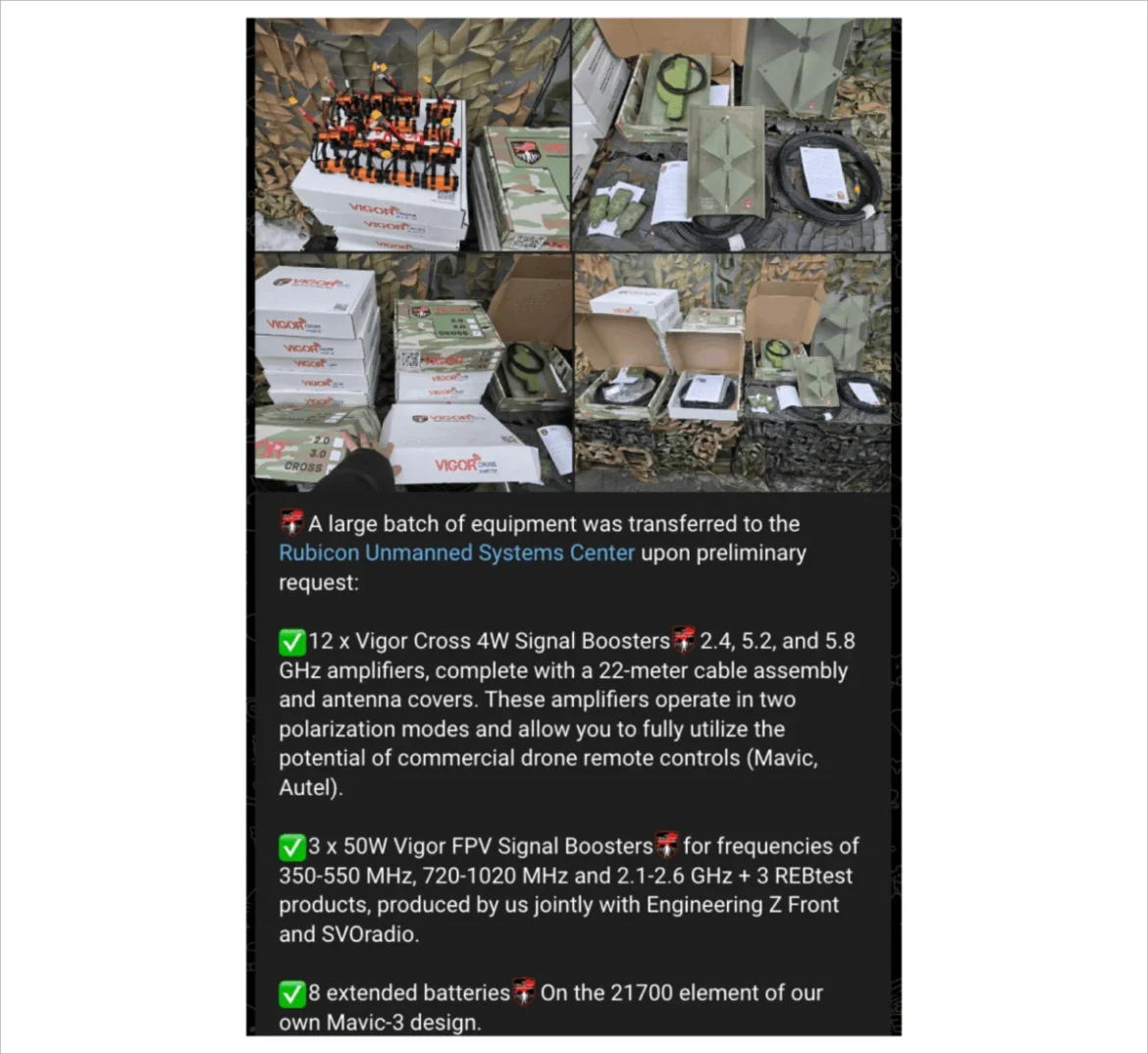
One of the most visible manifestations of the crypto-drone nexus operates at the militia level, frequently fueled by open crowdfunding campaigns disseminated across social media platforms. Following the full-scale invasion of Ukraine by Russia in early 2022, researchers identified dozens of pro-Russia volunteer and paramilitary organizations soliciting cryptocurrency donations for the acquisition of military equipment. Collectively, these groups have raised over $8.3 million in cryptoassets, with drones consistently listed among the explicitly itemized purchases. Some solicitation posts have detailed campaigns aimed at raising sufficient funds to acquire reconnaissance drones, while others have published delivery manifests that include UAV components valued at approximately 200,000 rubles (around $3,400), alongside other essential military supplies such as radios, medical kits, and weapon maintenance equipment.
The significance of these figures lies not merely in their monetary value, but in the tactical logic they represent. At the militia level, low-cost commercial drones are among the most tactically impactful items that can be acquired through cryptocurrency crowdfunding. With individual units priced between $2,200 and $3,500, a single successful fundraising campaign can directly translate into enhanced battlefield capabilities for groups that lack access to conventional financial systems or are subject to international sanctions.

These groups typically procure components and complete drones through general electronics platforms and commercial resellers, utilizing the same global e-commerce infrastructure employed by hobbyists and legitimate commercial operators. While resellers and manufacturers openly list drone parts, the transformation of a legitimate commercial purchase into a national security concern hinges on the identity of the purchaser and their intended use of the equipment.
Evidence from social media analysis has revealed Russian militia fundraising groups openly discussing the utility of Chinese-manufactured drones. These same groups have historically been observed crowdfunding supplies for Russian militia units operating in eastern Ukraine. Further on-chain analysis has corroborated these findings, showing these groups making purchases from a Hong Kong-based drone manufacturer. Additional blockchain data indicates that other drone purchasers are acquiring liquidity from Russian-language, no-Know-Your-Customer (KYC) exchanges, sanctioned Russian exchanges like Garantex and Grinex, and an over-the-counter (OTC) service operating out of the Federation Tower in Moscow. This comprehensive analysis of drone purchasers and their liquidity sources strongly suggests that Russia-linked actors may be procuring drones from Chinese manufacturers for deployment in Ukraine.
More broadly, the liquidity source for a drone purchaser provides critical insights into whether their end use is intended for licit or illicit purposes. When purchasers receive liquidity from illicit sources, such as sanctioned entities, Russian-language no-KYC swap services, or entities operating within sanctioned jurisdictions, it raises strong suspicions of end-use cases involving nation-state actors like Iran or Russia and their proxies. Data indicates that inflows to a sample of drone vendors originate, to varying degrees, from these illicit sources, with the proportion of total inflows fluctuating over time, reflecting the dynamic nature of these procurement networks.

On-Chain Data Illuminating Drone Manufacturers
A second, and arguably more analytically significant, layer of investigation focuses on drone manufacturers themselves. These entities are not merely resellers of commercial components but are dedicated UAV developers with targeted military markets. In at least one instance, a manufacturer has maintained a publicly visible cryptocurrency payment channel. In 2024, the U.S. Department of the Treasury’s Office of Foreign Assets Control (OFAC) designated two Russian UAV developers: OKO Design Bureau (May 2024) and KB Vostok, also known as Vostok Design Bureau (August 2024). Both entities solicited cryptocurrency through public channels. While OKO Design Bureau raised less than $1,000, KB Vostok’s public footprint offers far deeper insights. Their fundraising efforts allow for a direct comparison between on-chain financial movements and the known costs of their hardware, providing a tangible link between financial transactions and military production.
Pricing Reveals Counterparty Insights
KB Vostok is known for designing the "Scalpel," a one-way attack UAV with a payload capacity of up to five kilograms. This drone is reportedly priced at approximately 200,000 rubles per unit, which translates to roughly $2,200. Russian press reports have highlighted the Scalpel’s simplicity of production and its affordability relative to other UAVs in its class. This specific price point is analytically significant. At $2,200 per unit, individual purchases are plausible in round-number transactions, and patterns of repeat purchasing become observable on-chain.
OFAC’s designation of KB Vostok included a wallet address that the company had published on its website. An analysis of this wallet revealed transaction patterns inconsistent with typical donation campaigns. Instead, the regularity and sizing of the transfers—clustering around $2,200 and its clean multiples—are more indicative of recurring unit purchases. The scale of the counterparties involved suggests institutional participation, likely representing nodes within Russia’s military supply chain, rather than individual buyers.

Furthermore, KB Vostok’s utilization of stablecoins, rather than Bitcoin, is also analytically significant. This choice reflects a broader trend in illicit crypto finance towards dollar-denominated cryptocurrencies, which offer the price stability essential for commercial procurement activities. Investigators who focus exclusively on Bitcoin flows risk missing this entire layer of financial activity.
The KB Vostok case serves as a template for how analyzing drone vendors on-chain can uncover broader procurement networks. By examining the source of liquidity flowing into a vendor’s wallet, investigators can formulate hypotheses about the identity of the buyers and their operational locations. Funds sourced from Russian-language no-KYC exchanges, for instance, strongly suggest Russian buyers, while funds originating from Iranian-linked services point towards Iranian actors. When mapped against known product prices, transaction volumes allow investigators to distinguish between a one-time component purchase and a pattern of recurring procurement that may signify a state-adjacent supply chain. Analysis of fund flows from wallets associated with entities like Garantex and other Russia-related Specially Designated Nationals (SDNs), including Colonelcassad, to drone vendors, often through intermediary wallets, illustrates these complex procurement pathways.
Iran: From Proxy Networks to State-Level Commercialization
The dual-use procurement challenge extends significantly beyond Russia. Sanctions-constrained actors, including Iranian defense entities and Iran-aligned proxies, require components subject to export controls. Drone parts precisely fit this profile, and Iran’s own Shahed drone program has demonstrably relied on commercially available components sourced through third-country procurement networks.

A January 2026 Financial Times investigation revealed that Iran’s Ministry of Defense Export Center (Mindex) was publicly advertising advanced weapons—including Shahed drones, ballistic missiles, and warships—for sale to foreign governments, with cryptocurrency accepted as a payment method. This development appears to be one of the first known instances of a nation-state openly advertising strategic military hardware for cryptocurrency. Notably, Mindex’s website explicitly addressed buyer concerns regarding sanctions evasion, stating that Iran’s policies ensure contracts "can be executed." This underscores the growing perception among heavily sanctioned actors that cryptocurrency is not merely a niche workaround but a deliberate, institutionalized tool for circumventing sanctions.
On-chain analysis has provided further corroboration. A wallet observed purchasing drone parts from a Hong Kong-based supplier exhibits direct and indirect liquidity flows from the Iranian exchange Nobitex, wallets associated with the Islamic Revolutionary Guard Corps (IRGC), and OFAC SDN Alireza Derakhshan. Derakhshan, an Iranian national, has been designated for facilitating crypto transfers on behalf of the Iranian regime.
During the 12-day conflict between Iran and Israel in June 2025, inflows to a small subset of drone vendors saw a notable spike, returning to pre-war levels once a ceasefire was concluded. While this activity is consistent with a wartime surge in drone-related procurement, it represents only a snapshot of limited vendor activity at a specific moment and should not be interpreted as indicative of Iran’s entire drone payment landscape or broader global patterns. Nevertheless, it highlights the potential for real-time monitoring of transactional activity, even during periods of active conflict.

The Blockchain as a Weapons Tracker
The ability to track drone purchases on the blockchain represents a significant evolution in the field of financial intelligence and national security. Each supplier address identified becomes an investigative anchor—a fixed point from which blockchain analysis can map counterparty relationships, trace liquidity sources, and identify previously unknown nodes within opaque procurement networks.
The most crucial insight offered by the blockchain is not necessarily the sheer volume of cryptocurrency flowing into drone procurement, although these volumes are substantial. Rather, it is the unique, near real-time visibility it provides into procurement networks that would otherwise remain entirely opaque. Drones are inexpensive, proliferating rapidly, and increasingly central to how states and non-state actors project power and conduct warfare. The blockchain, with its inherent transparency and immutability, offers one of the few existing mechanisms through which the financing of these critical military assets leaves a permanent, actionable trace, providing invaluable intelligence for counter-proliferation efforts and national security agencies worldwide.
