

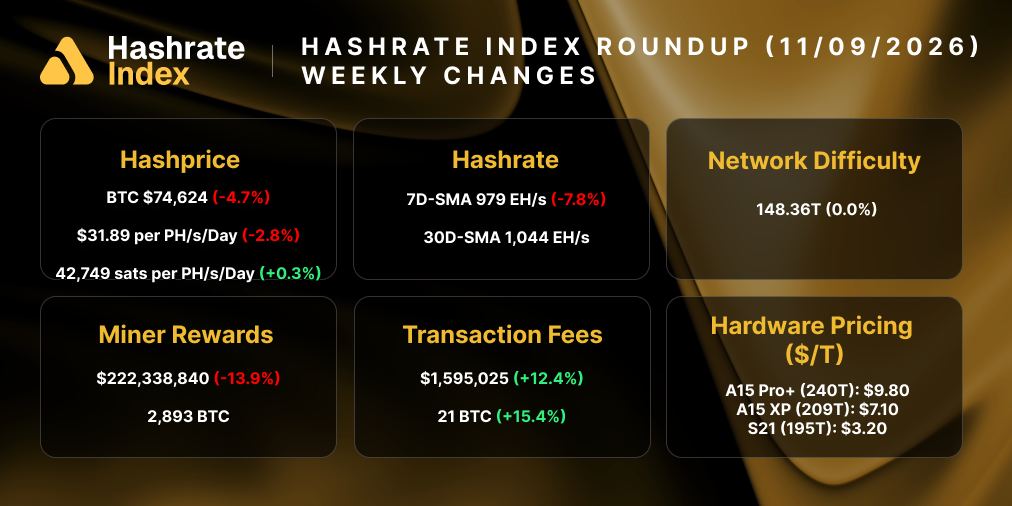
The global Bitcoin mining landscape experienced a week of contraction and recalibration, marked by a notable decline in network hashrate and a simultaneous dip in the price of the flagship cryptocurrency. For the week ending November 9, 2026, Bitcoin saw its market value retract by 4.7%, sliding from approximately $78,288 to $74,624. This downward movement has rippled through the mining ecosystem, impacting profitability metrics—often referred to as hashprice—and triggering a reassessment of operational efficiency among major mining firms.
Market Dynamics and the Contraction of Network Hashrate
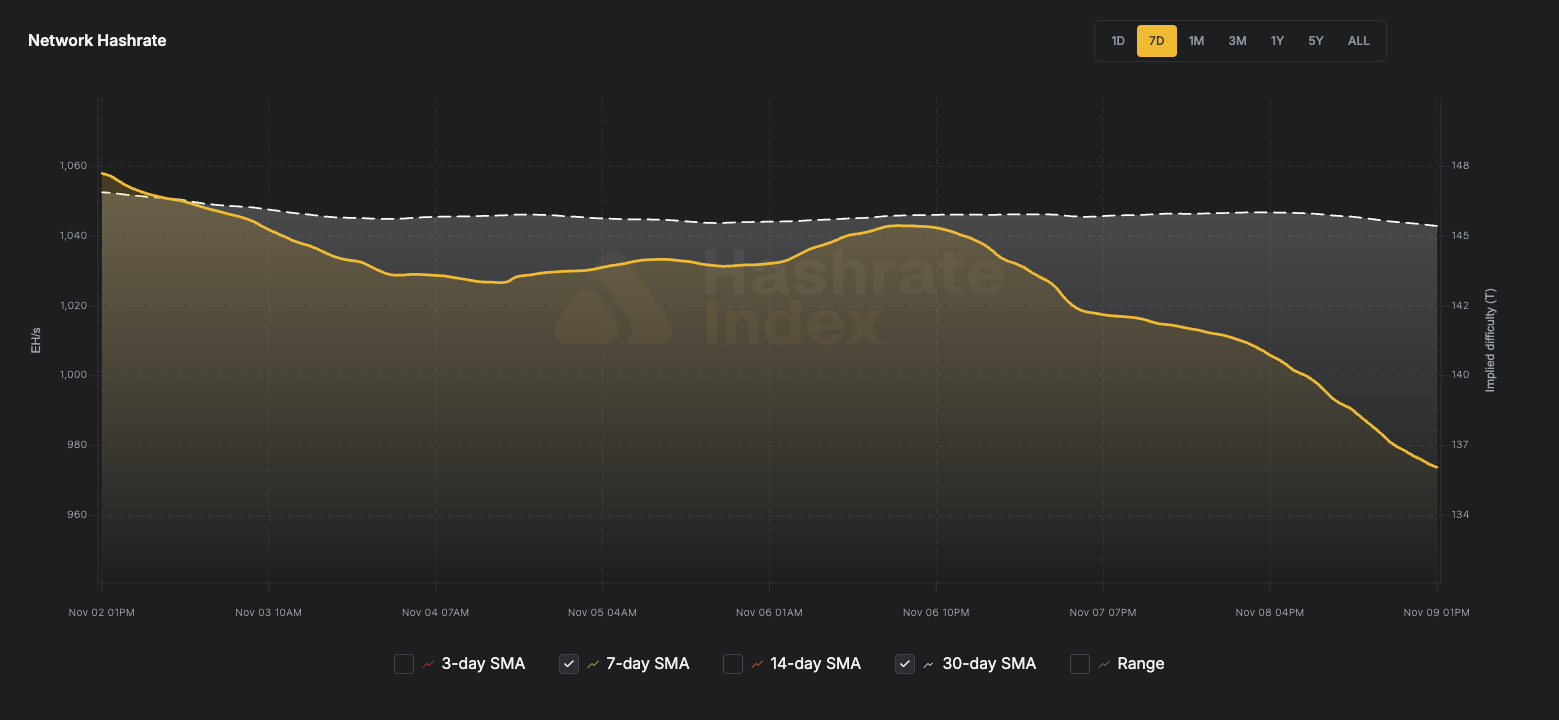
The most significant development of the week was the 7.8% decline in the Bitcoin network hashrate. The seven-day simple moving average (SMA) dropped from 1,062 EH/s to 979 EH/s, while the 30-day SMA remained more stable at 1,044 EH/s. This reduction in aggregate computing power suggests that a portion of the global mining fleet has either been taken offline due to tightening margins or is undergoing maintenance and hardware rotation.
This volatility occurs against a backdrop of ongoing difficulty adjustments. The most recent adjustment on October 29 resulted in a 5.5% increase, bringing network difficulty to 148.36T. However, current projections indicate that the next adjustment, slated for November 13, will likely see a reversal, with an estimated decrease of 6.5%. This anticipated decline is a natural, algorithmic response to the lower hashrate, designed to bring block production times back to the protocol’s ten-minute target. Currently, block times have drifted slightly higher, averaging approximately 10 minutes and 41 seconds over the last 24 hours.
Economic Implications for Mining Operations
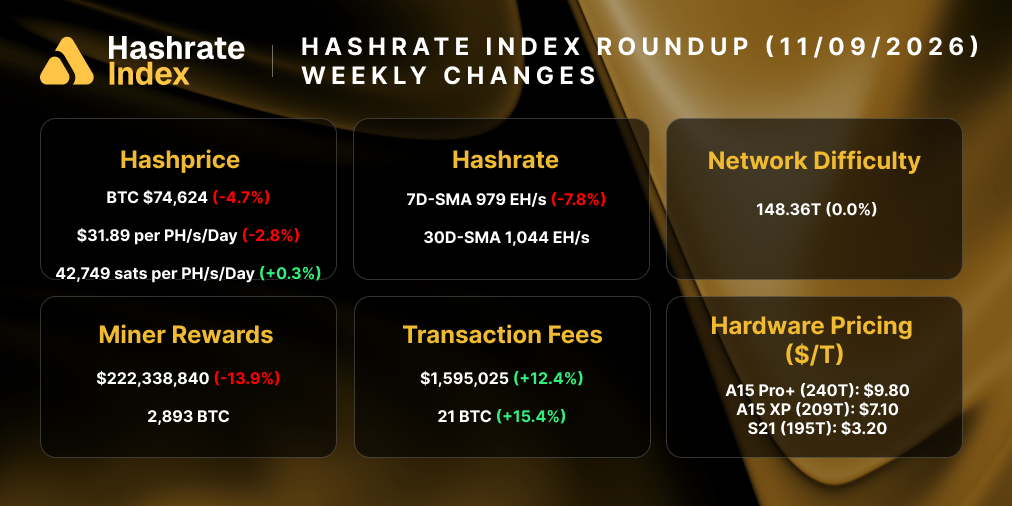
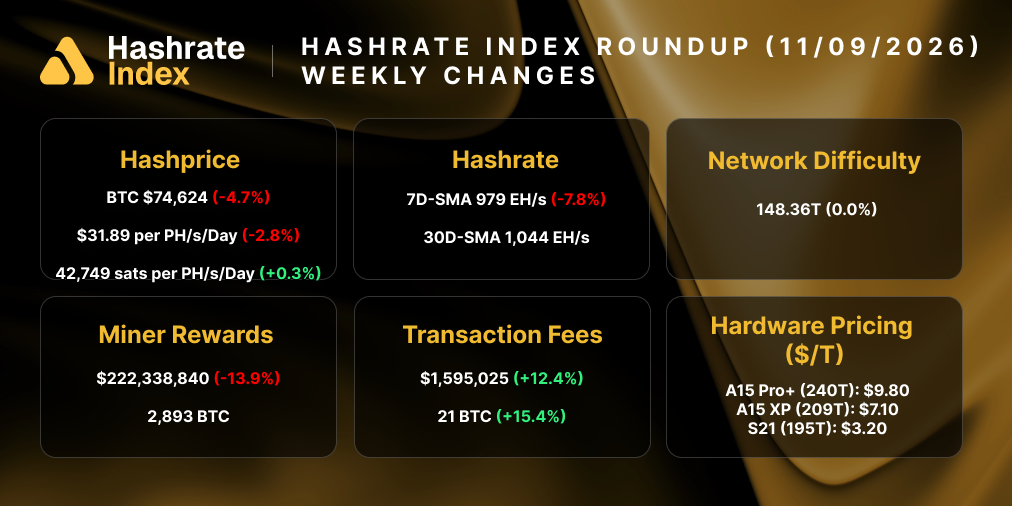
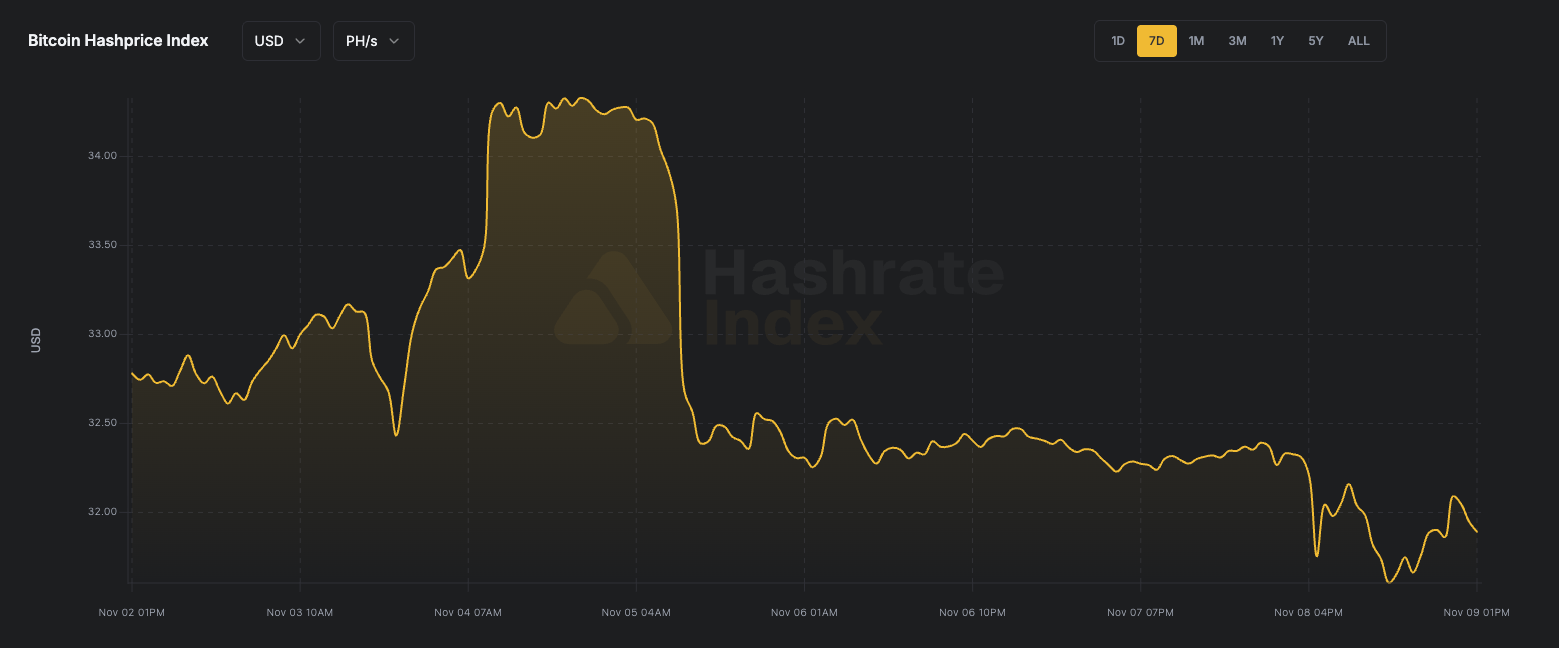
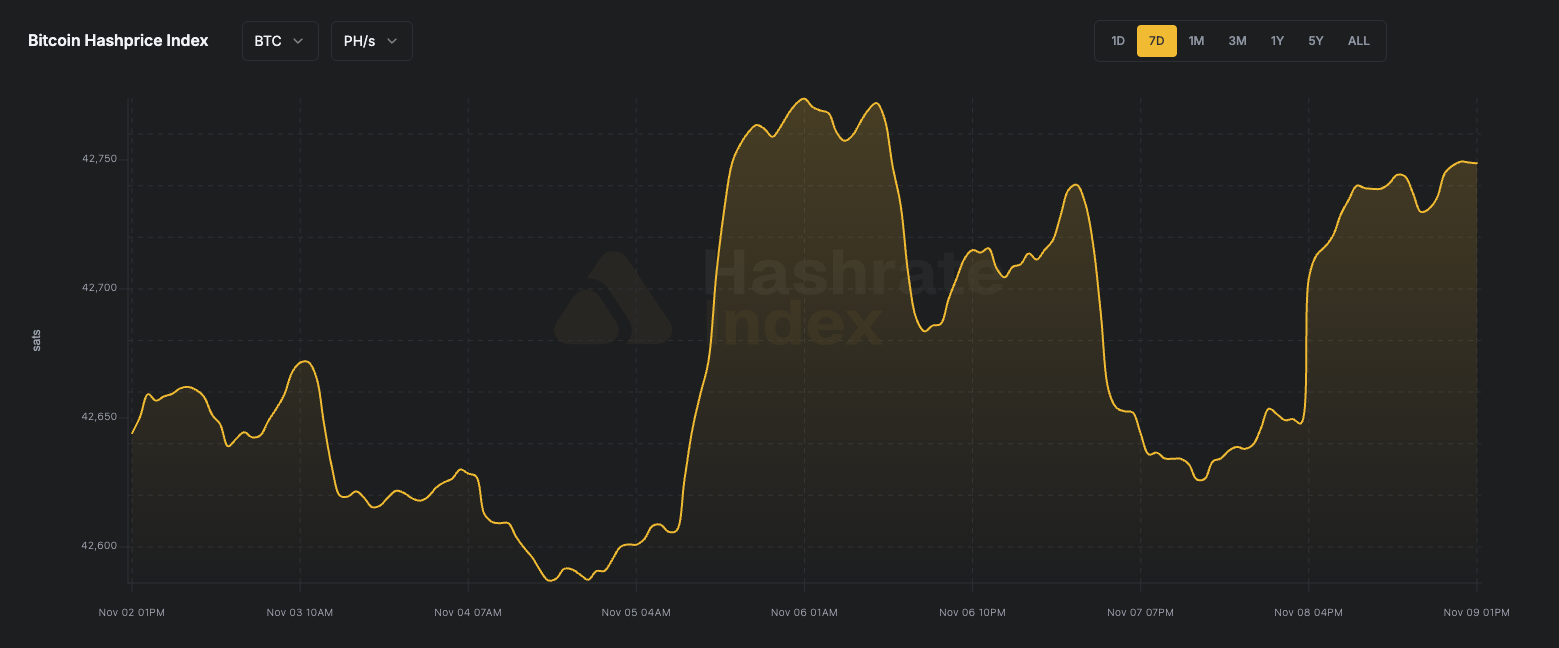
The profitability of mining, measured in USD hashprice, fell by 2.8% over the week, moving from $32.82 to $31.89 per PH/s/Day. While the USD-denominated revenue per unit of computing power declined, the BTC-denominated hashprice saw a marginal increase of 0.3%, rising to 0.00042749 BTC per PH/s/Day. This discrepancy highlights the dual pressure miners face: the volatility of Bitcoin’s spot price against the USD and the competitive intensity defined by network difficulty.
Miners collected a total of 2,893 BTC in block rewards this week, with a total value of approximately $222 million. Transaction fees, while a smaller component of the total reward, saw a significant uptick of 31.3%, totaling 21 BTC or roughly $1.60 million. This increase in fee revenue, while currently representing only 0.72% of total block rewards, serves as an important secondary income stream for miners, particularly during periods of depressed block subsidy value.
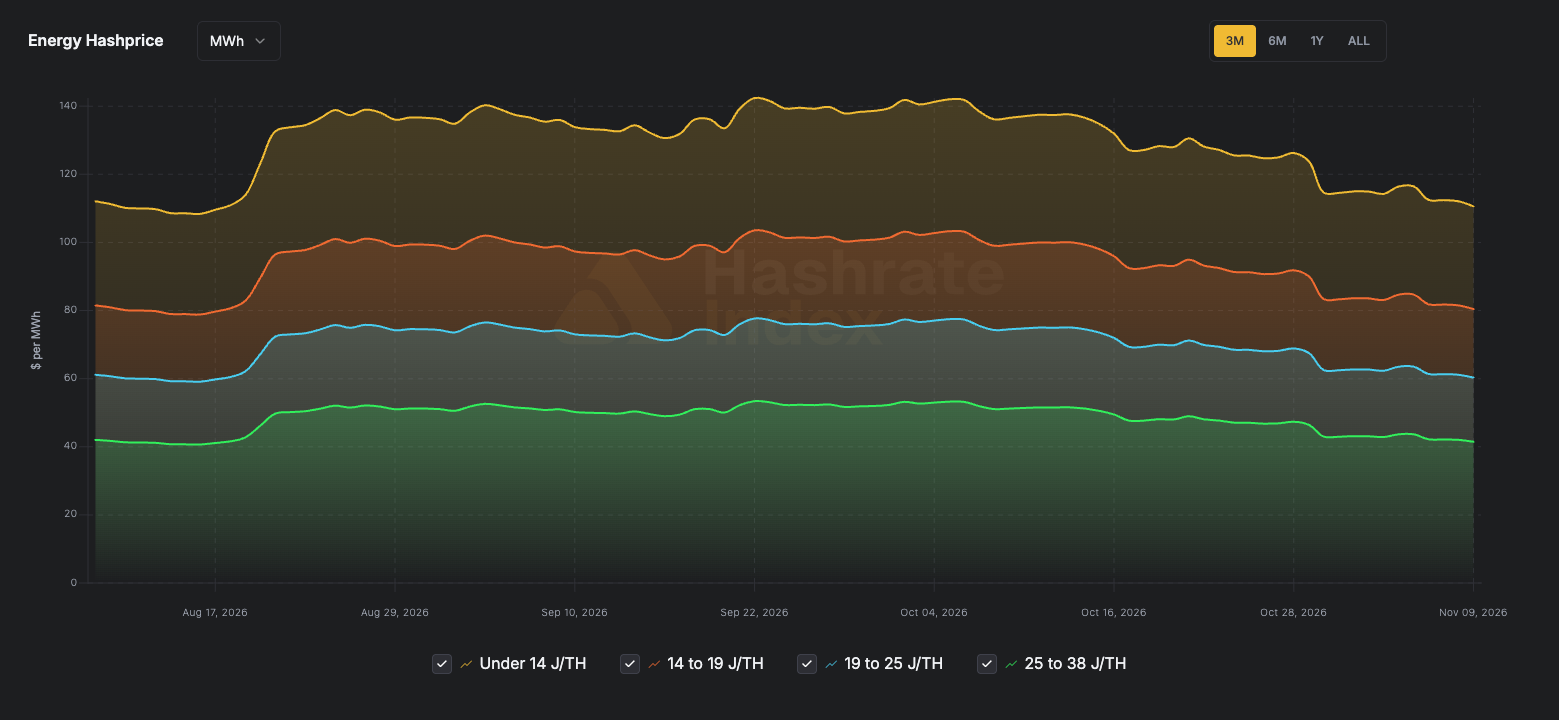
The current hashprice environment is placing immense pressure on operators utilizing older generation hardware. With hashprice hovering near or below $32, firms are increasingly turning toward firmware optimization—such as the integration of advanced tuning software like LuxOS—to extract higher efficiency and hashrate from existing S19 and S21 series equipment. The goal is to extend the operational lifespan of hardware that would otherwise be rendered unprofitable by rising difficulty and fluctuating energy costs.
Performance of Bitcoin Mining Equities
The equity markets mirrored the volatility observed in the mining sector, with Bitcoin mining stocks showing mixed results. Out of 18 tracked companies, performance was evenly split between gains and losses.
The standout performer was Riot Platforms (RIOT), which surged 48.3% over the week. Conversely, ABTC faced the most significant downturn, shedding 13.7% of its value. Other notable movements included Wolfspeed (WULF), which saw a 10.5% gain, and Core Scientific (CORZ), which remained relatively flat with a minor 0.6% decline. The divergence in stock performance suggests that investors are increasingly differentiating between firms based on their capital structures, energy procurement strategies, and fleet efficiency rather than viewing the sector as a monolithic asset class.
Forward Market Outlook
Looking toward the immediate future, the Hashrate Forward Market provides a window into industry expectations. Pricing models suggest an average hashprice of $32.69 (or 0.00043 BTC) over the next six months. This forward-looking data implies that while the market is currently experiencing a period of contraction, there is a degree of tempered stability expected through the first half of 2027.
The forward curve serves as a critical tool for miners who utilize hedging strategies to lock in revenue. By securing future hashprice, firms can protect themselves against sudden dips in the spot price of Bitcoin or unexpected spikes in network difficulty. As the industry matures, these derivative instruments are becoming increasingly central to the risk management strategies of large-scale, publicly traded mining operations.
Analysis: A Period of Strategic Consolidation
The current data reflects a market in a phase of strategic consolidation. The decline in hashrate is not necessarily indicative of systemic failure, but rather a reflection of the protocol’s self-correcting nature. As marginal miners are squeezed by the combination of higher difficulty and lower asset prices, the network’s total power consumption becomes more concentrated among the most efficient operators.
The 6.5% anticipated decrease in difficulty on November 13 will likely provide a temporary "breather" for miners, potentially improving margins for those who have weathered the recent volatility. However, the long-term trend remains clear: as the block subsidy continues to decrease over the coming years through the halving mechanism, the reliance on operational efficiency and transaction fee revenue will become even more pronounced.
For institutional and retail observers alike, the key metrics to monitor in the coming weeks will be the actualized network difficulty adjustment and the consistency of transaction fee volume. If fee revenue continues to trend upward, it may provide a vital cushion for miners, even if the price of Bitcoin remains stagnant. Conversely, if hashrate continues to drop without a corresponding increase in fees, the sector may see further consolidation as smaller, less capitalized operations are forced to liquidate hardware or merge with larger, more efficient mining entities.
Summary of Market Metrics (November 9, 2026)
- Bitcoin Price: $74,624 (-4.7% WoW)
- USD Hashprice: $31.89/PH/s/Day (-2.8% WoW)
- BTC Hashprice: 0.00042749 BTC/PH/s/Day (+0.3% WoW)
- Network Hashrate: 979 EH/s (7-day SMA, -7.8% WoW)
- Network Difficulty: 148.36T (Current)
- Transaction Fees: 0.0228 BTC/block/day (+31.3% WoW)
As the industry navigates this latest cycle of difficulty and price adjustment, the focus remains on the intersection of energy technology and financial engineering. The ability to maintain high uptime while minimizing energy costs—often through flexible load-balancing and demand-response programs—remains the primary determinant of success for Bitcoin miners in 2026. With the upcoming difficulty adjustment expected to lower the barrier for profitable mining slightly, the coming week will be critical in determining whether the network hashrate stabilizes or continues its current retracement.
