
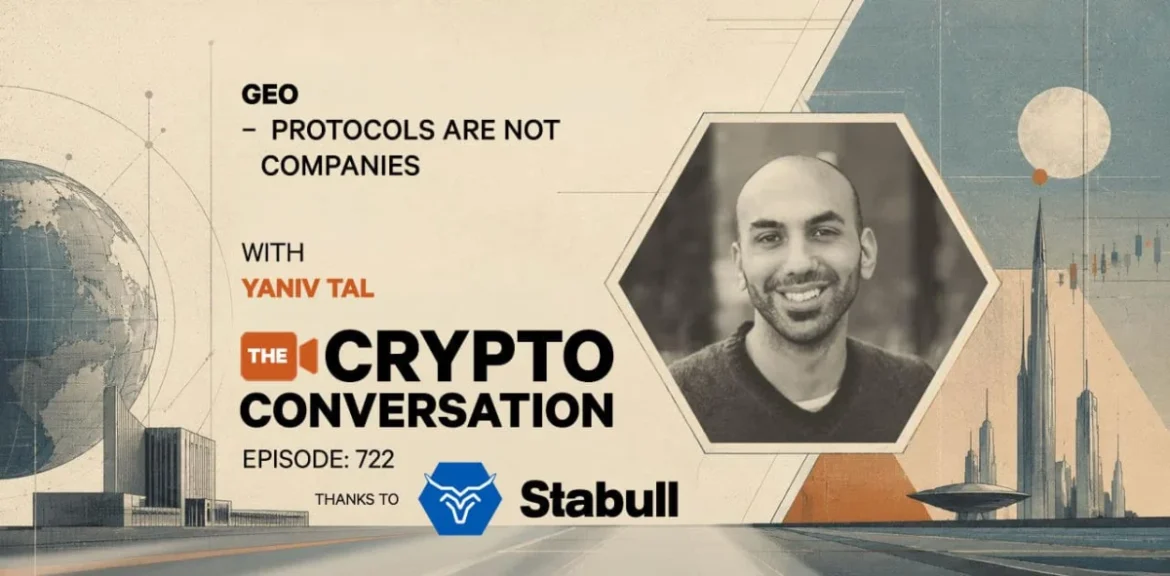
The architecture of the decentralized web is undergoing a profound philosophical and structural reassessment, driven by veterans of the industry who are urging a return to foundational principles. Yaniv Tal, the founder and CEO of Geo—a decentralized knowledge graph network designed for verifiable information—recently shared deep insights into the trajectory of blockchain technology, economic design, and the long-term utility of crypto protocols. Best known as the co-founder of The Graph, an indispensable indexing protocol that serves as core infrastructure for Web3, Tal has spent years observing how capital, development, and community incentives shape the digital landscape. His transition from building developer tools to spearheading decentralized data verification underscores a broader industry pivot: moving away from traditional corporate metrics toward resilient, public-utility frameworks.
The Category Error of Crypto Economics
At the heart of Tal’s analysis is a critical diagnosis of the cryptocurrency industry’s historical missteps: a phenomenon he describes as a "category error." During the excessive fundraising cycles of 2017 and 2021, the market experienced a massive influx of capital. As investors demanded tangible proof of utility for their capital injections, the industry rightly pivoted toward fundamental value creation. However, Tal argues that the fatal flaw lay in borrowing the foundational templates of traditional equity corporations rather than designing economic models native to open-source protocols.
In traditional finance, a corporate entity operates to sell a proprietary product, protect competitive moats, and return profit margins to shareholders. Conversely, foundational network protocols like Ethereum function more akin to global public infrastructure. Their primary mandate is to maximize utility and value for their end users and token holders, rather than acting as rent-seeking corporate intermediaries.
This perspective aligns closely with recent debates within the Ethereum ecosystem, including commentary from co-founder Vitalik Buterin regarding the valuation of Ether (ETH) primarily as a robust store of value rather than strictly a fee-burning mechanism. Tal points out a historical precedent in Bitcoin, which achieved its premier monetary status without ever relying on high transaction fees as its primary value driver.
The Barbell Market and the Multi-Asset Store of Value Thesis
Expanding on macroeconomic theories within digital assets, Tal challenges the rigid maximalist view that only Bitcoin can qualify as a legitimate cryptographic store of value. He posits that absorbing trillions of dollars of global wealth into a nascent, high-tech asset class inherently demands diversification. Furthermore, Ethereum’s architectural capacity for continuous upgrades positions it advantageously against future technological risks, such as the looming threat of quantum computing.
Tal ties the burgeoning demand for non-fiat stores of value directly to the escalating sovereign debt burdens carried by fiat currency economies worldwide. To evaluate the longevity of these digital systems, he proposes a rigorous 100-year stress test. Traditional listed corporations have an average lifespan of merely a decade or two, implying that true, generational value cannot rely on transient corporate business models. Instead, it must emerge from decentralized networks backed by undeniable utility and powerful network effects. In this light, Ethereum is framed not merely as a speculative asset, but as a global, permissionless system of digital property rights.
Analyzing the current distribution of the digital asset economy, Tal characterizes the market as a structural barbell. At one extreme lie fee-maximizing infrastructure solutions tailored for institutional banking; at the other sit speculative, valueless memecoins. The glaring omission in this landscape, according to Tal, is the middle ground: networks that users hold not for immediate financial extraction, but out of a fundamental conviction that they improve the world. Cultivating this missing middle, he asserts, is a collective responsibility shared by venture capitalists, industry media, and token holders, as developers will inevitably build whatever products the market rewards.
From The Graph to Geo: Realizing the Semantic Web
Tal’s transition from indexing blockchain data with The Graph to pioneering Geo in 2022 represents a direct evolution in his approach to information architecture. Geo is engineered as a decentralized knowledge graph designed to restore trust and verifiability to human knowledge.
The pursuit of a "semantic web"—a standardized framework that allows machines to understand and process the meaning of data—is not a new concept. The original architects of the internet attempted to build it decades ago, ultimately falling short due to centralized bottlenecks and the absence of verifiable trust layers. Tal argues that contemporary public blockchain infrastructure and cryptographic verification finally make the semantic web practically achievable. This technological convergence is especially timely given the exponential rise of autonomous AI agents, which increasingly require structured, trustworthy data to operate independently on behalf of users.
Geo operationalizes this vision through initiatives like Geo Debates, a mechanism where users engage in decentralized voting on complex, contested questions spanning geopolitics, public health, and artificial intelligence. Building upon these foundations, the network is advancing through structured curator programs. In these phases, participants contribute context, publish verified knowledge units, and actively fact-check claims against authoritative sources.
The ultimate long-term trajectory for Geo envisions a modern iteration of collaborative platforms like Reddit, but anchored securely to a shared, immutable knowledge graph. Within such an ecosystem, communities gain the cryptographic tools to flag information taken out of context, trace the lineage of data points, and hold original sources fully accountable.
Broader Implications and Industry Outlook
The insights offered by infrastructure veterans like Tal signal a mature phase for the Web3 sector. As regulatory scrutiny tightens globally and institutional capital seeks sustainable deployment avenues, the emphasis on robust infrastructure, data integrity, and authentic network utility becomes paramount.
The convergence of decentralized data graphs with artificial intelligence represents one of the most critical frontiers in modern technology. As AI models consume vast swathes of internet data—much of it plagued by misinformation and lack of attribution—cryptographically verified knowledge graphs offer a viable antidote. By ensuring data provenance and enabling decentralized consensus on factual accuracy, networks like Geo aim to establish a secure foundation for the next generation of digital intelligence.
Ultimately, the maturation of decentralized protocols depends on shifting the developer and investor mindset away from short-term financial engineering and toward durable public infrastructure. Whether through multi-asset monetary stores of value or verifiable semantic web protocols, the blueprint for the next decade of blockchain technology relies on building systems that outlast traditional corporate lifecycles and deliver enduring value to global societies.
