
The global cryptocurrency sector is reeling following an unprecedented cyber heist in which threat actors linked to North Korea successfully looted approximately $6.4 billion from major exchange Binance. Investigations spearheaded by blockchain analytics firm Chainalysis have revealed that the colossal breach did not begin with a sophisticated cryptographic exploit or a brute-force server attack. Instead, the multi-stage operation originated through a deceptively simple human vulnerability: employment fraud.
The Binance breach marks a watershed moment in cyber security and financial crime history. For years, intelligence agencies and blockchain forensics teams have tracked the steady evolution of Democratic People’s Republic of Korea (DPRK) hacking cells, which have increasingly relied on social engineering, fraudulent recruitment processes, and insider infiltration to bypass corporate perimeters. The successful execution of the Binance theft represents the chilling culmination of a meticulously rehearsed playbook, highlighting the expanding threat landscape facing centralized financial platforms and decentralized networks alike.
Anatomy of a Breach: The Fake Job Interview That Opened the Door
According to initial findings released by Binance, the sophisticated multi-stage attack commenced in September when a corporate engineer received an unprompted invitation for a job interview via a legitimate professional platform. Over the course of several weeks, the threat actors systematically built rapport and trust with the employee through multiple rounds of rigorous interviews purportedly conducted by a fictitious corporate entity.
Once trust was firmly established, the candidate was directed to complete a technical assessment that supposedly evaluated their programming capabilities. Unbeknownst to the employee, the assignment file contained malicious code designed to execute quietly upon download.
This malicious payload established an initial foothold inside the victim’s local device. From this beachhead, the attackers deployed advanced malware, harvested credentials, and ultimately exploited access to an internal artificial intelligence tool utilized by the exchange. Leveraging these elevated privileges, the actors moved laterally through Binance’s internal infrastructure, ultimately orchestrating the largest digital asset theft in history.

Industry experts refer to this specific vector as a "contagious interview." Rather than attempting to breach heavily fortified external firewalls, DPRK operatives target individuals possessing privileged access to sensitive corporate networks. By weaponizing the recruitment process, attackers bypass traditional defensive perimeters by transforming trusted employees into unwitting entry points.
Evolution of a Methodology: From Low-Level Intrusions to Historic Heists
The Binance hack is far from an isolated incident. Over the preceding eighteen months, Chainalysis investigators attributed more than $14.3 million in losses to similar DPRK-linked fake interview and malware schemes targeting individual cryptocurrency holders, private wallets, decentralized autonomous organizations (DAOs), and various blockchain protocols.
Senior intelligence analysts at Chainalysis noted that while these earlier compromises resulted in losses ranging from tens of thousands to millions of dollars, their primary significance lay in the training ground they provided for the hackers. Across successive operations, DPRK actors iteratively perfected and evolved their methodology. They tested evasion techniques, refined their command-and-control frameworks, and gradually built the technical capabilities necessary to target institutional behemoths of Binance’s scale.
Microsoft and other leading cybersecurity entities have similarly documented this trend, noting that specialized malware deployed through fake developer job interviews actively scans infected systems for cryptocurrency seed phrases, cloud storage access tokens, and password-manager artifacts. The extraction of credentials early in an operation frequently permits attackers to compromise cloud-based backup vaults even when physical seed phrases have never been downloaded to the local device.
The Broader DPRK Illicit Employment and Financing Ecosystem
The exploitation of corporate recruitment channels represents only one facet of North Korea’s sprawling cyber-enabled financial engine. The regime operates a multi-pronged illicit employment ecosystem designed to generate hard currency under international sanctions.

This ecosystem operates on two distinct fronts: external infiltration and internal placement. On one side, malicious actors deploy malware through fake interviews to steal assets directly or compromise corporate supply chains. On the other side, thousands of state-sponsored North Korean IT workers deploy globally—often utilizing stolen identities, fabricated resumes, and Virtual Private Networks (VPNs)—to secure remote engineering positions at legitimate Western and Asian technology companies.
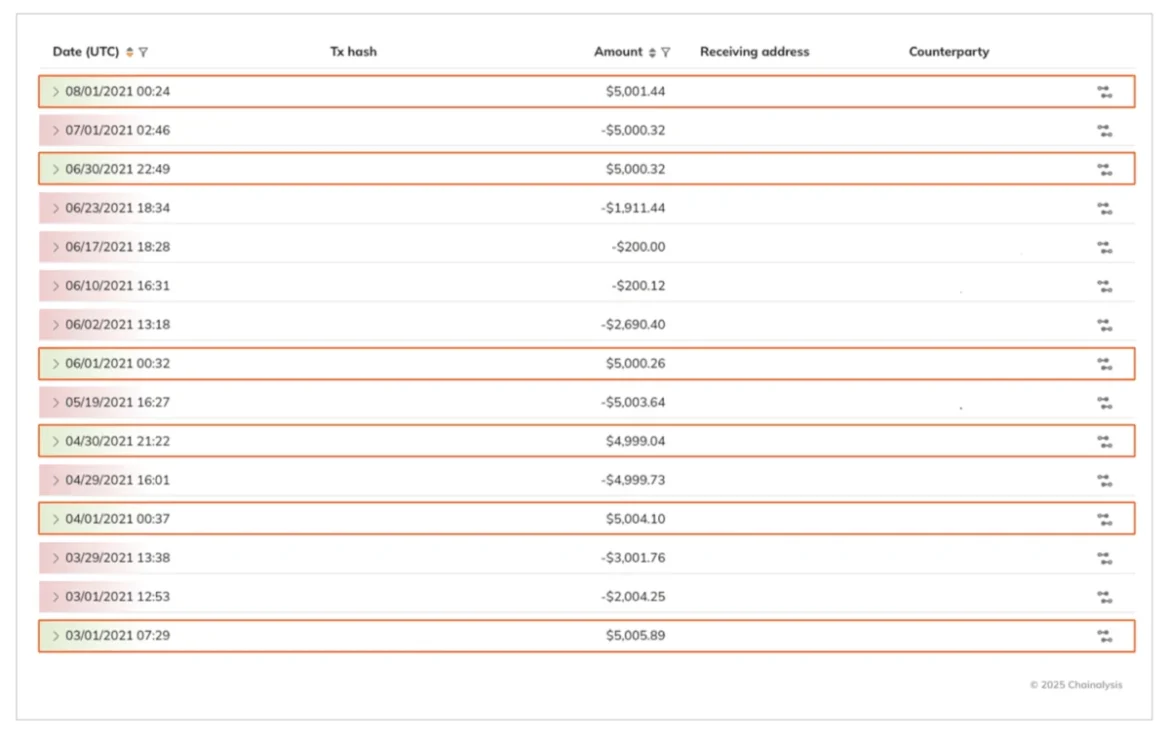
According to United Nations estimates, this shadow workforce generates upwards of $600 million in annual revenue for the regime. These fraudulent IT workers frequently request compensation in stablecoins, funneling their salaries back to intermediaries and state-controlled entities to evade global financial sanctions. The United States Treasury Department and international law enforcement agencies have repeatedly sanctioned networks of Russian and North Korean nationals implicated in facilitating these operations.
Blockchain Dead Drops and Advanced Infrastructure Resilience
To maintain persistent connectivity with infected target systems while evading traditional law enforcement seizures, DPRK actors have innovated novel command-and-control (C2) mechanisms. One such emerging trend identified by blockchain researchers is the use of public distributed ledgers to conceal malware instructions—a technique known as Blockchain Dead Drops (BDDs) or "Etherhiding."
Research indicates a dramatic surge in blockchain-assisted cyberattacks, driven in part by nation-state actors leveraging open-weight AI models to automate threat deployment. North Korean operatives began utilizing these techniques in early 2025 to maintain resilient links between victim computers and C2 infrastructure. Because public ledgers cannot be easily seized or censored by central authorities, they offer superior redundancy compared to traditional web hosting.
Chainalysis on-chain analysis uncovered specific instances where threat actors distributed C2 communications across multiple blockchains. For example, operatives embedded routing pointers on the TRON and Aptos blockchains that directed infected machines to a final payload stored on Binance Smart Chain (BSC). If a compromised device encountered errors querying the TRON network, it automatically pivoted to Aptos as a backup before successfully retrieving instructions from BSC. More recently, actors have adopted "null receiver" strategies, embedding C2 logic within specially crafted blockchain addresses that do not control real assets but serve purely as informational signposts for malware.
Implications and the Road Ahead for Global Cryptocurrency Security

The staggering scale of the Binance theft underscores an urgent reality for the digital asset industry: conventional cybersecurity controls focused solely on network perimeters and endpoint detection are no longer sufficient. Because nation-state actors are increasingly exploiting human resources pipelines, financial infrastructure, and blockchain transparency itself, organizations must adopt a holistic defense posture.
Effective mitigation requires unprecedented collaboration between traditional cybersecurity teams and blockchain intelligence specialists. While corporate human resources departments must institute rigorous verification protocols for remote hiring and technical assessments, security operations centers must monitor for anomalous cloud access and unauthorized credential exportation.
Concurrently, blockchain intelligence remains an indispensable tool for post-incident analysis. By mapping on-chain transaction flows, forensic investigators can trace stolen funds across disparate networks, identify intermediary laundering nodes, and supply actionable data to law enforcement agencies seeking to freeze assets and enforce international sanctions.
As the investigation into the Binance breach remains active, industry observers anticipate that the stolen funds will continue moving through complex cross-chain mixing and laundering protocols in the coming days. The global cryptocurrency community, regulatory bodies, and analytics firms face an ongoing challenge in neutralizing a well-funded, highly adaptable state-sponsored cyber threat apparatus that views the digital asset ecosystem as its primary source of revenue.
