
The landscape of American monetary policy and digital asset regulation shifted significantly as a key congressional panel advanced landmark legislation designed to embed the nation’s cryptocurrency holdings into federal law. The US House Financial Services Committee voted to advance H.R. 8957, officially titled the American Reserve Modernization Act of 2026. This pivotal legislative move seeks to establish a permanent Strategic Bitcoin Reserve, placing strict statutory boundaries on how the federal government manages, retains, and eventually evaluates its digital asset portfolio.
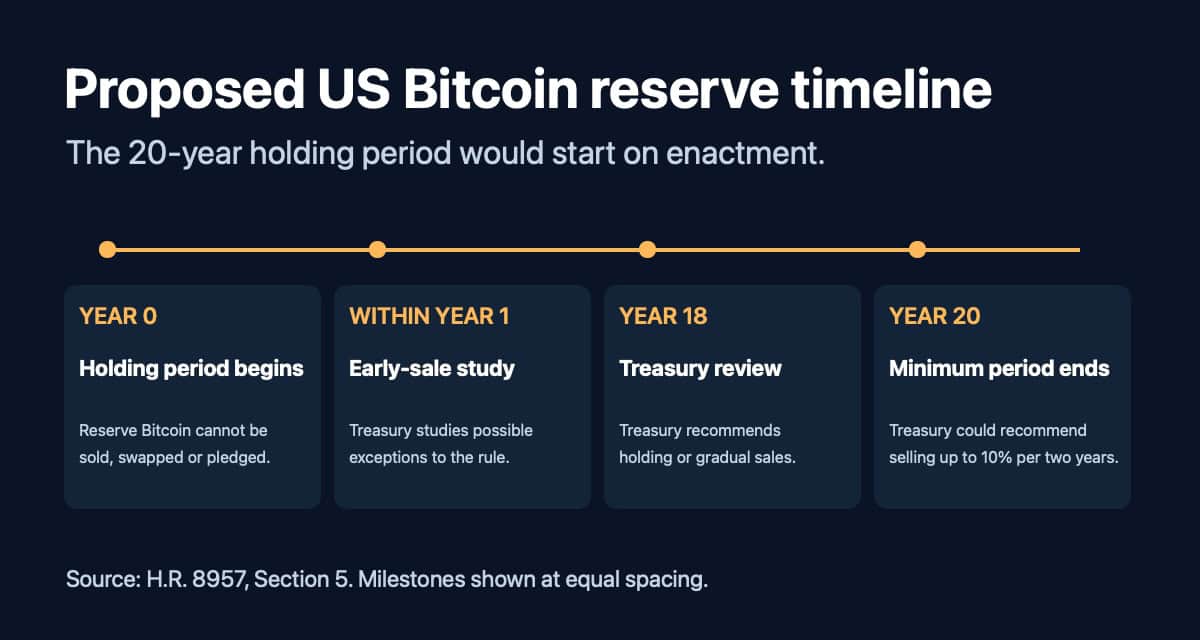
Under the provisions outlined in the proposed measure, the United States Department of the Treasury would be legally barred from selling, swapping, auctioning, encumbering, or otherwise disposing of any Bitcoin held within the reserve for a minimum duration of two decades. By transitioning what was initially a directive of executive action into codified federal statute, the bill aims to institutionalize Bitcoin as a long-term sovereign asset class, safeguarding government-held cryptocurrency against short-term political shifts and fluctuating administrative priorities.
Legislative Pathway and Committee Action
The advancement of H.R. 8957 follows a systematic review process within the House Financial Services Committee, which reported the bill with targeted amendments. Following this committee action, the measure was formally placed on the House Union Calendar, a crucial procedural milestone that renders the bill eligible for full floor consideration by the House of Representatives.
The legislative journey began in May, when Alaska Republican Representative Nick Begich introduced the measure to the House. While clearing the Financial Services Committee represents a major hurdle cleared, the bill still faces a demanding path. To become law, H.R. 8957 must secure passage in both the full House of Representatives and the United States Senate before being presented to the President for final signature. With the 119th Congress drawing toward its eventual close, legislative analysts note that lawmakers face a compressed timeframe to shepherd the bill through both chambers amid a crowded legislative calendar.
Structure and Administration of the Reserve
Should H.R. 8957 successfully pass both chambers of Congress and be enacted into law, the architecture of federal digital asset management would undergo a systematic reorganization. The legislation directs qualifying Bitcoin already owned by the federal government—predominantly assets acquired through law enforcement seizures, asset forfeitures, and legal settlements—to be deposited directly into the newly codified Strategic Bitcoin Reserve.
Simultaneously, the bill mandates the creation of a separate administrative entity known as the Digital Asset Stockpile, which would house qualifying non-Bitcoin digital assets owned by the federal government. Both the reserve and the stockpile would fall under the administrative purview and regulatory management of the United States Department of the Treasury.
The core pillar of the proposed law is the 20-year moratorium on liquidation. The text of the bill explicitly stipulates that reserve assets cannot be sold, swapped, auctioned, encumbered, or otherwise disposed of during this mandatory holding period. This restriction takes effect immediately upon the enactment of the legislation and applies universally to all Bitcoin acquired by the United States and deposited into the reserve, irrespective of the original legal mechanism through which the government obtained the assets.
Oversight, Milestones, and Long-Term Roadmap
The legislation does not merely freeze the assets indefinitely; it establishes a rigorous, phased timeline for future review and congressional oversight.
In year eighteen of the mandate—precisely two years before the expiration of the 20-year holding period—the Treasury Department would be legally required to submit a comprehensive assessment to lawmakers. This report must explicitly recommend whether the federal government should continue holding the entirety of its Bitcoin reserves or whether it should prepare for a gradual, structured release into the broader market.
Once the milestone 20-year minimum holding period officially expires, the Secretary of the Treasury would be granted the statutory authority to recommend selling up to a maximum of 10 percent of the reserve’s total assets within any given two-year period. However, any such sales would remain subject to stringent oversight and executive-legislative coordination.
Furthermore, the bill directs the Treasury Department to conduct a preliminary study within one year of enactment. This initial study is tasked with evaluating scenarios in which an early sale of assets might be deemed appropriate, and requires the department to recommend potential legislative adjustments or targeted statutory exceptions. Specifically, the framework allows for potential carve-outs centered around urgent matters of national security or systemic financial stability. Crucially, the bill ensures that the final authority to authorize any such exception remains vested exclusively in Congress, preserving the separation of powers regarding fiscal and monetary policy.
Evolution from Executive Order to Federal Statute
The introduction and advancement of H.R. 8957 represent the natural evolution of federal policy that began taking shape under the executive branch. In March 2025, President Donald Trump formally established both the Strategic Bitcoin Reserve and the United States Digital Asset Stockpile via executive order.
That foundational executive action utilized eligible forfeited Bitcoin as the bedrock for the reserve, establishing a clear policy directive for the federal government to retain its holdings rather than liquidating seized digital assets through traditional public auctions—a practice that had historically exerted localized downward pressure on cryptocurrency markets. Additionally, the 2025 executive order authorized the Treasury and the Department of Commerce to devise innovative strategies aimed at acquiring additional Bitcoin holdings without imposing incremental financial burdens or tax liabilities on American taxpayers.
While the executive order successfully laid the administrative groundwork, proponents of H.R. 8957 argue that relying solely on executive actions leaves the reserve vulnerable to future presidential reversals. Codifying the reserve into federal statute provides permanent legal certainty, institutionalizing the framework and ensuring that future administrations cannot unilaterally dismantle the sovereign portfolio.
Acquisition Studies and Broader Congressional Proposals
Beyond establishing the 20-year holding rule and formalizing public proof-of-reserves verification protocols, the House bill addresses the long-term expansion of the federal government’s digital asset holdings.
H.R. 8957 mandates that the Treasury Department and the Department of Commerce collaborate on a 180-day study to explore whether the federal government can acquire additional Bitcoin through mechanisms that strictly avoid increasing the national debt or expanding federal budget deficits. Significantly, the bill’s current iteration is structured as a study mandate rather than an aggressive purchase schedule; it sets no binding purchase targets, timetables, or acquisition quotas.
This measured approach contrasts with parallel legislative initiatives moving through Capitol Hill. Notably, a separate legislative proposal introduced by Senator Cynthia Lummis—widely known as the BITCOIN Act—advocates for a much more aggressive accumulation strategy, which would formally authorize the federal government to actively acquire up to one million Bitcoin over a defined period. The existence of these concurrent legislative tracks underscores a growing bipartisan and bicameral debate regarding the precise velocity and scale at which the United States should integrate digital assets into its sovereign balance sheet.
Market Implications and Economic Analysis
Financial analysts and digital asset market participants have closely monitored the progression of H.R. 8957, viewing it as a watershed moment for the institutionalization of cryptocurrency. By removing a substantial volume of government-owned Bitcoin from potential market circulation for a minimum of two decades, the legislation effectively creates a permanent supply sink. Historically, federal law enforcement agencies periodically auctioned off seized Bitcoin, injecting millions of dollars worth of supply back into public exchanges. Codifying a holding period eliminates this overhang, providing structural supply-side stability.
From a macroeconomic perspective, supporters argue that establishing a sovereign Bitcoin reserve positions the United States at the forefront of financial innovation, hedging against long-term inflationary pressures and currency devaluation. Skeptics and fiscal traditionalists, however, continue to raise questions regarding the volatility of digital assets and the propriety of sovereign entities holding speculative instruments on government balance sheets. Despite these contrasting viewpoints, the bipartisan committee vote signals a clear legislative appetite to explore digital asset integration within traditional federal finance.
As H.R. 8957 prepares for its next critical test on the floor of the House of Representatives, lawmakers, institutional investors, and the broader financial community remain focused on whether Congress can successfully navigate procedural hurdles and enact the nation’s first comprehensive statutory framework for sovereign digital asset reserves before the conclusion of the 119th Congress.
