
The global transition toward electric vehicles and renewable energy storage systems faces a formidable economic hurdle as lithium carbonate markets in China experience a sharp, protracted downturn. Despite brief periods of speculative optimism earlier in the year, chronic oversupply and soft incoming demand have dragged prices down aggressively from their 2026 peaks. Market participants are increasingly wary as futures hover perilously close to the crucial 80,000 yuan per tonne threshold, leaving analysts and investors searching for a definitive market bottom.
The renewed hesitation among buyers underscores a broader crisis of confidence across the battery metals sector. After several failed attempts by market bulls to spark a sustainable recovery from persistent structural oversupply, a yawning valuation gap has emerged between historical price highs and current spot levels. This widening chasm has cast a shadow over the near-term profitability of major lithium producers and refiners, prompting a reevaluation of expansion timelines and capital allocation strategies globally.
Futures Retreat as Sellers Defend Critical Resistance Levels
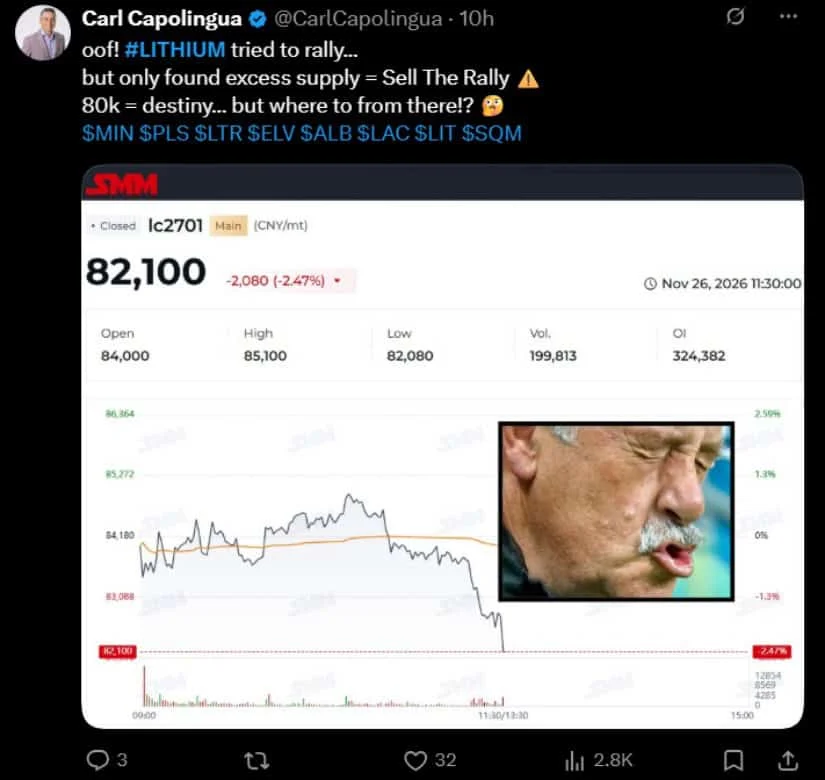
Recent trading sessions on Chinese commodities exchanges have vividly illustrated the prevailing bearish sentiment. The January lithium carbonate futures contract (LC2701) faced renewed selling pressure, retreating to 82,100 yuan a tonne, which marked a 2.47% decline for the session. Technical indicators highlight a struggle by momentum buyers to maintain upward traction following an initial, albeit fleeting, bounce.

Data from market analysts mapping the session show the contract opening at 84,000 yuan before attempting a brief intraday rally to a high of 85,100 yuan. However, aggressive selling quickly neutralized these gains, driving prices down to a session low of 82,080 yuan. Trading volume during this pivotal session reached 199,813 lots, accompanied by an open interest of 324,382 lots, reflecting heavy market participation and intense positioning by both bulls and bears.
The inability of the LC2701 contract to sustain values above the 84,000 yuan mark suggests that this level has transitioned into an immediate psychological and technical resistance zone. Market strategists note that a decisive breakthrough and daily close above 85,100 yuan would be required to signal genuine, fresh buying support. Conversely, with 82,080 yuan currently serving as fragile support, a firm breach below this threshold is widely expected to trigger cascading sell orders, directly challenging the psychologically vital 80,000 yuan per tonne floor.
A Chronology of Decline: Tracing the 2026 Price Trajectory
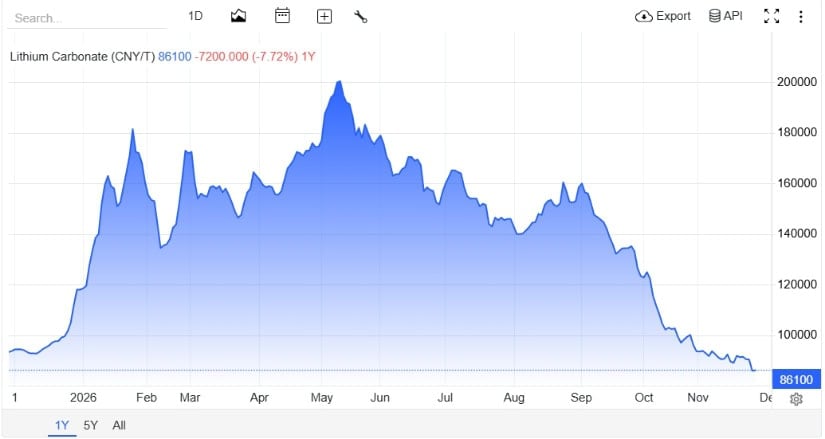
The current market distress is the culmination of a severe, multi-month correction that has unfolded across 2026. Data compiled by Trading Economics reveals a dramatic downward trajectory over the past year, with lithium carbonate tumbling from robust highs of approximately 200,000 yuan per tonne in May down to 86,100 yuan by late November. This represents a substantial correction, stripping away more than half of the commodity’s peak valuation from earlier in the cycle.
The path downward has been punctuated by several aborted rallies that ultimately trapped late-stage buyers. In August, a speculative push drove prices toward 140,000 yuan, creating premature hopes of a market stabilization. This was followed by a more aggressive surge in September that temporarily lifted prices to 160,000 yuan.
However, these upward movements lacked fundamental support from end-user demand, setting the stage for a brutal reversal. A renewed wave of selling accelerated throughout October and November, systematically breaking technical supports. The late-November reading of 86,100 yuan translates to a steep year-over-year decrease of 7.72%, cementing the bearish market structure. Looking upward, analysts point to the previous trading region around 90,000 yuan as an initial rebound benchmark, with heavier resistance thresholds clustered between 95,000 and 100,000 yuan. A concerted, volume-backed break above these higher zones would be necessary to signal a genuine shift in macroeconomic price momentum.
Macroeconomic Drivers: Spodumene Imports and Inventory Gluts
The fundamental underpinnings of the lithium market remain heavily skewed in favor of abundant supply and cautious downstream procurement. A primary catalyst for ongoing inventory anxieties in China was the surge in lithium spodumene imports, which surpassed one million tonnes in October. This massive influx of raw material underscored continuous high levels of upstream production, even as domestic processing facilities grappled with saturated markets.
Compounding the supply-side pressure is the sluggish pace at which high-cost spodumene mines are curtailing production or executing operational restarts. While producers globally face compressed margins, many have maintained output to preserve market share or meet long-term contractual obligations, inadvertently exacerbating the supply glut. On the demand side, while low-end battery sector procurement has shown pockets of relative resilience, it has proven entirely insufficient to absorb the towering volume of available refined product.
Industry stakeholders and procurement managers at major battery manufacturing facilities have adopted a strictly hand-to-mouth purchasing strategy. Rather than building strategic stockpiles in anticipation of price recoveries, buyers are capitalizing on the downward momentum to secure spot volumes at increasingly discounted rates, further demoralizing bullish sentiment.
Investor Outlook and Strategic Implications
As the market navigates this difficult terrain, investors and market makers are advised to closely monitor specific technical and fundamental markers. In the immediate term, attention remains fixed on whether the LC2701 contract can successfully defend the 82,080 yuan support level or if it will inevitably test the 80,000 yuan psychological boundary. On the recovery front, market watchers must observe if buying interest can materialize to challenge the 84,000 to 85,100 yuan resistance band.
Beyond futures charts, industry participants are keeping a watchful eye on physical spot-market transactions, domestic inventory liquidation rates, and forward-looking procurement schedules from Tier-1 and Tier-2 battery cell manufacturers. The stabilization of lithium prices over the medium term will ultimately depend on a combination of disciplined supply-side rationalization—such as widespread production cuts or project delays—and a measurable acceleration in global electric vehicle adoption rates heading into the subsequent fiscal year. Until these structural imbalances are resolved, the Chinese lithium carbonate market is expected to remain range-bound, defensive, and highly sensitive to macroeconomic shifts.
