
The Solana blockchain ecosystem entered a state of heightened operational readiness over the weekend as core infrastructure developers issued an uncompromised, urgent directive to network operators. Anza, the prominent development team tasked with maintaining and engineering the Agave validator client, formally instructed node administrators across the globe to immediately upgrade their systems to software version 4.4.2. The urgent advisory, succinctly summarized by developers with the direct command to "Don’t wait, upgrade now," applies universally to both staked and unstaked nodes operating within the decentralized network. Despite the high-priority nature of the release, official network monitoring and developer confirmations verified that the Solana mainnet continued to process transactions and operate under normal parameters without experiencing an outage or degradation in consensus speed.
The sudden rollout highlights the complex logistical mechanics of maintaining a high-performance decentralized ledger. Unlike centralized cloud infrastructure where updates can be deployed instantaneously from a single administrative console, a globally distributed blockchain relies entirely on the voluntary, coordinated actions of independent node operators. These operators must download, review, and install patches manually or through automated scripts, making the speed of propagation a vital metric for network health and resilience.
Anatomy of the Urgent Release and Multi-Client Ecosystem
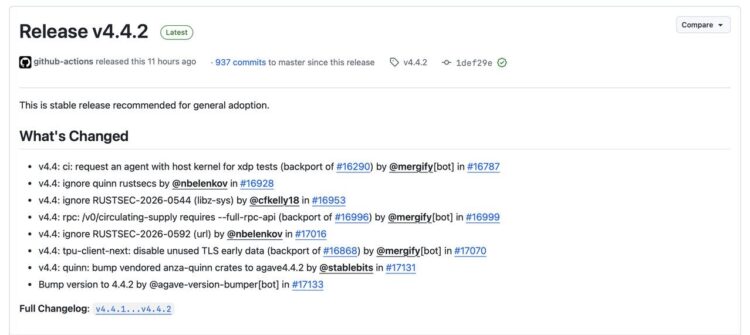
The release of Agave version 4.4.2 was formally documented within Anza’s official public GitHub repository, providing technical transparency for developers and node operators wishing to inspect the patch contents. Simultaneously, secondary client builders within the broader Solana ecosystem—most notably Jito-Solana and Harmonic—moved quickly to release their own compatible builds, ensuring that the network’s architectural diversity remained intact during the patch deployment cycle.
Agave functions as a fundamental software implementation utilized by network validators to process incoming transactions, execute smart contracts, and participate directly in Solana’s Proof-of-Stake (PoS) consensus mechanism. Because validators bear the responsibility of verifying state transitions and adding finalized blocks to the blockchain ledger, running deprecated or vulnerable software can introduce systemic risks to network synchronicity.
While the urgency of the advisory triggered immediate discussions across community channels and developer forums, Anza and other core contributors maintained disciplined discretion regarding the precise technical vulnerability prompting the update. In cybersecurity and blockchain infrastructure management, maintaining a window of opacity prior to widespread patching is a standard defensive protocol. This practice prevents malicious actors from reverse-engineering the newly released software patch to exploit unpatched nodes that have not yet updated their clients. Consequently, industry analysts cautioned against premature speculation, noting that characterizing the emergency patch as a response to an active network exploit or live attack remains entirely unsubstantiated until official post-mortem technical disclosures are published.
Chronology of Recent Network Evolution and Milestones
The deployment of Agave v4.4.2 arrives during a particularly dynamic operational period for the Solana network. The blockchain has experienced significant structural maturation over the preceding weeks, marked by major milestones aimed at shedding its historical experimental labels and cementing its status as an enterprise-grade financial settlement layer.
Earlier in November, the Solana Foundation officially dropped the long-standing "mainnet beta" designation from its primary network identifier, transitioning formally to protocol version 1.0. This monumental shift represented a collective psychological and technical acknowledgment by core developers that the foundational architecture had achieved the necessary stability, economic security, and stress-tested resilience required for institutional-grade utilization.
Concurrently, the broader ecosystem has been aggressively pushing forward with performance enhancements and developer tooling improvements. Earlier in the month, developer changelogs emphasized accelerated Web3.js builds, refinements to transaction routing logic, and iterative optimizations across multiple client implementations, including ongoing developmental work on Firedancer—the independent validator client being engineered by Jump Crypto designed to massively scale Solana’s theoretical throughput ceiling.
Furthermore, Solana’s ongoing transition toward advanced consensus mechanics, such as the exploration of the Alpenglow architecture, has consistently placed transactional speed and finality at the forefront of the protocol’s value proposition. However, industry veterans frequently emphasize that raw speed and high throughput numbers lose their value if the underlying infrastructure lacks the operational agility to withstand emergency interventions.
Network Staking Metrics and Validator Participation Dynamics
To contextualize the scale of the deployment, current network metrics captured during the release window offer a comprehensive snapshot of Solana’s underlying economic security and validator distribution. Network monitoring dashboards, including data aggregated by Validator Info and the official Solana validator directory, indicated that the mainnet was supported by approximately 655 active validators, with a remarkably low count of only five delinquent nodes recorded at the time of the snapshot.
Economic commitment to the network remained exceptionally robust. Out of the total circulating supply, approximately 432.44 million SOL was actively staked by tokenholders delegating their voting power to validator operators. This figure represented an overwhelming 99.97% of the total reported stake across the network.
This high concentration of staked capital underscores why rapid communication between core developers and node operators is critical. When a high-priority software upgrade is issued, the validators holding the vast majority of economic stake must update efficiently to prevent consensus stalls or a bifurcated chain state. Even though alternative client implementations like Jito-Solana and Firedancer contribute to client diversity—with Firedancer’s versioning tracking separately around build 26.11.1—the immediate synchronization of the validator set around secure builds is paramount for maintaining uninterrupted block production.
Implications for SOL Tokenholders and End Users
For retail participants, decentralized finance (DeFi) traders, and ordinary holders of the native SOL token, Anza’s urgent directive required no direct operational intervention. Unlike network hard forks that occasionally demand tokenholder migration or wallet updates, client-level validator patches are handled exclusively by the infrastructure providers who run the hardware nodes.

Users were not required to move their funds, adjust their staking delegations, or modify how they interacted with decentralized applications (dApps) operating on the Solana network. Throughout the dissemination and installation of Agave v4.4.2, user-facing applications, decentralized exchanges (DEXs), and lending protocols continued to function without interruption, demonstrating the graceful isolation of validator-level maintenance from end-user experience.
However, the event serves as an educational reminder of the structural dependencies inherent in public blockchain networks. While tokenholders enjoy the abstract benefits of high-speed settlement and low transaction fees, the ongoing security of their assets ultimately relies on the vigilance, responsiveness, and technical competence of the global community of independent validator operators who maintain the physical infrastructure.
Broader Industry Context: Speed Versus Resilience
The swift issuance and adoption of Agave v4.4.2 provide market analysts and distributed systems researchers with a valuable case study in network governance and crisis response. Over the past several years, Solana has successfully rehabilitated its public narrative regarding network reliability, systematically addressing historical uptime challenges through protocol-level improvements, localized fee markets, and the introduction of diversified client software.
Historically, critics of high-performance monolithic blockchains frequently pointed to network interruptions as a structural flaw of prioritizing high throughput over minimalist design. The successful, coordinated deployment of an emergency patch without incurring a single minute of downtime or network consensus failure challenges those persistent critiques. It illustrates that Solana’s operational maturity has evolved to a point where core development teams and independent node operators can collaborate seamlessly under pressure to fortify the network against potential vulnerabilities before they manifest as critical incidents.
Looking forward, the primary metric of interest for infrastructure watchers will be the telemetry data tracking the adoption rate of Agave 4.4.2 across the active validator set over the subsequent operating epochs. As Solana continues to scale toward mass adoption and integration with traditional financial systems, the ability to execute rapid, seamless, and secure infrastructural interventions will remain the ultimate litmus test of its long-term viability as a global financial utility.
