
The derivatives market for Ethereum (ETH) on Binance is currently exhibiting a precarious setup that could leave a substantial number of short sellers vulnerable to significant losses should the cryptocurrency’s recent upward trajectory persist. Analysis shared on X by CryptoQuant contributor Darkfost highlights an increasingly one-sided positioning among traders, even as ETH has staged a robust rebound from its February lows. This divergence between price action and market sentiment has created ripe conditions for potential short squeezes, a phenomenon where rapidly rising prices force leveraged short positions to close, further accelerating the price surge.
Ethereum Bears Crowd In On Binance’s Order Books
At the heart of Darkfost’s argument is a notable mismatch between Ethereum’s price performance and the prevailing conviction among a segment of traders on Binance, one of the world’s largest cryptocurrency exchanges by trading volume. Since February, a significant volume of approximately 350,000 ETH has been added to the open interest on Binance’s derivatives platform. This substantial increase positions Binance’s ETH derivatives complex to represent roughly 37% of the total market share for Ethereum perpetual futures, a figure underscoring the exchange’s pivotal role in shaping market dynamics. Valued at current prices, this influx of open interest translates to more than $1 billion flowing into bearish bets on Ethereum’s future.
What is particularly striking about this surge in open interest is not merely its magnitude, but the directional bias embedded within it. Darkfost noted, "What is paradoxical is that despite the recent price increase (+35% since the February low), the majority of investors appear to be positioning for a correction by shorting the market." This counter-intuitive positioning suggests a deep-seated skepticism among many traders, who seem to be viewing the price rally as a temporary bounce rather than a sustained recovery.
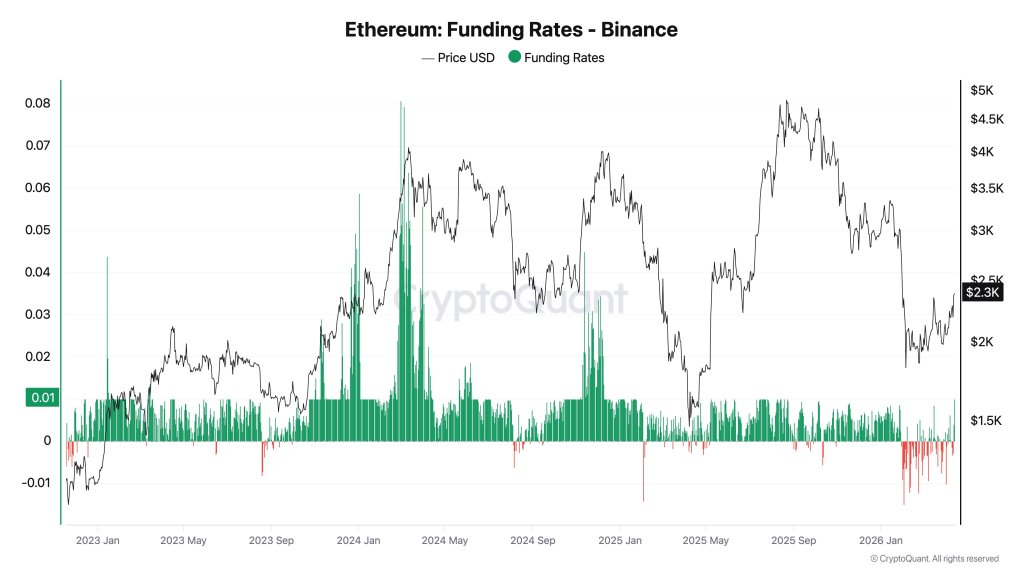
This bearish sentiment is starkly reflected in Ethereum’s funding rates on Binance. Funding rates are periodic payments exchanged between long and short position holders in perpetual futures contracts, designed to keep the contract price pegged to the underlying asset’s spot price. A positive funding rate indicates that long positions are paying shorts, suggesting bullish sentiment, while a negative funding rate means shorts are paying longs, signaling bearish dominance. Darkfost pointed out that these funding rates have descended to levels not observed since the depths of the previous bear market, specifically referencing the period of sustained market contraction between late 2021 and 2022. During such times, widespread capitulation and negative sentiment often lead to prolonged periods of negative funding as traders aggressively short assets.

The Mechanics of Negative Funding and Disbelief
The sustained negativity in funding rates since late January suggests a persistent belief among traders that Ethereum’s price will fall, compelling them to pay a premium to maintain their short exposure rather than joining the bullish momentum. This dynamic implies that the recent upward price movement has not fundamentally altered bearish conviction across a significant portion of the derivatives market.
The skepticism has now reached a critical threshold, according to Darkfost. "Observing such negative levels, with funding rates dropping below -0.01%, is relatively rare and indicates a significant buildup of short positions while investors remain in disbelief," he articulated. Such extreme negative funding is not a common occurrence and typically signals a high degree of consensus among traders regarding an impending downturn. However, history often shows that when such a strong consensus forms, the market frequently moves in the opposite direction, triggering a cascade of liquidations for the most aggressively positioned short sellers. This self-reinforcing cycle is precisely what constitutes a short squeeze.
Chronology of Mounting Pressure and Initial Squeezes
The groundwork for this scenario began to be laid in late January, when Ethereum’s funding rates on Binance first turned consistently negative. This coincided with a period of broader market uncertainty following a significant rally in late 2023 and early 2024. Despite a subsequent rebound in Ethereum’s spot price, which saw ETH climb over 35% from its February lows, the derivatives market, particularly on Binance, continued to accumulate short positions. This suggests that traders were actively "fading the rally," betting that the price increase was unsustainable and due for a correction.
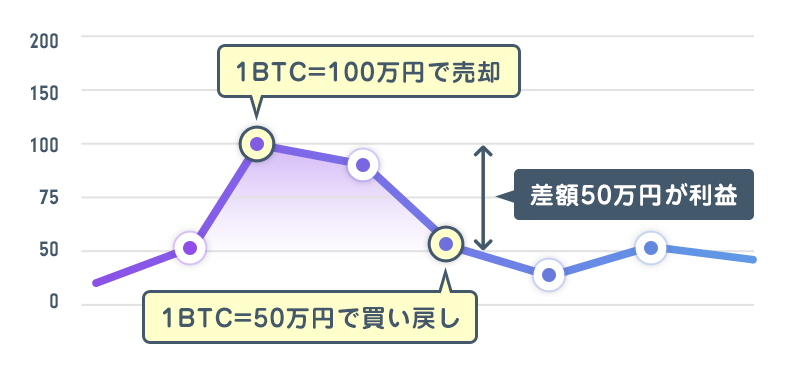
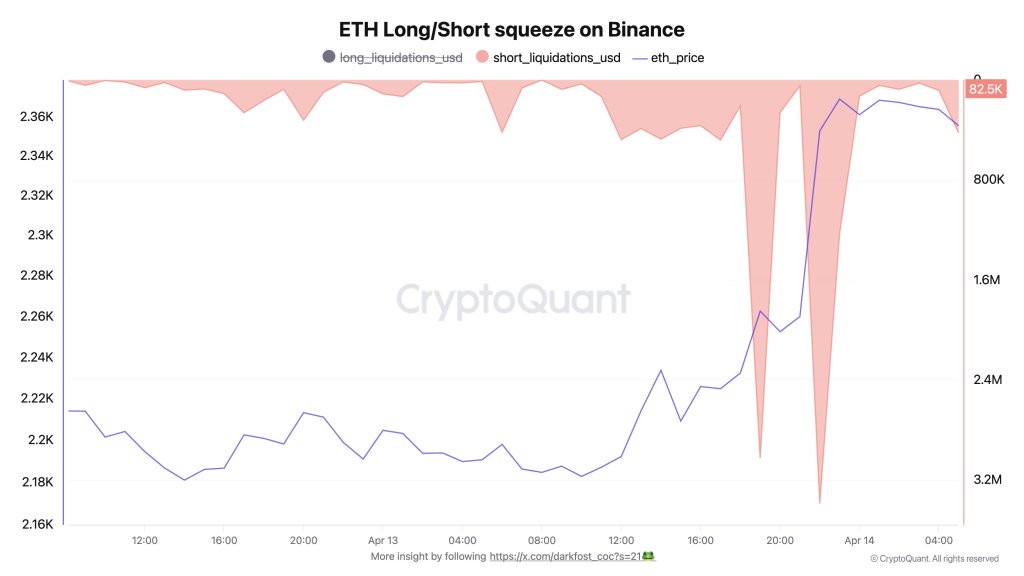
The initial tremors of this impending squeeze have already manifested in the liquidation data. Darkfost observed that more than $3 million in short positions were liquidated not just once, but twice within a single hour on Binance recently. These rapid, concentrated liquidations serve as a potent indicator that even modest upward price movements are sufficient to force highly leveraged bears out of their positions. In crowded market setups, where a large number of traders hold similar positions, these forced exits can become a powerful self-reinforcing mechanism. As short positions are liquidated, the exchange automatically buys back the underlying asset to close the position, creating incremental buy pressure. This additional buying pushes the price higher, which in turn triggers the liquidation of the next layer of vulnerable short positions, potentially leading to an accelerated upward price spiral.
Broader Market Context and Ethereum’s Fundamentals
This derivatives market dynamic is unfolding against a backdrop of several key fundamental developments for Ethereum. The successful Dencun upgrade in March 2024, which introduced "proto-danksharding" (EIP-4844) to significantly reduce transaction costs on Layer 2 networks, has been a major catalyst for positive sentiment. This upgrade is expected to enhance Ethereum’s scalability and efficiency, making it a more attractive platform for decentralized applications.
Furthermore, the ongoing anticipation surrounding the potential approval of spot Ethereum Exchange-Traded Funds (ETFs) in major markets like the United States has fueled speculative interest. While the regulatory landscape for ETH ETFs is more complex than for Bitcoin ETFs, any positive movement in this direction could unlock significant institutional capital and dramatically alter market perception. These fundamental drivers provide a strong bullish undercurrent that contrasts sharply with the bearish conviction observed in the derivatives market. The interplay between these fundamental tailwinds and the technical setup in derivatives creates a volatile environment.
Implications and the Shifting Landscape
The broader implication of this situation is not necessarily that Ethereum is guaranteed to enter a straight-line parabolic rally, but rather that the structure of the derivatives market has become heavily tilted in a way that can significantly amplify upside price movements if sentiment is slow to adjust. Darkfost characterized the recent rally as the "early phase of the uptrend," suggesting that the months of aggressive short accumulation could continue to provide substantial fuel for further price increases if traders stubbornly remain positioned for a reversal instead of aligning with the prevailing upward trend.
However, a crucial shift is reportedly underway. Darkfost noted that Ethereum funding rates are now beginning to turn positive again, citing a reading around +0.01%, although the day’s full data was not yet complete at the time of the analysis. If this change holds and funding rates sustain positive territory, the market structure would begin to normalize. This would signify a potential capitulation among short sellers and a gradual alignment of derivatives traders with the bullish trend observed in the spot market. In such a scenario, the market would become less driven by "disbelief-fueled squeezes" and more by genuine buying interest and positive sentiment.
Expert Commentary and Market Sentiment
While Darkfost’s analysis focuses on quantitative data, the underlying psychological aspect of market behavior is critical. The "disbelief rally" phenomenon is well-documented in financial markets, where initial price increases are met with skepticism, leading to persistent shorting until the sheer force of the upward movement overwhelms bears. Other market analysts often look for such divergences between price action and sentiment as potential indicators of impending trend accelerations. The general cautious sentiment that frequently follows sharp rebounds can often lead to a "fade the rally" mentality among some traders, particularly those who have been conditioned by previous market downturns. However, when these fade attempts become overly concentrated, they create the very conditions for a powerful counter-move.
Risks and Caveats for a Volatile Market
It is crucial to acknowledge that derivatives markets are inherently high-risk and highly leveraged. While the current setup suggests a strong potential for a short squeeze, market sentiment can shift rapidly. External factors such as unexpected regulatory announcements, significant macroeconomic events, or a sharp downturn in the broader cryptocurrency market (e.g., a major Bitcoin correction) could quickly reverse any bullish momentum. Traders employing leverage always face the risk of rapid liquidations, and even the most seemingly robust technical setups can be invalidated by unforeseen catalysts. The data presented reflects a snapshot of market positioning and potential outcomes but does not guarantee future price movements.
For now, the message emanating from Binance’s Ethereum derivatives market is starkly clear. Short positions have been accumulated aggressively, creating a crowded trade. The more concentrated these bearish bets become, the more fragile the market structure grows, particularly if Ethereum continues its upward grind. At press time, ETH was trading at approximately $2,318, with the market watching closely to see if the growing pressure on short sellers will translate into a more significant upward movement in the coming days and weeks. The battle between conviction and price action continues to unfold, holding significant implications for Ethereum’s short-term trajectory.