
The global cryptocurrency market is currently witnessing a technical phenomenon that has historically preceded some of the most significant wealth transfers in digital asset history. Despite Bitcoin reaching unprecedented price levels over the past two years, the broader altcoin market has remained largely suppressed, characterized by a high level of Bitcoin dominance that has left little room for secondary assets to appreciate. However, recent technical data and a shifting macroeconomic landscape suggest that the tides are turning, with market analysts identifying a "setup of epic proportions" that could lead to an altcoin season significantly more explosive than the historic bull run of 2021.
The Technical Foundation: ALT/BTC Bullish Crossover
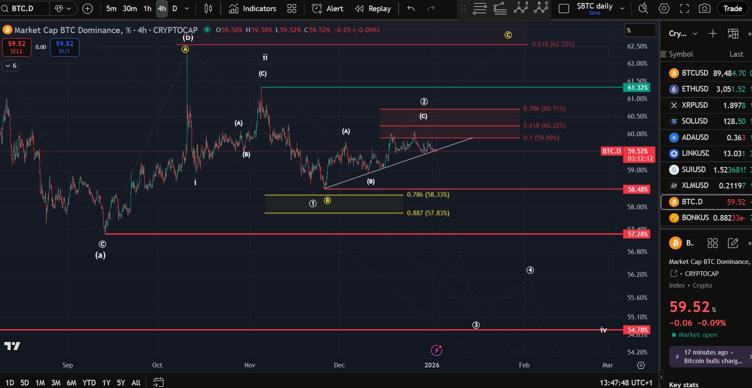
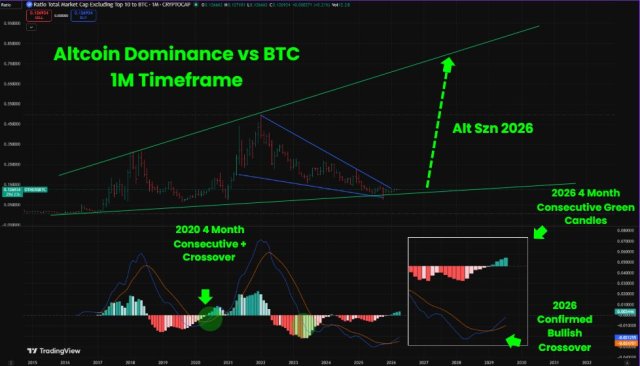
The primary catalyst for the current optimism among market participants is the performance of the ALT/BTC chart, which tracks the value of altcoins relative to Bitcoin. According to prominent market analyst Mark Chadwick, the altcoin market has recently achieved a critical technical milestone: the confirmation of its fourth consecutive green monthly candle against Bitcoin. This sustained momentum has triggered a bullish crossover, a technical signal that has not been observed with this level of clarity since the early stages of the 2021 bull market.
In 2021, a similar crossover served as the precursor to a parabolic move in the altcoin sector, where numerous projects saw their valuations increase by ten to fifty times within a single year. The current crossover suggests that the period of Bitcoin’s absolute dominance may be nearing a cyclical peak, allowing capital to rotate into Ethereum, Solana, and other high-utility or high-speculation assets. While Bitcoin remains the "reserve currency" of the crypto space, the ALT/BTC ratio is often viewed as the definitive barometer for risk appetite; a rising ratio indicates that investors are willing to move further down the risk curve in search of higher returns.
Chronology of Market Cycles and the "Lag Effect"
To understand why this potential shift is significant, it is necessary to examine the chronology of the current market cycle. Typically, cryptocurrency bull markets follow a predictable four-stage progression. The cycle begins with a "Bitcoin Phase," where the primary asset absorbs the majority of new liquidity entering the space. This is followed by an "Ethereum Phase," where the second-largest cryptocurrency begins to outperform Bitcoin. The third stage is the "Large-Cap Altcoin Phase," and the final stage is the "Full Altcoin Season," where liquidity flows into small and mid-cap projects.

During 2023 and 2024, the market remained stuck in the first phase. Bitcoin’s price was bolstered by the approval of Spot Bitcoin ETFs and the anticipation of the halving event, while altcoins struggled to maintain their value in BTC terms. This "lag effect" created a massive divergence between Bitcoin’s price and the rest of the market. Analysts now argue that this divergence has reached an extreme, creating a "coiled spring" effect. As Bitcoin stabilizes at its new higher price floors, the surplus liquidity is expected to cascade into the broader market, seeking undervalued opportunities that have yet to reach their previous all-time highs.
Macroeconomic Liquidity and the Role of the Federal Reserve
Beyond technical indicators, the broader financial environment is providing a tailwind that did not exist in the same capacity during the previous two years. The Federal Reserve has transitioned from a period of aggressive quantitative tightening to a more accommodative stance. As the central bank injects liquidity into the financial system, "risk-on" assets like cryptocurrencies typically benefit.
Historically, altcoins are more sensitive to global liquidity shifts than Bitcoin. When the dollar weakens or the M2 money supply expands, investors seek assets with higher beta—meaning assets that move more significantly than the market average. Analysts point out that billions of dollars are currently being funneled back into the financial markets, and with the crypto infrastructure now more robust than it was in 2021, this liquidity has more direct channels through which to enter the altcoin ecosystem.
Regulatory Clarity and the Clarity ACT
One of the most significant hurdles for altcoins over the last cycle has been regulatory uncertainty. The U.S. Securities and Exchange Commission (SEC) has historically taken a "regulation by enforcement" approach, leading to many altcoins being labeled as unregistered securities. This has deterred institutional investment and limited the availability of these assets on major exchanges.
However, the introduction and potential passage of the "Clarity ACT" represents a pivotal shift in the legislative landscape. This proposed framework aims to provide formal regulation by clearly categorizing digital assets as either securities or commodities. By providing a definitive legal pathway, the Clarity ACT would remove the "regulatory overhang" that has suppressed altcoin prices. Institutional investors, who are often bound by strict compliance mandates, would finally have the legal certainty required to allocate capital to projects outside of Bitcoin and Ethereum.

The Shift in the SEC and Executive Leadership
The political climate in the United States has also undergone a dramatic transformation regarding digital assets. Under the Trump administration, the federal government has signaled a move toward a pro-crypto stance. This includes potential changes in leadership at the SEC, moving away from the restrictive policies of the previous years toward a framework that encourages innovation within the domestic market.
Market reactions to these political shifts have been overwhelmingly positive. The prospect of an SEC that views digital assets as a legitimate component of the financial system rather than a threat has led to increased activity from traditional financial institutions. Both the New York Stock Exchange (NYSE) and NASDAQ have shown rising interest in expanding their crypto trading services, which would bridge the gap between traditional equity markets and the altcoin sector.
Institutional Integration: Fannie Mae and Mastercard
Perhaps the most compelling evidence for a superior altcoin season lies in the recent actions of major financial entities. In a landmark announcement, Fannie Mae (the Federal National Mortgage Association) recently indicated that it would begin exploring the use of Bitcoin as collateral for loans. While this directly benefits Bitcoin, the implications for the altcoin market are profound. As Bitcoin becomes integrated into the mortgage and lending industries, it validates the underlying blockchain technology, paving the way for other assets to be used in decentralized finance (DeFi) protocols and traditional lending.
Simultaneously, Mastercard has been actively building "crypto rails" to facilitate seamless payments using blockchain technology. By integrating altcoins into their global payment network, Mastercard is providing the utility that was largely missing during the 2021 run. During that era, many altcoins were driven purely by speculation; in the upcoming cycle, analysts expect a shift toward utility-driven value, where tokens are utilized for real-world transactions, cross-border remittances, and automated smart contracts.
Sector-Specific Growth: DeFi, AI, and RWAs
While the 2021 altcoin season was defined by the rise of NFTs and "meme coins," the next cycle is expected to be more diversified. Several key sectors are positioned to lead the charge:
- Decentralized Finance (DeFi): With better regulatory clarity, DeFi protocols are expected to attract institutional liquidity, offering decentralized alternatives to traditional banking, lending, and insurance.
- Artificial Intelligence (AI) Tokens: The intersection of blockchain and AI is a new frontier. Projects that offer decentralized compute power or AI data marketplaces are seeing significant interest.
- Real-World Assets (RWAs): The tokenization of real estate, bonds, and commodities is a multi-trillion-dollar opportunity. This sector bridges the gap between traditional finance and the blockchain.
- Layer 2 Scaling Solutions: As the Ethereum ecosystem matures, Layer 2 networks are providing the speed and low costs necessary for mass adoption, making them a focal point for investors.
Potential Risks and Market Volatility
Despite the overwhelmingly bullish sentiment, analysts warn that an altcoin season is not without its risks. Altcoins are notoriously volatile, and while the rewards can be substantial, the drawdowns can be equally severe. Furthermore, the market is much more saturated than it was in 2021. There are now thousands more projects competing for the same pool of liquidity, meaning that not every altcoin will see a "moonshot."
Investors are advised to focus on projects with strong fundamentals, active developer communities, and clear use cases. The "spray and pray" strategy of previous cycles may be less effective in a market that is increasingly dominated by sophisticated institutional players.
Conclusion: A New Era for Digital Assets
The convergence of technical crossovers, macroeconomic liquidity, legislative progress, and institutional adoption has created a unique environment for the cryptocurrency market. The data suggests that the altcoin market is not only winning its battle against Bitcoin dominance but is also preparing for a cycle that could redefine the industry.
If the current ALT/BTC trend continues and the proposed regulatory frameworks are enacted, the upcoming altcoin season will likely surpass the 2021 bull run in both total market capitalization and mainstream integration. As the digital asset landscape matures, the focus is shifting from "if" altcoins will succeed to "which" altcoins will lead the next generation of financial technology. For the patient investor, the current "setup of epic proportions" represents a historical window of opportunity as the market prepares for its most significant transition to date.