In an era where modern supply chains, clinical trials, and multinational regulatory frameworks span fragmented digital ecosystems, establishing an unshakeable chain of custody remains one of enterprise software’s most persistent challenges. Business records are typically scattered across isolated databases, internal spreadsheets, and manual logging systems, leaving them vulnerable to retroactive alterations, missing entries, and bureaucratic disputes. Addressing this critical vulnerability, the IOTA Foundation has officially announced the alpha release of IOTA Audit Trails, an innovative open-source solution designed to anchor governed, chronologically ordered histories directly onto a decentralized ledger.
By bridging the gap between private enterprise databases and public distributed ledgers, IOTA Audit Trails enables organizations to maintain their internal privacy while granting external stakeholders—such as regulators, supply chain partners, and auditors—the ability to independently verify the authenticity, sequencing, and authorization of critical operational records. Available immediately for developers and enterprise architects, the release includes a dedicated Move smart-contract package, a strongly typed Rust SDK, and WebAssembly (WASM) bindings tailored for modern JavaScript and TypeScript applications.
The Anatomy of Fragmented Trust in Enterprise Operations
The fundamental operational flaw in contemporary business processes is the absence of portable trust. When a product journeys from a raw material supplier to a tier-one manufacturer, or when a clinical trial collects multi-site patient data, each participating organization maintains its own localized ledger or database. Consequently, when a compliance failure, safety incident, or trade dispute occurs, verifying the timeline requires trust in third-party data exports, centralized administrators, or manual reconciliations.
These legacy workflows expose enterprises to profound legal and operational risks. Because traditional databases can be altered, backfilled, or quietly purged by system administrators with elevated privileges, external actors have historically been forced to accept aggregated reports on blind faith. This lack of interoperable verification becomes especially damaging in tightly regulated sectors like pharmaceuticals, aerospace logistics, international trade, and automated IoT (Internet of Things) environments.
IOTA Audit Trails resolves this systemic weakness by transforming isolated event logs into shared, tamper-resistant on-chain history objects. Rather than forcing companies to expose proprietary documents or sensitive customer records on a public blockchain, the architecture strategically separates data visibility from data integrity. Confidential source materials, personal identifiable information (PII), and proprietary reports remain securely stored off-chain, while cryptographic hashes, structured metadata, and sequential operational proofs are anchored immutably to the IOTA ledger.
Architectural Framework and Core Capabilities
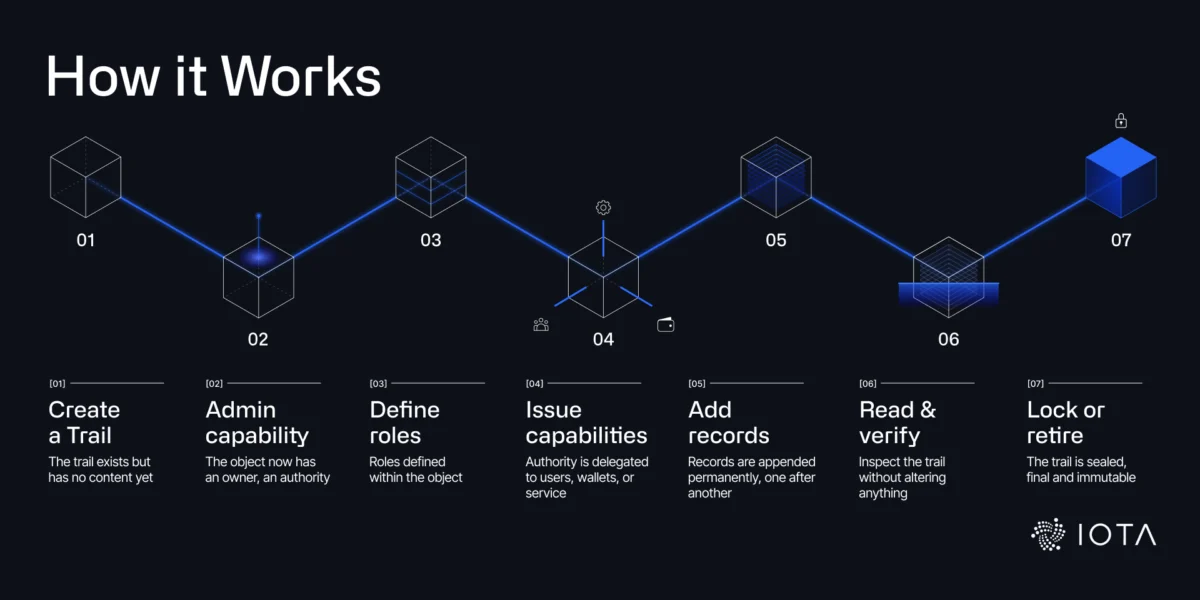
Built as an extension of the broader IOTA Notarization toolkit, Audit Trails elevates individual notarized objects into fully governed, chronologically sequenced event histories. The solution introduces a robust, multi-layered framework that handles everything from initial record creation to final administrative locking.
At its technical core, an IOTA Audit Trail functions as a shared on-chain object capable of storing text or binary records alongside optional metadata and classification tags. Each entry within the trail is bound by immutable creation metadata—recording precisely when the record was added and by whom—alongside updatable operational metadata and strict lifecycle configuration rules.
To govern these interactions without necessitating complex, bespoke smart contracts for every unique business workflow, IOTA Audit Trails implements a sophisticated role-based access control (RBAC) model. Within this framework:

- Roles define specific sets of operational permissions.
- Capabilities securely delegate those roles to designated cryptographic wallets or automated microservices.
- Tag rules enforce structural uniformity across entries.
This design ensures that a manufacturer can write physical lifecycle milestones, an external auditor can inspect trail sequences via read-only clients without holding write privileges, and a compliance officer can enforce rigorous data retention policies—all within the same transparent, cryptographically secure environment.
Integration Pathways and Developer Tooling
To accelerate enterprise adoption, the IOTA Foundation has launched Audit Trails with a comprehensive suite of developer-centric tools. The toolkit is engineered for seamless integration into existing software stacks, offering three primary deployment paths:
- A Move package designed for native on-chain contract logic and execution.
- A typed Rust SDK built for high-performance backend enterprise integrations.
- WebAssembly (WASM) bindings that empower JavaScript and TypeScript web applications to interact natively with audit trails.
Furthermore, the repository includes production-ready reference examples covering prominent use cases such as automated customs clearance pipelines, multi-center clinical trials, and Digital Product Passports (DPPs). Crucially, transaction construction is decoupled from network submission, allowing engineering teams to integrate Audit Trails directly into their existing internal key-management systems, enterprise wallets, or customized gas-sponsoring workflows.
Industry Implications and Sector-Specific Applications
The launch of IOTA Audit Trails arrives at a pivotal juncture for global commerce, where regulatory bodies across the European Union and North America are tightening traceability mandates. Industries dealing with complex cross-border logistics and compliance find themselves under mounting pressure to provide verifiable, unalterable proof of provenance.
In the realm of global supply chains and Digital Product Passports, manufacturers can leverage the tool to record end-to-end component lifecycles, maintenance intervals, and regulatory certifications that follow a physical asset from initial assembly to eventual decommissioning. Similarly, legal and compliance divisions can establish undisputed chronological trails for corporate approvals, statutory filings, and binding contracts.
Customs and international trade workflows stand to gain significant efficiency through coordinated, role-scoped clearance steps shared transparently among exporters, shipping firms, and border protection agencies. Meanwhile, automated industrial IoT deployments can utilize the immutable logs to attest to machine events, sensor readings, and autonomous system state transformations with cryptographic certainty.
Strategic Outlook and Next Steps
By moving past the limitations of centralized database logging, IOTA Audit Trails establishes a new benchmark for cross-organizational accountability. It shifts the enterprise paradigm from "trust us" to "verify for yourself," ensuring that operational history remains intact, transparent, and verifiable by design.
Engineering teams, enterprise architects, and protocol developers can begin exploring the alpha release today by experimenting with the open-source repositories on GitHub, testing implementations on the IOTA Testnet, or reviewing the official documentation provided by the IOTA Foundation. As organizations increasingly prioritize cryptographic trust and verifiable transparency in their digital operations, IOTA Audit Trails offers a scalable, production-ready foundation to secure the workflows of tomorrow.