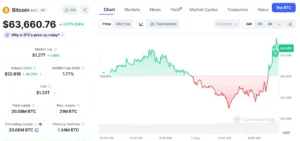
Following a notable resurgence, Bitcoin has successfully climbed back above the $73,000 mark, recovering from recent lows that had pushed the Crypto Fear & Greed Index into single-digit "fear" territory. This upward movement has predictably reignited a familiar wave of optimism across the cryptocurrency community, with many declaring that the market bottom is definitively in, signaling the imminent approach of the next bullish leg and a full-scale return to an upward cycle. However, amidst this renewed bullish fervor, a prominent crypto analyst operating under the pseudonym Max on the social media platform X has voiced a starkly contrasting perspective. Max posits that the current rebound and the accompanying surge in optimistic sentiment are not harbingers of a new bull run, but rather a deceptive precursor to further downside, grounding his contrarian view in a deeply rooted and historically consistent pattern observed throughout Bitcoin’s price history. His analysis suggests that the market has yet to experience the true capitulation and structural shifts necessary to confirm a genuine cycle bottom, projecting a much later and lower floor for Bitcoin’s price.
The Resurgence of Optimism and Max’s Dissent
The cryptocurrency market, inherently volatile and sentiment-driven, often sees rapid shifts in investor psychology. The recent recovery of Bitcoin from its lower price points, which had briefly pushed the Crypto Fear & Greed Index to levels indicating extreme apprehension among investors, has predictably fostered a renewed sense of confidence. This index, a composite measure reflecting various market data points such as volatility, market momentum, social media sentiment, and Google Trends data, serves as a powerful barometer for collective investor emotion. When it dips into single digits, it typically signifies widespread panic and capitulation, often interpreted by contrarian investors as a potential buying opportunity. Conversely, its ascent from such lows, accompanied by a price rally, tends to restore optimism.
This psychological rebound is evident in recent market commentary, where discussions around an imminent "next leg up" and forecasts for Bitcoin to surge towards $80,000 or even higher have become commonplace. The narrative suggests that the worst of the correction is over, and the market is poised for significant gains, propelled by factors like institutional adoption, particularly through spot Bitcoin Exchange-Traded Funds (ETFs), and a broader acceptance of Bitcoin as a legitimate asset class. However, Max’s analysis on X presents a powerful counter-narrative, arguing that this very return of optimism, especially at this juncture, is a critical warning sign. "When sentiment slowly starts turning bullish again," Max cautioned, "that’s usually your sign that the bottom isn’t in yet." This perspective challenges the conventional wisdom that market recoveries immediately signify a new uptrend, instead suggesting that such sentiment shifts can trap unwary investors.
Deconstructing Max’s Bearish Thesis: The Sentiment Trap
Max’s thesis hinges on the idea that market psychology often plays out in predictable patterns, particularly during corrective phases. The premature re-emergence of widespread bullish sentiment, he argues, is a classic "sentiment trap" that has historically preceded further price declines in Bitcoin’s multi-year cycles. During a genuine market bottom, sentiment is typically characterized by extreme fear, despair, and widespread capitulation, where even long-term holders begin to question their convictions. The market becomes saturated with sellers, and buyers are scarce, leading to prolonged periods of consolidation or further drops.
The analyst suggests that the current environment, despite the recent price recovery, lacks this profound sense of despair. Instead, the rapid return of optimism, fueled by a relatively swift rebound, indicates that many market participants have not yet experienced the full emotional and financial exhaustion typically associated with a cycle low. This incomplete emotional cycle means that there is still significant latent selling pressure or a lack of conviction among a substantial portion of investors, who might be eager to exit their positions at the first sign of recovery, thereby providing liquidity for further downside. Max’s view implies that until this "hope" is thoroughly purged from the market, a true and sustainable bottom cannot be formed. This psychological component is critical to his analysis, as it suggests that the market needs to inflict maximum pain on the largest number of participants before it can genuinely reverse course.

Absence of Key Capitulation Signals
Beyond the psychological aspect of sentiment, Max identifies three concrete structural conditions that have historically confirmed Bitcoin cycle lows, all of which he notes are currently absent from the market. These conditions represent the culmination of a bear market, signaling a complete washout of weak hands and the establishment of a robust foundation for the next bull phase.
-
Total Capitulation: This refers to a period of intense, widespread, and often panic-driven selling, characterized by exceptionally high trading volumes and significant liquidations. Historically, true capitulation events have seen massive outflows from exchanges, large-scale miner selling to cover operational costs, and a general abandonment of the asset by retail and even some institutional investors. Prices often drop sharply in a short period, accompanied by long "wicks" on candlestick charts, indicating brief but dramatic plunges below support levels before some buying interest emerges. The market structure during capitulation often involves a rapid descent, breaching multiple support levels, and instilling a sense of ultimate despair among investors. Max suggests that the recent pullback, while significant, did not reach the intensity or breadth of previous capitulation events, implying that many investors are still holding onto their positions with the hope of further recovery, rather than being forced to sell at a loss.
-
Repeated Sweeps of the Lows: Following a period of initial capitulation, genuine market bottoms are often characterized by multiple "sweeps" or retests of the newly established low price levels. These sweeps involve the price briefly dipping below the perceived support, often to "hunt" for stop-losses or liquidate leveraged positions, before quickly recovering. This pattern indicates that strong buying interest exists at these lower levels, absorbing selling pressure and confirming the area as a significant demand zone. These retests serve to shake out any remaining weak hands and build a solid base for a future uptrend. Max’s analysis implies that the current market has not yet undergone this rigorous testing phase, suggesting that the recent lows might not be the ultimate floor but rather temporary support levels that could eventually give way.
-
Confirmed Change in Market Structure on the Weekly Timeframe: A definitive shift in market structure on higher timeframes, particularly the weekly chart, is crucial for confirming a cycle low. This typically involves the price breaking a long-standing downtrend line, establishing a clear series of higher lows and higher highs, and moving above key moving averages (such as the 200-week Simple Moving Average or Exponential Moving Average) that have historically acted as resistance during bear markets. This structural shift provides a macroscopic view of the market’s health, indicating that the prevailing trend has fundamentally reversed from bearish to bullish. According to Max, the current Bitcoin chart, despite its recent rebound, has yet to demonstrate these sustained and unambiguous structural changes on the weekly timeframe, leaving the long-term trend still ambiguous or leaning towards a continuation of the corrective phase.
Historical Cycle Rhythms: A Chronological Analysis
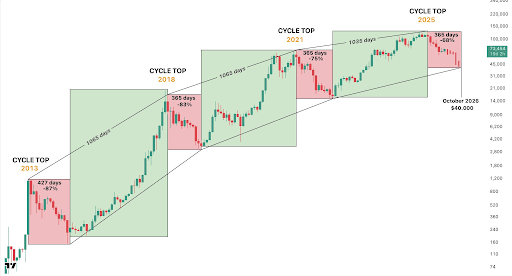
Perhaps the most compelling aspect of Max’s forecast is its reliance on Bitcoin’s historical cycle timing. By meticulously overlaying previous Bitcoin cycles onto its entire price history, Max highlights a remarkably consistent rhythm of extended accumulation and expansion phases followed by lengthy, often brutal, corrections. This cyclical behavior, largely influenced by Bitcoin’s programmatic halving events, has been a defining characteristic of its market dynamics.
Max specifically points to the durations of declines from previous cycle tops:

- 2013 Cycle Top: Following its peak, Bitcoin experienced a prolonged 427-day decline, shedding approximately 87% of its value before finding its bottom.
- 2018 Cycle Top: The peak in 2018 was followed by a 365-day drop, with Bitcoin losing around 83% of its value during this bear market.
- 2021 Cycle Top: From its 2021 peak, Bitcoin endured another 365-day correction, this time seeing a decline of roughly 75%.
A notable observation from this historical data is the consistent duration of approximately one year for the corrective phases in the 2018 and 2021 cycles, even as the magnitude of the percentage decline lessened with each subsequent cycle. This suggests a maturing asset with diminishing volatility but a persistent temporal rhythm in its market cycles.
Projecting this consistent 365-day decline pattern forward from what Max identifies as the October 2025 cycle peak (a critical assumption within his analysis, indicating a forward-looking perspective relative to the current real-world date of this article’s drafting), his chart targets October 2026 as the likely window for the next definitive bottom. This projection aligns not only with the duration of previous bear phases but also with a projected price of approximately $40,000. This implies a significant further decline from current levels, challenging the expectation of a much faster recovery that many market participants are currently holding. Such a bottom would adhere to both the temporal consistency and the diminishing magnitude of decline observed in prior cycles, rather than a rapid V-shaped recovery.
Macroeconomic and On-Chain Context
While Max’s analysis is primarily technical and sentiment-based, it implicitly intersects with broader macroeconomic factors and on-chain data. The global economic landscape, characterized by fluctuating interest rates, inflation concerns, and geopolitical tensions, undeniably influences risk-on assets like Bitcoin. A prolonged period of tight monetary policy or economic uncertainty could exacerbate a bear market, making a deeper and longer correction more plausible. Conversely, a dovish shift from central banks or a stabilization of global markets could provide a tailwind for recovery.
On-chain metrics, which track real-time activity on the Bitcoin blockchain, offer another layer of insight. Indicators like exchange reserves, long-term holder behavior, miner profitability, and realized price levels can provide independent confirmation or contradiction to Max’s thesis. For instance, a true capitulation often sees a significant accumulation by long-term holders at discounted prices, a reduction in miner selling pressure as weaker miners exit the market, and the price dipping below the realized price (the average price at which all coins last moved), indicating that the average investor is underwater. Should these on-chain signals fail to show signs of extreme stress and accumulation, it could lend further credence to the idea that a true bottom has not yet formed. The influx of institutional capital through spot Bitcoin ETFs, while a long-term bullish factor, might also introduce new dynamics to market cycles, potentially affecting the timing and depth of corrections. However, even institutional flows are not immune to broader market sentiment and economic conditions.
Contrasting Perspectives and Market Diversity
It is crucial to acknowledge that Max’s bearish outlook, while historically informed, represents one perspective within a diverse and often conflicting landscape of market analysis. Many other analysts and market participants maintain a bullish stance, pointing to several factors that could underpin a sustained uptrend. These include:
- Institutional Adoption: The success of spot Bitcoin ETFs has brought significant new capital into the market, providing a more accessible and regulated avenue for traditional investors. Proponents argue that this influx of institutional money creates a higher floor for Bitcoin’s price and dampens extreme volatility.
- Bitcoin Halving Event: The quadrennial halving, which reduces the supply of new Bitcoin entering the market, has historically preceded significant bull runs. While the immediate impact is often delayed, many believe its long-term effects are overwhelmingly bullish.
- Macroeconomic Tailwinds (Potential): Should global inflation come under control and central banks begin to ease monetary policy, risk assets like Bitcoin could benefit significantly from increased liquidity and investor appetite for higher returns.
- Digital Gold Narrative: Bitcoin’s increasing acceptance as a "digital gold" or a hedge against inflation and geopolitical instability continues to attract investors seeking alternative stores of value.
These contrasting views highlight the inherent complexity and uncertainty of predicting market movements, particularly in a nascent and rapidly evolving asset class like cryptocurrency. Max’s analysis serves as a valuable counterpoint to prevailing optimism, urging investors to consider historical patterns and structural market conditions rather than relying solely on recent price action or short-term sentiment.
Implications for Investors
Should Max’s projection of an October 2026 bottom at $40,000 materialize, the implications for various types of investors would be significant. For short-term traders and those heavily invested with leverage, a prolonged and deeper correction could lead to substantial losses and liquidations. It would necessitate a reassessment of risk management strategies and a patient approach to market re-entry.
For long-term investors, particularly those employing a dollar-cost averaging strategy, such a scenario could present an extended period of accumulation at lower prices, potentially setting the stage for significant gains in the subsequent bull cycle. However, it would also test their conviction and patience through a prolonged period of market weakness and negative sentiment.
The broader cryptocurrency ecosystem, including altcoins, would likely experience similar or even more pronounced downturns, given their higher beta to Bitcoin. A deep Bitcoin correction tends to drag the entire market with it, leading to a "crypto winter" that purges speculative projects and consolidates value in stronger assets. This period, while challenging, often fosters innovation and strengthens the underlying infrastructure of the industry.
At the time of writing, Bitcoin is trading at approximately $74,590, reflecting a 5.4% increase over the past 24 hours. This immediate price action underscores the tension between short-term market dynamics and the longer-term cyclical analysis presented by Max. While the market celebrates recent gains, the historical patterns suggest that true market bottoms are rarely characterized by widespread cheer, but rather by profound despair, capitulation, and a definitive structural shift that is yet to be confirmed. Investors are thus faced with the critical task of discerning between transient recoveries and the genuine signals of a sustainable market reversal, with historical precedents serving as a cautionary guide.