The State Bank of Pakistan (SBP), the nation’s central monetary authority, has officially authorized commercial banks and regulated financial institutions to provide banking services to licensed Virtual Asset Service Providers (VASPs). This landmark decision effectively repeals a restrictive policy maintained since 2018, which had prohibited the country’s financial sector from engaging in any transactions involving virtual currencies or tokens. The shift marks a fundamental pivot in Pakistan’s approach to digital finance, transitioning from a regime of prohibition to one of regulated integration.
According to a formal notice issued by the SBP’s Banking Policy & Regulations Department, the updated framework permits banks to onboard VASPs that have secured a valid license from the newly established Pakistan Virtual Asset Regulatory Authority (PVARA). This policy reversal is not an unconditional opening of the floodgates but rather a highly controlled environment characterized by rigorous compliance mandates, enhanced due diligence (EDD), and continuous monitoring protocols designed to mitigate the inherent risks of the digital asset sector.
The End of the Prohibitive Era: From 2018 to 2026
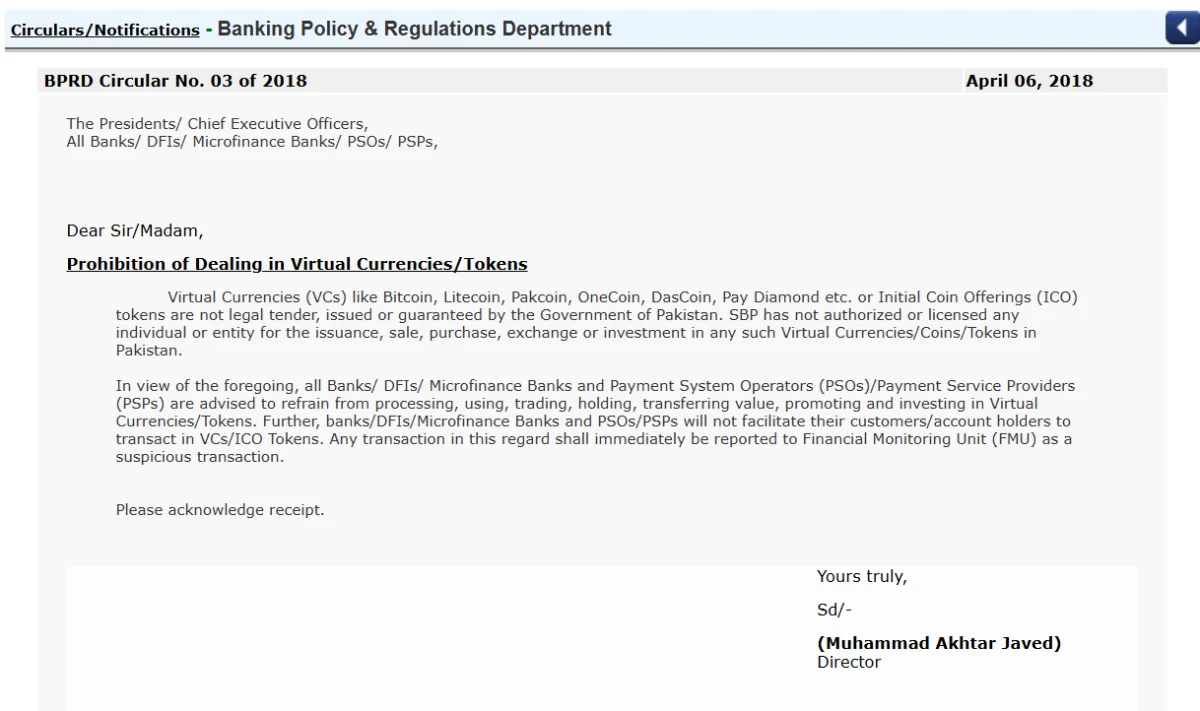
The roots of the previous restrictive environment trace back to April 2018, when the SBP issued a circular (BPRD Circular No. 03 of 2018) warning the public against the risks of virtual currencies. At that time, the central bank explicitly prohibited banks, microfinance banks, and payment system operators from processing, using, trading, or investing in virtual assets. The primary concerns cited were the potential for money laundering, terror financing, and the lack of consumer protection.
However, the 2018 ban did not achieve its intended goal of stifling the growth of digital assets. Instead, the market moved underground. According to reports from the Federation of Pakistan Chambers of Commerce and Industry (FPCCI), peer-to-peer (P2P) crypto activity in Pakistan surged by more than 700% in the years following the ban. By early 2024, it was estimated that Pakistanis held billions of dollars in virtual assets, largely facilitated through informal "Digital Hundi" networks and global exchanges like Binance, which operates as the dominant platform in the region with an estimated user base exceeding 20 million.
The realization that prohibition was fueling an unregulated shadow economy led to a multi-year legislative effort, culminating in the enactment of the Virtual Assets Act of 2026. This legislation provided the legal basis for the creation of PVARA and the subsequent re-entry of the banking sector into the virtual asset ecosystem.
The Role of the Pakistan Virtual Asset Regulatory Authority (PVARA)
The centerpiece of the new regulatory regime is the Pakistan Virtual Asset Regulatory Authority (PVARA). Established under the 2026 Act, PVARA serves as the primary supervisor for the virtual asset industry, tasked with licensing VASPs, ensuring market integrity, and protecting retail investors.
The SBP’s new guidelines are inextricably linked to PVARA’s licensing status. Banks are only permitted to offer full-scale banking services to entities that hold a formal license from the authority. For entities still in the nascent stages of the licensing process, the framework allows for the issuance of a No Objection Certificate (NOC) from PVARA. This NOC permits a VASP to open a "limited-purpose" account, which is restricted to facilitating the administrative and financial requirements necessary to complete the licensing procedure. Full operational banking services, however, remain contingent upon the final grant of a VASP license.
Strict Safeguards: The Client Money Account (CMA) Framework
To ensure financial stability and protect consumer funds, the SBP has introduced a stringent structural requirement for VASP banking: the Client Money Account (CMA). Banks are mandated to maintain a clear and absolute segregation between a VASP’s operational funds and the funds belonging to its customers.
These CMAs are subject to several restrictive conditions:
- Currency Denomination: All accounts must be denominated in Pakistani Rupees (PKR), preventing the direct use of foreign currency for domestic virtual asset trading and mitigating risks related to capital flight.
- Non-Interest Bearing: To maintain the transactional nature of these accounts and align with specific domestic financial standards, CMAs must be non-interest-bearing.
- Prohibition of Cash Transactions: The framework strictly prohibits cash deposits and withdrawals from VASP accounts. All movements of funds must occur through traceable digital banking channels, such as inter-bank fund transfers (IBFT) or wire transfers.
- No Collateralization: VASP accounts and the funds held within them cannot be used as collateral for any form of financing, credit, or margin lending by the bank.
Furthermore, the SBP has reiterated a "Chinese Wall" policy regarding bank participation. While banks can facilitate the transactions of VASPs, they are explicitly forbidden from investing in, trading, or holding virtual assets using their own proprietary funds or customer deposits.
Enhanced Due Diligence and AML/CFT Compliance
In alignment with international standards set by the Financial Action Task Force (FATF), the SBP has placed a heavy burden of responsibility on the banking sector regarding Anti-Money Laundering (AML) and Countering the Financing of Terrorism (CFT).

Banks are required to perform "Enhanced Due Diligence" before onboarding any VASP. This process involves a deep dive into the provider’s business model, its target customer base, the geographic scope of its operations, and its internal compliance controls. Banks must also assess the VASP’s own KYC (Know Your Customer) procedures to ensure that the "on-ramps" and "off-ramps" for digital assets are not being exploited by illicit actors.
Ongoing monitoring is another critical pillar of the new framework. Banks are expected to utilize sophisticated transaction monitoring tools to detect patterns indicative of money laundering or unusual financial behavior. Any suspicious activity must be reported immediately to the Financial Monitoring Unit (FMU) of Pakistan, in accordance with the AML Act.
Economic Implications and Market Reaction
The decision to integrate virtual assets into the formal banking system is expected to have far-reaching economic consequences. By bringing crypto activity out of the shadows, the Pakistani government aims to increase its tax base. Previously, the billions of dollars flowing through P2P and Hundi networks were largely untaxed. With transactions now flowing through PKR-denominated bank accounts, the Federal Board of Revenue (FBR) will have a clearer window into the wealth generated within the sector.
Market analysts also suggest that the move will bolster financial inclusion. With over 20 million users already active in the space, providing a legal and secure way to convert digital assets to fiat currency encourages the use of formal banking channels by a demographic that may have previously been skeptical of traditional finance.
Furthermore, the Virtual Assets Act of 2026 includes provisions for "innovation sandboxes" and "virtual asset zones." These initiatives are designed to attract foreign investment from global blockchain firms, positioning Pakistan as a potential hub for Web3 development in South Asia. The support for tokenized financial systems could also modernize the country’s capital markets, potentially allowing for the fractional ownership of real estate or other traditional assets via blockchain technology.
Reaction from the Industry and Financial Experts
The response from the domestic fintech community has been overwhelmingly positive. Spokespersons for several emerging Pakistani VASPs have noted that the lack of banking access was the single greatest hurdle to legitimate growth. "For years, we were treated as pariahs despite our efforts to comply with international best practices," stated a CEO of a Karachi-based digital asset exchange. "The SBP’s new notice provides the legal certainty required to attract institutional partners and scale our operations safely."
However, some financial experts urge caution. Economists have pointed out that while the framework is robust, the implementation phase will be challenging. Banks will need to invest heavily in specialized training for compliance officers and acquire new technological tools to understand the complexities of blockchain forensics. There are also concerns regarding the volatility of virtual assets and whether the SBP can effectively prevent these fluctuations from spilling over into the broader financial system.
A Strategic Alignment with Global Standards
Pakistan’s shift is also seen as a strategic move to remain in the good graces of international regulatory bodies. The FATF has increasingly focused on "Recommendation 15," which requires countries to regulate VASPs for AML/CFT purposes. By establishing PVARA and a formal banking framework, Pakistan is demonstrating its commitment to international financial transparency standards, which is crucial for its long-term economic stability and relationship with global lenders.
The move puts Pakistan in a similar trajectory to other regional players. While India has maintained a high tax regime on crypto without a formal licensing framework, and the UAE has established itself as a global leader with its VARA regulations in Dubai, Pakistan’s approach appears to be a middle ground—focused on strict central bank oversight combined with a dedicated sectoral regulator.
Conclusion and Future Outlook
The State Bank of Pakistan’s decision to authorize banking for licensed VASPs represents a sophisticated evolution of the country’s financial policy. By replacing a blanket ban with a nuanced, risk-based regulatory framework, the government is attempting to harness the potential of blockchain technology while maintaining a firm grip on financial integrity.
As the Virtual Assets Act of 2026 begins to take full effect, the focus will shift to how effectively PVARA can license providers and how strictly the SBP will enforce its CMA and EDD requirements. For a nation with one of the world’s fastest-growing populations of digital asset users, the transition from "Digital Hundi" to a regulated, bank-integrated ecosystem marks the beginning of a new chapter in Pakistan’s digital economy. The success of this initiative will ultimately depend on the synergy between the central bank, the new regulatory authority, and a banking sector that must now navigate the complexities of the frontier of finance.